The AI Search Ecosystem: How AI Decides Which Brands to Recommend
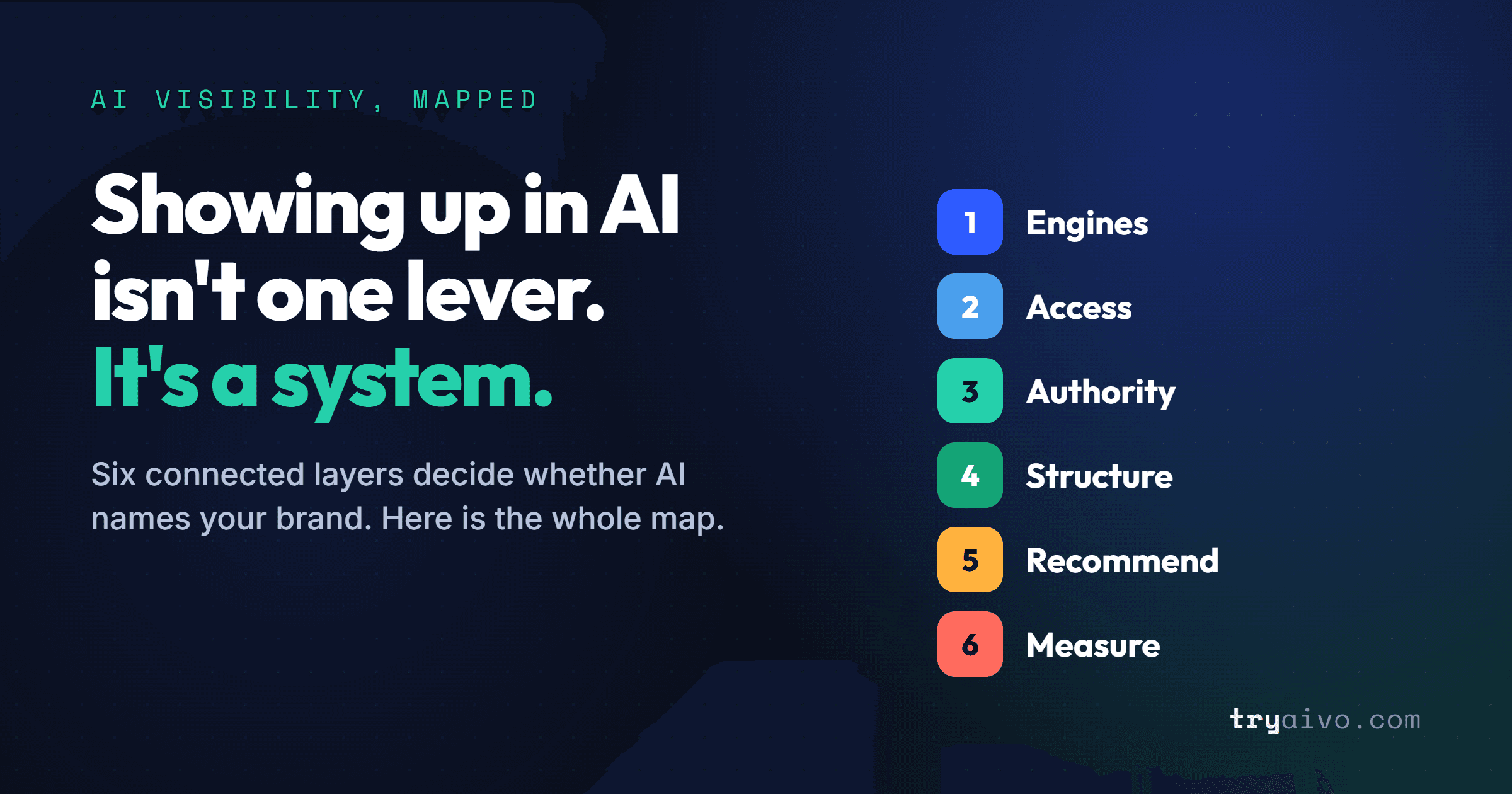
AI visibility is not one lever. It is a system with six layers, from whether a crawler can reach you to whether the answer is accurate. Here is the whole map.
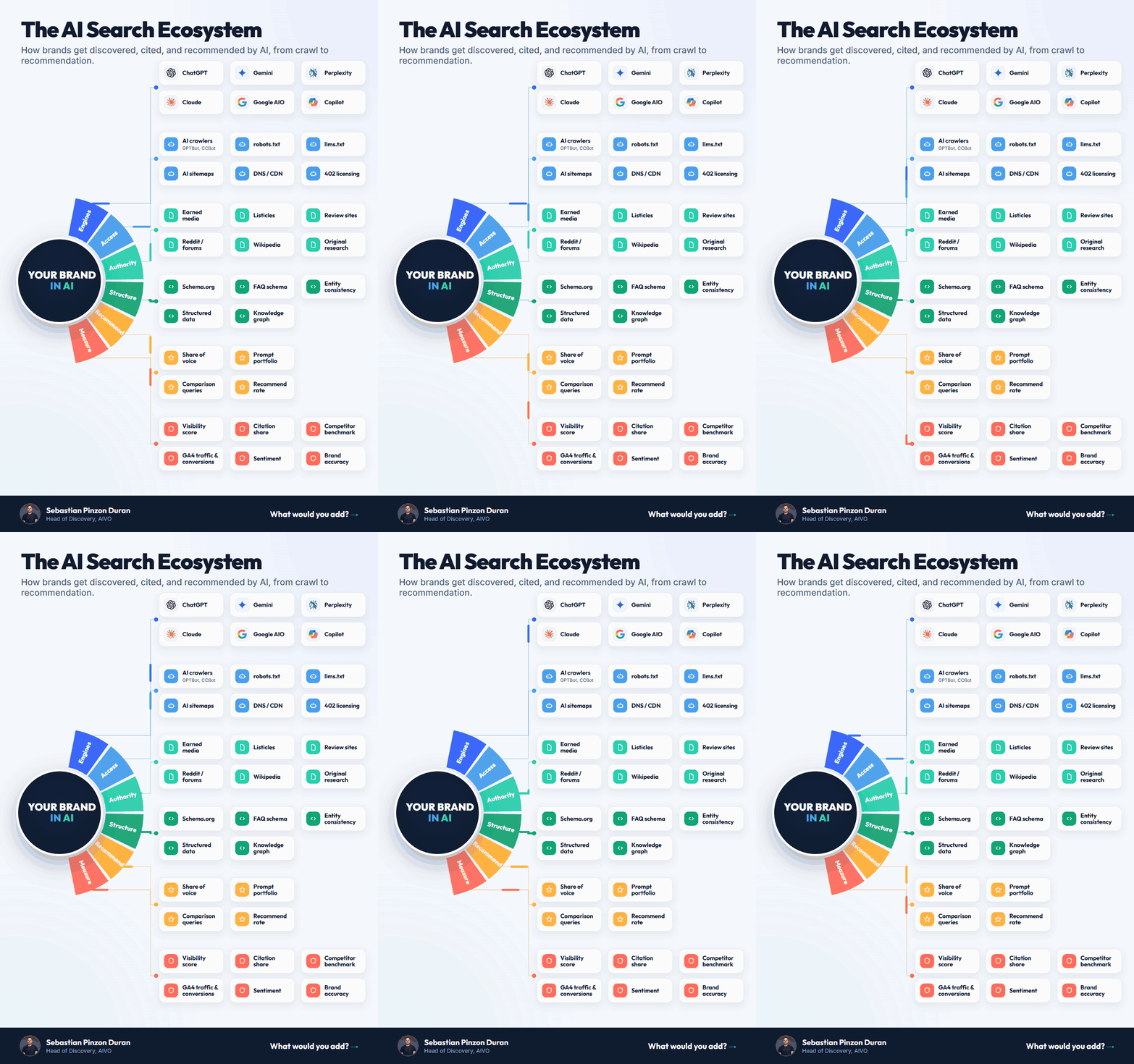
The AI Search Ecosystem: Every Layer That Decides If AI Names Your Brand
AI visibility is not one lever. It is a system with six connected layers, from whether a crawler can reach your site to whether the answer the model gives is even accurate. Here is the whole map.
Most teams treat AI visibility as a single question: are we in ChatGPT? That question hides an entire system. Whether an AI engine names your brand is decided by six connected layers, and a weakness in any one of them caps everything downstream. A perfectly structured page no crawler is allowed to read is invisible. A brand cited in every source but recommended in none still loses the sale.
At AIVO (AI Visibility Optimization) we track what ChatGPT, Gemini, Google AI Overviews, Perplexity, and Claude say about brands every day. This is the ecosystem those answers are built from, one layer at a time.
📋 TL;DR
- AI visibility is six layers, not one lever: engines, crawl access, sources, structure, recommendation, and measurement.
- Engines disagree—Claude and ChatGPT overlap on cited sources only 8% of the time—so win the engines your buyers use.
- Access is the silent gatekeeper; a page no crawler can read cannot be cited.
- Citation is not recommendation; the goal is being named as the answer.
- Measure per engine, tie it to revenue, and watch the story the model tells about you.
Layer 1: The engines
The answer happens inside six surfaces: ChatGPT, Gemini, Perplexity, Claude, Google AI Overviews, and Microsoft Copilot. They do not read the same web and they do not agree with each other. Give Claude and ChatGPT the same prompt and their cited sources overlap just 8% of the time. Each engine has its own sources and its own way of deciding what to cite. Treating AI search as one channel is the first mistake, because search itself has fragmented into a different result on every engine.
But the sharper question is not how the engines differ. It is which engines your buyers actually use. A travel brand is discovered on Perplexity, Google AI Overviews, and ChatGPT, where Claude barely registers. A B2B software brand is the reverse, because Claude skews technical and professional. Chasing all six equally wastes budget. Knowing which engines own your category and prioritizing them is a core part of what we do at AIVO.
Takeaway: there is no single AI search. Win the engines your buyers actually use, not all six.
Layer 2: Crawl and access
Before an engine can cite you, its crawler has to be able to reach you. GPTBot, ClaudeBot, PerplexityBot, Google-Extended, and CCBot each follow different rules, and most brands block them by accident. Your robots.txt, an llms.txt file, AI-specific sitemaps, and controls at the DNS or CDN layer decide what these bots see. A growing number of publishers now meter these crawlers with HTTP 402 Payment Required, charging for access instead of blocking outright. This is mostly a publisher move: news sites and content owners monetizing the bots that scrape their work for AI training, rather than handing it over for free. Get this wrong and you are invisible before the game starts, which is why we built an AI crawler cheat sheet for which bots to allow, charge, or block.
Takeaway: access is the silent gatekeeper. You cannot be cited from a page the model was never allowed to read.
Layer 3: Sources and authority
AI engines do not answer from your website. They answer from the sources they already trust: earned media, listicles, review sites, Reddit and forums, Wikipedia, and original research. This is where authority is won or lost, and it rarely lives on your own domain.
There is no silver bullet here. It is tempting to hear "just get on listicles" or "just get reviews" and treat one tactic as the answer, but the sources that move the needle depend entirely on your industry and your brand. For a travel brand, TripAdvisor can be decisive. For a local business, the Google Business Profile carries the weight, and it grounds what Google's AI Overviews and AI Mode say while ChatGPT has no first-party local data at all, as our Hudson Valley hotels study found. This is exactly why listicles are not the silver bullet people claim, and why tracking which sources actually drive your citations matters more than chasing a generic checklist. Even your own best-of listicle can get cited while a competitor gets recommended. The AI visibility funnel shows how content moves from cited to recommended. It cuts the other way too: a wrong fact on Wikipedia becomes an AI fact about your brand.
Takeaway: there is no universal source that wins citations. Track which ones move yours, because it depends on your category.
Layer 4: Structure and entities
Once the model can reach your content, it has to understand it. This layer is machine-legibility: schema.org markup, FAQ schema, structured data, consistent entities, and a clean presence in the knowledge graph. It is the least glamorous layer and the most overlooked. Schema for AI platforms is not the same as traditional SEO schema, and getting it right is a large part of why AEO is not just SEO.
Takeaway: if the model cannot parse who you are, it cannot repeat it back.
Layer 5: Getting recommended
Being cited is not being recommended, and this is the layer where the answer is actually won. It is measured by share of voice, the prompt portfolio you track, how you perform on comparison queries, and your recommendation rate: how often the model names you as the answer, not just a footnote. AI does not recommend who you think, and recommendation is the new brand metric that is easy to game and hard to earn. Winning it is a deliberate strategy, which is the case for a framework-led AEO approach over an SEO-first one.
Takeaway: the goal is being named, not just referenced.
Layer 6: Measure and protect
You cannot improve what you cannot see, and you cannot ignore what the model gets wrong. This layer is your visibility score, citation share, competitor benchmarks, the GA4 traffic and conversions AI actually sends you, sentiment, and brand accuracy. The tools finally exist: we cover how to measure AI visibility in 2026, what Microsoft Clarity citation data shows, and why your AI traffic is already there but GA4 cannot see it yet. Protection matters just as much, because every channel AI trusts becomes a channel someone games, as our proof that black hat AI search is real shows.
Takeaway: measure per engine, tie it to revenue, and watch the story the model tells about you.
What this means for your brand
The six layers are a chain, not a menu. Access decides whether you are visible at all. Sources and structure decide whether you are legible. Recommendation decides whether you win the answer. Measurement decides whether you can see any of it. Most brands invest in one box and wonder why the answer does not change.
The brands that will own AI search treat it as a system: crawlable, legible, cited by sources that matter, recommended on the queries that convert, and measured per engine against the truth. That demand-side work is the half of AI marketing in 2026 most teams still miss. Google's own AI Mode data makes the same point from the other side: search became a conversation, and the model—not the search box—decides who gets named. Anthropic's Economic Index confirms it from Claude usage itself: the top work tasks people give AI are search and product recommendations. Paid AI ads on Google, ChatGPT, Amazon, and Walmart are a different layer entirely—opt-in inventory beside the answer, not a way to buy the recommendation. If you do not know which of these six layers is breaking for your brand, that is the place to start.
Book a meeting and we will map your category across all five engines.
FAQ
Q: What is the AI search ecosystem? A: It is the full set of layers that decide whether an AI engine names your brand: the engines themselves, whether their crawlers can access you, the sources they trust, how your content is structured, whether you get recommended, and how you measure and protect the result. AI visibility depends on all six, not on any single tactic.
Q: What is answer engine optimization (AEO)? A: Answer engine optimization is the practice of getting a brand cited and recommended inside AI-generated answers from tools like ChatGPT, Gemini, Perplexity, and Google AI Overviews. Unlike SEO, it optimizes for being named in the answer rather than ranking in a list of links.
Q: Why is my brand cited by AI but not recommended? A: Because citation and recommendation are different layers. An engine can use your page as a source and still name a more established competitor. In one 2026 study, brands that published their own best lists were left out of the recommendation 69% of the time.
Q: Do all AI engines recommend the same brands? A: No. Claude and ChatGPT overlap on cited sources only 8% of the time, and each engine reads a different slice of the web. A brand visible in one engine can be absent from another, so visibility has to be measured per engine.
Q: Which AI crawlers should I allow? A: User-facing bots such as ChatGPT-User, Claude-Web, and PerplexityBot bring qualified traffic and citations and are usually worth allowing. Training bots like GPTBot and CCBot are a licensing decision. Blocking the wrong one can make you invisible in AI answers.
Q: How do I measure AI search visibility? A: By running the same buyer prompts across every engine and tracking which brands get cited and recommended, how often, and in what position, then tying that to the traffic and conversions AI sends. AIVO does this at scale.
Key Takeaways
- Treat AI visibility as six connected layers, not a single channel or tactic.
- Prioritize the engines your buyers actually use; the engines do not agree with each other.
- Fix crawl access first—nothing downstream works if bots cannot read you.
- Track the sources that move citations in your category; there is no universal checklist.
- Optimize for recommendation rate, not citation count alone.
- Measure per engine, protect against gaming, and tie visibility to revenue.


