How AI Engines Decide What to Cite
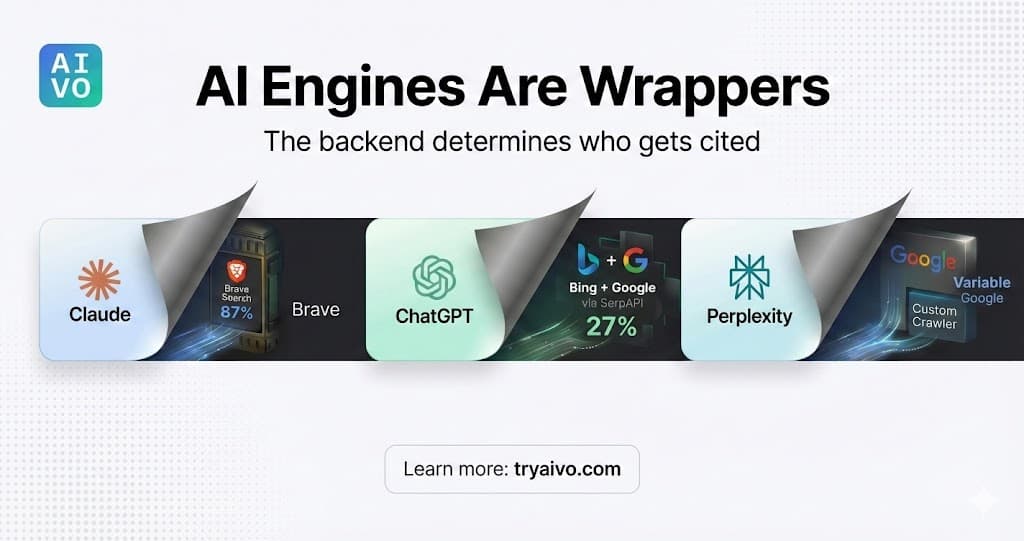
Claude uses Brave Search (87% correlation). ChatGPT uses Bing + SerpAPI (27% correlation). Learn how each AI engine decides what to cite and how to optimize for visibility.
How AI Engines Decide What to Cite: The Backend Reality
Six months ago, I asked Claude for tool recommendations.
It suggested two products I'd never heard of: Resend for email infrastructure. SerpAPI for API monitoring.
I'm now a paying customer of both.
That experience changed how I think about marketing. AI engines aren't just answering questions—they're making buying decisions for your customers. The question is: are they recommending you?
📋 TL;DR (Key Takeaways)
- Claude uses Brave Search with an 87% correlation—the most predictable AI engine for optimization
- ChatGPT uses Bing + SerpAPI (Google) with only 27% correlation—making optimization unpredictable
- Claude searches less often than other engines, relying on training data for "stable, factual" queries
- Perplexity searches every query but uses multiple sources—good for broad visibility but harder to control
- AI engines are wrappers around traditional search infrastructure, not independent search systems
The Uncomfortable Truth: AI Engines Are Wrappers
AI engines are NOT independent search systems. They're "wrappers" around traditional search infrastructure.
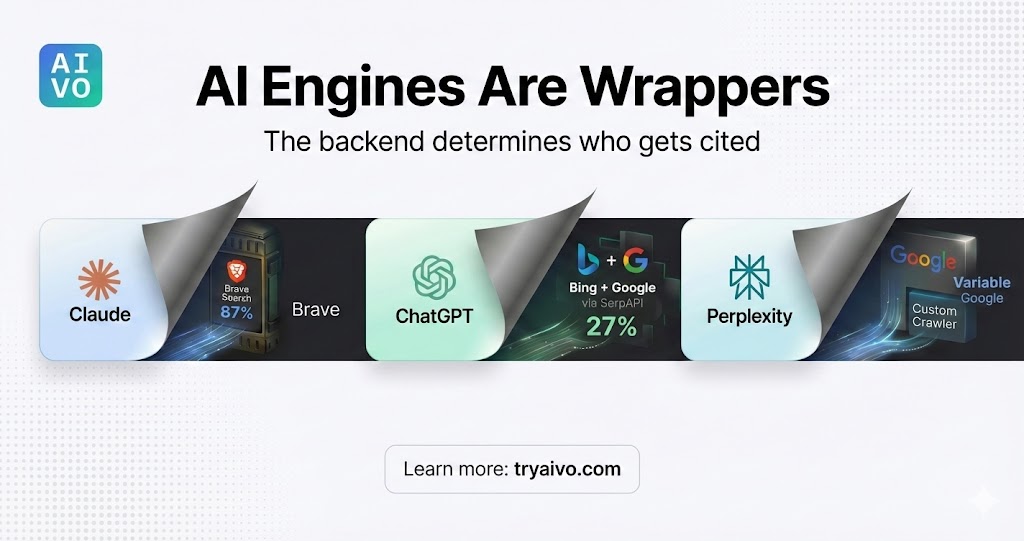
Key Finding: AI engines aren't independent search systems—they're wrappers around traditional infrastructure.
| AI Engine | Search Backend | Correlation | Optimization Complexity |
|---|---|---|---|
| Claude | Brave Search | 87% | Low (predictable) |
| ChatGPT | Bing + SerpAPI | 27% | High (unpredictable) |
| Perplexity | Multiple sources | Variable | Medium |
Sources: Profound Analysis, Search Engine Land
This fundamentally changes how we think about AI visibility optimization.
Claude: The Most Predictable AI Engine
Claude's partnership with Brave Search creates the most predictable optimization opportunity in AI visibility.
The 87% Correlation
Our testing shows an 86.7% correlation between Brave's top results and Claude's citations. If you can rank on Brave, you have a very high probability of being cited by Claude.
Source: Profound: What is Claude Web Search Explained
The Catch: Claude Searches Less Often
A leaked Claude system prompt from May 2025 revealed:
"Internet search is only used when absolutely necessary. Claude always tries to answer using its internal training data first."
Search Frequency Comparison:
- Perplexity: ~100% (every query)
- ChatGPT: ~31% (1 in 3 prompts)
- Claude: Lowest rate (only when necessary)
- Recency signals: "2026", "latest", "current"
- Complexity: Multi-part questions requiring synthesis
- Explicit requests: "Search for..." or "Find recent..."
Optimization Strategy for Claude:
- Rank on Brave Search first (check rankings at search.brave.com)
- Use strong recency signals in H1s and opening paragraphs
- Structure for extraction: Short, clear sentences (15-25 words)
- Allow ClaudeBot in robots.txt
ChatGPT: The Complicated One
The SerpAPI Revelation (August 2025)
Search Engine Land broke the story: OpenAI was using SerpAPI to scrape Google results, supplementing their Bing partnership.
Source: Search Engine Land: OpenAI ChatGPT SerpAPI Google Search Results
The Legal Fallout
In December 2025, Google filed a federal lawsuit against SerpAPI:
- Query volume increased 25,000% over two years
- Hundreds of millions of automated queries daily
- Primary customers: OpenAI, Meta, Perplexity
Why 27% Correlation?
ChatGPT doesn't parrot Bing results. It:
- Ingests top 10-20 results from Bing AND Google/SerpAPI
- Applies semantic re-ranking based on content quality
- Discards content deemed "too promotional" or "poorly structured"
- Synthesizes information from multiple sources
Optimization Strategy for ChatGPT:
- Optimize for BOTH Bing and Google
- Use highly structured content (tables, lists, clear headings)
- High information density (avoid fluff)
- Educational tone (not promotional)
- Allow GPTBot and OAI-SearchBot in robots.txt
Perplexity: The Hybrid Approach
The Reddit "Trap"
Reddit engineers proved Perplexity was scraping Google's index:
- Created a "trap" post visible only to Google's crawler
- Blocked PerplexityBot via robots.txt
- Hours later, trap content appeared in Perplexity results
Perplexity's Reality:
- Searches every query (100% search rate)
- Uses multiple backends (Google, Bing, proprietary sources)
- Favors recent, authoritative content
- Strong bias toward structured data
- Focus on Google rankings first
- Build authority through citations from trusted sources
- Keep publication dates visible and recent
- Use FAQ and HowTo schema markup
The 15-25 Word Citation Rule
AI engines extract sentences, not paragraphs. Claude's system prompt specifically limits quotes to 15 words.
Won't Get Cited:
"Our ground-breaking research, which was painstakingly conducted over several months, found that conversion rates improved by approximately 35% across various customer segments..."
Will Get Cited:
"Conversion rates improved by 35% in Q4 2025."
The Rule: Key facts and statistics should be in standalone sentences of 15-25 words. No fluff. No hedging. Just clear, extractable information.
The Optimization Checklist
For Claude (Brave Search Backend)
- [ ] Check your rankings on search.brave.com
- [ ] Ensure robots.txt allows ClaudeBot
- [ ] Use recency signals ("2026", "latest") in H1s and opening paragraphs
- [ ] Keep key sentences under 25 words
- [ ] Use answer-first structure (conclusion before explanation)
For ChatGPT (Bing + Google Hybrid)
- [ ] Optimize for both Bing AND Google simultaneously
- [ ] Use highly structured content (tables, bullet lists, numbered steps)
- [ ] Maximize information density (avoid introductory fluff)
- [ ] Educational tone, not promotional
- [ ] Allow GPTBot and OAI-SearchBot in robots.txt
- [ ] Implement FAQPage schema markup
For Perplexity (Google Primary)
- [ ] Focus on Google rankings as primary signal
- [ ] Build authority through citations from trusted sources
- [ ] Display publication dates prominently
- [ ] Update content quarterly minimum for recency
- [ ] Use FAQ and HowTo schema markup
- [ ] Allow PerplexityBot in robots.txt
FAQ
How do I check my Brave Search rankings?
Go to search.brave.com and search your target keywords. Compare results to Google—they often differ significantly. Brave favors privacy-focused sites and penalizes tracking-heavy pages.
Does schema markup help with AI citations?
Indirectly. Schema helps search engines understand your content, which improves rankings on backends like Brave and Bing. But AI engines don't read schema directly during citation—they parse the rendered HTML.
How often should I update content for AI visibility?
For time-sensitive topics, monthly updates help maintain recency signals. For evergreen content, quarterly reviews are usually sufficient. Add "Updated: [Month Year]" to signal freshness.
Can I track AI referral traffic in Google Analytics?
Yes, but it requires specific setup. Look for referrals from chat.openai.com, perplexity.ai, and claude.ai. Note: Most AI traffic is zero-click (they see your brand in AI, search for you directly later), so correlation analysis is critical.
Which AI engine should I optimize for first?
Start with Claude if you can rank on Brave Search (87% correlation = predictable). Add Perplexity second (searches every query). ChatGPT is unpredictable but has the largest user base, so include it in long-term strategy.
Key Takeaways
The Big Picture:
- AI engines are wrappers around traditional search infrastructure
- Claude (Brave) is the most predictable optimization target
- ChatGPT (Bing + Google) is the most unpredictable
- Perplexity (Google-heavy) searches every query
- You can't optimize for AI engines directly
- You optimize for their backends (Brave, Bing, Google)
- Then structure content for AI extraction (15-25 word sentences, answer-first)
- Monitor which approach drives citations
- Claude citations: 2-4 weeks if ranked on Brave
- Perplexity citations: 3-6 weeks if ranked on Google
- ChatGPT citations: 4-12 weeks (unpredictable)
What to Do Next
Option 1: DIY Optimization
Start with Brave Search optimization (easiest):
- Check current rankings on search.brave.com
- Optimize top-performing pages for AI extraction
- Add recency signals to trigger Claude searches
- Monitor citation frequency
Option 2: Get Expert Help
Want us to handle it?
AIVO provides complete AI visibility intelligence: track where you appear, understand why you're winning or losing, and get prioritized actions.
Get your free snapshot: Book an Intro
Questions? Email team@tryaivo.com
---
Sources & References
- Search Engine Land: ChatGPT's answers came from Google Search after all (Aug 2025)
- Profound: Claude web search explained (Mar 2025)
- ALM Corp: Google Sues SerpAPI (Dec 2025)
- Search Engine Land: Reddit sues Perplexity, SerpAPI (Oct 2025)
- ChatOptic: Claude's Leaked System Prompt (May 2025)
Author: Sebastian Pinzon is Co-Founder of AIVO, an AI Visibility Intelligence Platform helping e-commerce, SaaS, and travel brands get discovered by AI engines. With 20+ years of experience in digital marketing and platform transitions, he's focused on helping brands navigate the AI discovery landscape.
Connect on LinkedIn | tryaivo.com


