AI Chatbot Ads Are Coming — and Vertical Platforms Lead
ChatGPT launches ads in 2026. Mind Trip runs on DMO partnerships. A 100-country veteran traveler tested AI planners. Her review reveals the future of AI advertising.

AI Chatbot Ads Are Coming. Vertical Platforms Already Have a Different Playbook.
By Sebastián Pinzon • February 2026 • 8 min read
The thesis: ChatGPT is launching ads. Mind Trip runs on B2B partnerships. These two monetization models create fundamentally different recommendation engines—and vertical AI chatbots are becoming the new publishers.
The proof: Our research found 59% disagreement between platforms on identical queries.
Real adoption: My mom plans 45-60 day trips in spreadsheets, 100+ countries of refinement. She's used Lonely Planet, Meta AI, Layla AI, and Geek Guide. Mind Trip is the first one that surprised her. Here's her full review.
Key Takeaways
- Vertical AI chatbots are becoming the new publishers and ad networks—Mind Trip's model is a preview of what's coming across health, finance, and e-commerce
- ChatGPT announced ads in January 2026, forecasting $25B in "free user monetization" by 2029
- Mind Trip operates as a B2B platform—DMO partnerships, affiliate commissions, and visa/documentation guidance create a different recommendation engine
- Horizontal platforms sell impressions. Vertical platforms sell outcomes. This distinction will define AI advertising
- The business model behind your AI determines what it recommends—our research shows 59% disagreement on identical prompts
- Your AI recommendations may already be "sponsored," just not labeled that way
The Hook: Follow the Money
Two AI travel planners. Same question. Different answers.
One is launching ads.
One runs on destination partnerships.
A 100-country veteran traveler tested the vertical one and called it "surprising." She didn't know the business model behind it.
Here's what she missed and why it matters for every brand.
The Real-World Test: Asking Someone Who Actually Travels
Data is one thing. Real experience is another.
So I asked my mom to test AI travel planners.
She's visited over 100 countries. Not as a tourist ticking boxes, as someone who actually explores. She plans 45-60 day trips for small groups of 2-4 people, with moderate budgets focused on history, culture, gastronomy, and nature. She builds per-person daily budgets covering accommodation, food, transport, entrance fees, and excursions. Then she books everything herself.
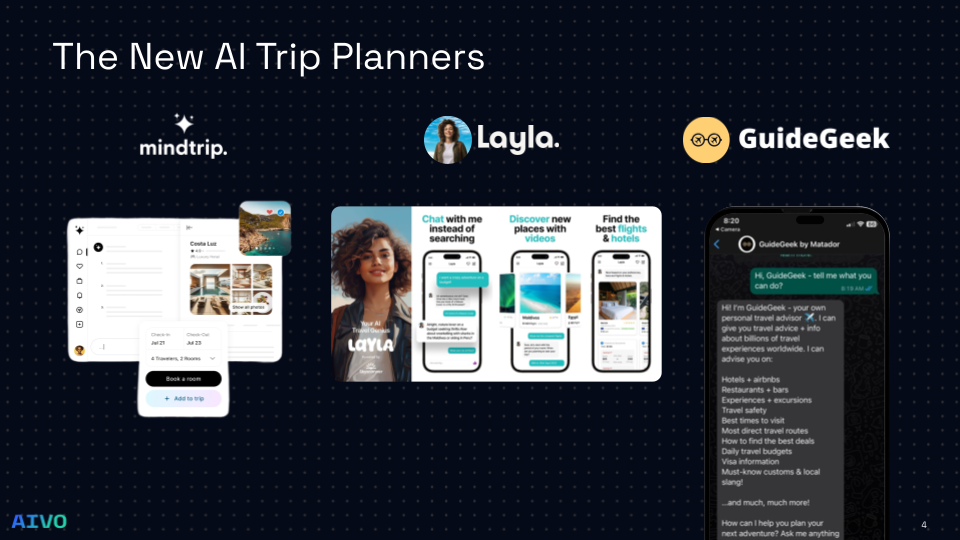
She's used Lonely Planet, Frommers, Fodors. She uses Meta AI regularly—it's popular in Colombia, especially with her generation. I suggested she also try Mind Trip, Layla AI, and Geek Guide.
In short: she's the ideal AI travel tester. Experienced enough to spot BS, methodical enough to know what matters.
Her Take: Mind Trip Surprised Me
"After years of using traditional travel guides like Lonely Planet, Frommers, and Fodors, and updating information with AI platforms like Layla AI and Geek Guide, Mind Trip surprised me because it allows personalized trip planning in English and Spanish. I tested it in both languages, but it likely supports others."
"With this free tool, the itinerary is tailored to the traveler's needs—through a chat, you interact with the platform by sharing relevant details like your age, interests, preferences, and budget so the trip can be designed around those parameters. Mind Trip also provides a map showing tourist points of interest."
"It helps from the start by informing you about visa requirements and required documentation like medical insurance, and recommends flights, restaurants, hotels, and excursions. For flights, it provides booking pages. For hotels, it works with Booking & Priceline. Excursions are handled through Viator."
"The speed and precision of the responses surprised me."
Her one critique—and it's a fair one:
"The map wasn't as useful as Google Maps, where routes show distance and travel time by foot, public transit, or private transport. Here it gives you a sense of proximity between locations, but not specifics."
For context, here's who's saying this:
"I'm a traveler. I've visited more than 100 countries, and 80% of those trips were planned by me using information from the internet. I generally travel in groups of 2 to 4, for 45 to 60 days, with a moderate budget, on itineraries that include history, culture, gastronomy, and nature—without activities that demand high physical exertion. Visa information is a priority."
"Once the data collection phase is done, all the information is organized with exact dates, places, visits, and prices, and a budget is built considering ticket costs and a daily per-person average that includes accommodation, food, transport, entrance fees, and excursions. Then you book on the recommended sites and proceed to pack your bags."
That's not a casual review. That's a veteran traveler with a refined system who found something that actually fits her workflow.
Here's an example of her last trip (in Spanish).
But here's the part she didn't see: why Mind Trip felt so personal.
What She Didn't See: The Business Model Behind the Recommendations
My mom evaluated Mind Trip as a traveler. She assessed accuracy, usefulness, how the recommendations felt.
What she couldn't see—what most users can't see—is how these platforms make money.
The Booking.com hotels she saw? Affiliate revenue. The Viator excursions? Affiliate revenue. The proactive visa info? Part of a comprehensive product designed to keep users inside the ecosystem.
And that changes everything.
Mind Trip: The B2B Play
Mind Trip isn't just a consumer travel app. It's a B2B platform that partners with destination marketing organizations (DMOs) and tourism boards.
Their current partners include:
| Partner Type | Examples |
|---|---|
| National Tourism Boards | Brand USA, Visit Costa Rica, British Virgin Islands |
| State Organizations | Visit California, Travel Nevada |
| Regional DMOs | Outer Banks Visitors Bureau, See Monterey |
| City Destinations | Visit Myrtle Beach, New Orleans & Company |
That's 35+ destination partnerships and counting.
The business model: DMOs pay Mind Trip to ensure their destinations get surfaced—with context, with authority, with conversion paths that lead to real bookings.
Mind Trip also earns through:
- Affiliate commissions from Booking.com, Viator, and Priceline
- B2B subscription fees from DMOs and hotels
- "Mindtrip for Hotels"—helping properties turn website content into personalized trip plans
- Visa and documentation guidance—proactively surfacing entry requirements and travel documentation
This isn't a side project. It's a serious platform with serious backing.
Want the full AI visibility playbook for hotels? Download the free Hotel AI Visibility Playbook — built from real citation data across ChatGPT, Perplexity, Gemini, and Google AI.
ChatGPT: The Mass Market Ad Play
OpenAI took a different path.
In January 2026, they announced ads would begin appearing for free-tier and Go-tier users. Their internal projections forecast $25B in "free user monetization" by 2029.
With 800 million monthly users, ChatGPT has the scale. The question is the format.
Perplexity, another AI search platform, has already been testing "sponsored follow-up questions" since late 2024. Their approach:
- Ads appear as suggested prompts (not in the answer)
- Clearly labeled as "sponsored"
- CPM pricing reportedly >$50 (premium inventory)
- 30M+ daily queries
The Two-Layer AI Advertising Model
Here's the framework that explains everything:
Layer 1: Horizontal AI Platforms
Platforms: ChatGPT, Perplexity, Google AI Overview, Gemini Audience: Mass market (everyone asking anything) Monetization: Traditional ads—CPM, sponsored questions, display Analogy: Google Search, Facebook What they're selling: Impressions to a general audience
Layer 2: Vertical AI Platforms
Platforms: Mind Trip (travel), niche industry chatbots Audience: High-intent users in specific verticals Monetization: B2B subscriptions, affiliate commissions, embedded recommendations Analogy: TripAdvisor, Expedia, industry publishers What they're selling: Outcomes (bookings, conversions, decisions)
The key insight: Vertical platforms are more valuable per user because:
- Higher intent — Users asking Mind Trip "Where should I stay in Costa Rica?" are planning a real trip
- Deeper context — The platform knows travel preferences, past searches, budget signals
- Direct transaction path — From recommendation to booking in one session
- B2B economics — DMOs pay for visibility because the ROI is measurable
Why This Matters: The New Travel Discovery Playbook
For the past 20 years, travel brands followed a simple formula:
Old Playbook: SEO → Website traffic → Compare options → Convert
That's breaking down. Here's why:
- 40% of product discovery now happens on AI platforms
- Users increasingly complete decisions within the chatbot—without clicking through
- The "zero-click future" means your website might never enter the picture
Mind Trip's DMO partnerships are the template. Costa Rica Tourism Board doesn't need travelers to visit their website—they need Mind Trip to recommend Costa Rica when someone asks "best beaches in Central America."
The brand that controls the AI recommendation controls the booking.
The 59% Disagreement Explained
Back to our research.
Why did Mind Trip and ChatGPT disagree on nearly 60% of identical prompts?
It's not random. It's structural:
| Factor | Mind Trip | ChatGPT |
|---|---|---|
| Data sources | 11M+ points of interest + 40K local guides + DMO partnerships | Web training data + Bing search |
| Business model | B2B subscriptions + affiliate | Ads (coming) + subscriptions |
| Optimization target | Conversion (bookings) | Engagement (session time) |
| Partner influence | Direct (DMOs pay for visibility) | Indirect (future ad placements) |
When Mind Trip recommends a specific resort in Costa Rica, it's drawing from:
- Their partnership with Costa Rica Tourism Board
- Real-time inventory from booking partners
- Local guide content they've specifically curated
- Web content (reviews, articles, SEO-optimized pages)
- Training data (which may be outdated)
- No direct commercial relationship with the destination
What This Means for Travelers
Should you trust AI travel recommendations?
Yes—but with context.
Know the business model:
- If a platform has destination partnerships, those destinations may be favored
- If a platform runs ads, sponsored content may appear (labeled or not)
- Neither is inherently bad—but both affect what you see
- Our 59% disagreement finding suggests you shouldn't rely on one source
- Ask the same question across ChatGPT, Perplexity, Mind Trip, and Gemini
- Notice the patterns
- My mom's 100-country intuition and refined methodology caught things AI missed (like Google Maps-quality transit info)
- She uses Meta AI regularly, tried Layla AI and Geek Guide, and Mind Trip still stood out
- AI is a starting point, not the final answer
What This Means for Brands
If you're a hotel, DMO, restaurant, or any business that depends on travelers finding you:
1. AI visibility is the new SEO Traditional SEO still matters—but it's table stakes. The question now is: Does ChatGPT recommend you? Does Mind Trip include you? Does Perplexity cite you?
2. Vertical partnerships matter more than horizontal reach A Mind Trip partnership that gets you recommended to 100K high-intent travelers may outperform a million generic impressions on Google.
3. The attribution is invisible When someone books through Mind Trip's Priceline integration, they may never know your content influenced the recommendation. Track AI visibility separately.
4. Monetization is coming everywhere ChatGPT ads. Perplexity sponsored questions. Mind Trip DMO subscriptions. Every AI platform needs revenue. Understand how that shapes recommendations.
The Bigger Picture: Vertical AI as Publisher
Here's my prediction:
Vertical AI chatbots are becoming the new publishers and ad networks.
Think about what Mind Trip actually is:
- A content platform (curated recommendations)
- A distribution channel (DMOs pay for placement)
- An ad network (affiliate commissions on bookings)
- A data business (user intent signals)
The same pattern will play out in:
- Health (AI symptom checkers with pharma partnerships)
- Finance (AI advisors with product affiliations)
- E-commerce (AI shopping assistants with brand deals)
- Real estate (AI search with listing partnerships)
Final Thought: What My Mom Taught Me
My mom has a system she's refined over 100+ countries and decades of travel. She uses Meta AI regularly. She tried Layla AI and Geek Guide at my suggestion. And Mind Trip is the one that surprised her.
She preferred it because it felt more personal. More local. More curated. It asked the right questions—age, interests, budget, travel style—and built an itinerary around her parameters. It proactively surfaced visa info, which she calls "priority." It connected to Booking and Viator for instant booking paths.
She was right about the quality. But the "personal" feeling isn't because Mind Trip has superior AI—they use OpenAI models like everyone else. The difference is their private database: 11M+ points of interest, 40K local guides, and curated DMO content. The "personal" feeling is a product of data curation and commercial partnerships, not a better brain.
That's not a criticism. It's how media has always worked.
The difference is transparency. When you read a travel magazine, you know there's advertising. When you use a travel AI, the lines are blurrier.
178 prompts. 59% disagreement. One insight:
The AI giving you travel advice has a business model. That business model shapes what you see. Understanding that is the first step to making better decisions—whether you're a traveler or a brand.
Want to see the full research? Read our Mind Trip vs ChatGPT platform comparison
FAQ
Q: Should I trust AI travel recommendations from ChatGPT or Mind Trip?
A: Both can be valuable—but with context. ChatGPT synthesizes web content without direct commercial relationships. Mind Trip draws from DMO partnerships and curated databases. Our research found 59% disagreement on identical prompts. Cross-reference across platforms and understand each one's business model.
Q: When will ChatGPT ads launch?
A: OpenAI announced in January 2026 that ads would begin appearing for free-tier and Go-tier users. Their projections forecast $25B in "free user monetization" by 2029. Paid tiers (Plus, Pro, Business, Enterprise) remain ad-free.
Q: How does Mind Trip make money?
A: Mind Trip operates as a B2B platform with DMO partnerships (35+ destinations), affiliate commissions from Booking.com/Viator/Priceline, B2B subscription fees, and their "Mindtrip for Hotels" product. They've raised $12M from Amex Ventures, Capital One Ventures, and United Airlines Ventures.
Q: What's the difference between horizontal and vertical AI platforms?
A: Horizontal platforms (ChatGPT, Perplexity) sell impressions to a mass audience via traditional ads. Vertical platforms (Mind Trip) sell outcomes—bookings, conversions—to high-intent users in specific industries. Vertical platforms often have higher value per user due to intent and context.
Key Takeaways
- Vertical AI chatbots are becoming the new publishers—Mind Trip's model previews what's coming across health, finance, and e-commerce
- ChatGPT ads arrive in 2026—$25B forecast by 2029; vertical platforms like Mind Trip already monetize via B2B partnerships
- Horizontal platforms sell impressions. Vertical platforms sell outcomes.—This distinction defines AI advertising
- Business model shapes recommendations—59% disagreement in our research on identical prompts
- AI visibility is the new SEO—Brands need presence across ChatGPT, Mind Trip, Perplexity, and vertical platforms in their industry
For hotel and travel brands: This post covers how AI advertising and vertical platforms reshape discovery. If you want the complete strategic framework for hotel AI visibility — covering citation optimization, platform-specific tactics, and measurement — download the free Hotel AI Visibility Playbook.
---
About the Author
Sebastián Pinzon is Co-Founder and Head of Discovery at AIVO, an AI visibility optimization consultancy helping brands get recommended by AI platforms. With 15+ years in marketing across Publicis, WPP, and OMG, he's been tracking the shift from search to AI-mediated discovery since the beginning.
Related Articles

How to Advertise in AI in 2026: Google, ChatGPT, Amazon & Walmart

How AI Recommends Beauty Brands: We Measured 750 Answers Across 5 Engines
