The AI Visibility Gap: 92% See It, 23% Know What to Do
Enterprise marketers know AI visibility matters, but most don't know how to act. Here's what the data reveals about the 69-point confidence gap—and how to close it.
The AI Visibility Gap: Why 92% of Marketers See the Shift But Only 23% Know What to Do
Here's a number that should concern every marketer: 92% of enterprise marketers now consider AI visibility a priority. But only 23% feel confident in their approach.
That 69-point gap isn't just a statistic. It's the defining challenge of marketing in 2026.
We're watching an industry collectively realize the ground has shifted, while scrambling to figure out where to stand. This piece breaks down what's actually happening, why traditional playbooks aren't working, and what the companies closing this gap are doing differently.
📋 TL;DR (Key Findings)
- The 69-point gap—92% of enterprise marketers prioritize AI visibility, but only 23% feel confident in their approach
- Zero-click acceleration—AI Overviews now appear on 30%+ of searches; first position only appears in AIOs 60% of the time
- Budget misalignment—67% plan to increase investment, but 41% have no dedicated budget
- The ChatGPT Tax—4% merchant fee on purchases inside ChatGPT (launched Jan 26, 2026)
- Traffic obsolescence—2/3 of web traffic could come from AI agents by 2027; traditional metrics are breaking
- Early mover advantage—brands optimizing for AI citation now are building compounding advantages
The Problem: A New Kind of Invisibility
For two decades, digital marketing followed a clear logic: rank higher, get more clicks, drive more conversions. The metrics were imperfect, but the game was understood.
That game is changing.
Google's AI Overviews now appear on over 30% of searches. ChatGPT processes millions of product queries daily. Perplexity is becoming the research tool of choice for a growing segment of users.
The result? Your brand can rank #1 in traditional search results and still be invisible where decisions are actually being made.
Recent research found that pages ranking first in traditional results only appear in AI Overviews 60% of the time. Position no longer equals visibility. The correlation between ranking and being recommended is breaking down.
The Agentic Commerce Shift
And it gets more complex. OpenAI has released the Agentic Commerce Protocol (ACP) and Google just announced the Universal Commerce Protocol (UCP)—technical frameworks that allow AI agents to browse, compare, and purchase products on behalf of users. Best Buy, Target, Walmart, and dozens of other retailers have already endorsed these standards.
The customer journey that marketers have optimized for decades? It might soon happen without the customer ever touching a browser.
The ChatGPT Tax
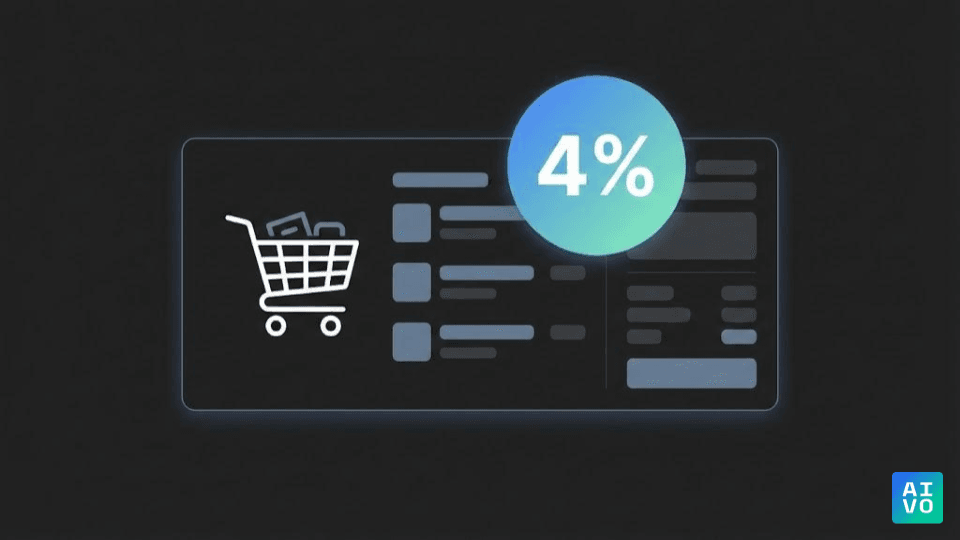
This introduces what we're calling the "ChatGPT Tax"—a 4% fee OpenAI charges merchants on every purchase completed inside ChatGPT. Think of it like Apple's App Store cut, but for AI commerce.
Starting January 26, 2026, Shopify merchants pay this fee on top of their standard ~2.9% processing costs. Google and Microsoft don't charge it yet, but the precedent is set.
The double hit? Brands that aren't visible to AI agents won't just pay the tax—they'll miss transactions they never knew existed. No abandoned cart to retarget. No awareness that they were even in consideration.
The Context: Why Now?
Three forces are converging to make 2026 the inflection point:
1. Zero-Click Is Accelerating
The shift from "search" to "answer" isn't new, but it's reaching critical mass. AI Overviews, featured snippets, and conversational interfaces are satisfying queries without requiring clicks. For informational searches, the destination page is increasingly irrelevant—the AI summary is the destination.
This fundamentally changes what "optimization" means. It's no longer about driving traffic. It's about being the source the AI references when constructing its answer.
2. Enterprise Budgets Are Moving—Slowly
Conductor's 2026 CMO Priorities Report reveals the awkward reality: 67% of enterprise marketers plan to increase investment in AI visibility this year. But 41% have no dedicated budget for it. And 56% cite "lack of clear best practices" as their biggest blocker.
The intent is there. The execution infrastructure isn't.
Companies are still measuring success through traditional SEO metrics—78% of them, according to the same report. They know the game has changed, but they're scoring it with the old rulebook.
3. The Content Monetization Model Is Breaking
Here's the uncomfortable truth publishers are grappling with: if AI agents answer questions without sending users to websites, the ad-supported content model collapses. No visits means no impressions means no revenue.
Some projections suggest two-thirds of web traffic could come from AI agents by 2027. Whether or not that specific number holds, the direction is clear. The content machine that fueled the web for 20 years is under structural pressure.
Smart publishers aren't waiting for the collapse. They're building new revenue streams—launching their own AI chatbots, selling "AI placement" packages, and repositioning their authority for a post-click world.
The Solution: Closing the Visibility Gap
The companies making progress aren't just tweaking their SEO strategies. They're rethinking what visibility means in an AI-mediated landscape.
Shift 1: From Keywords to Questions
AI platforms don't process queries the way traditional search does. They respond to questions, not keywords. The tactical shift is straightforward: transform your target keywords into the question-format queries AI platforms actually prioritize.
This isn't just about long-tail keywords. It's about understanding the conversational patterns users have with AI assistants and ensuring your content answers those specific framings.
Example transformation:
- Old keyword: "CRM software pricing"
- New question format: "What's the best CRM for a 50-person sales team under $10,000/year?"
Shift 2: From Position to Citation
Traditional SEO optimized for ranking. AI visibility optimizes for being cited.
When ChatGPT or Perplexity recommends a product or explains a concept, they reference sources. Being that reference—appearing in the AI's response, not just in its training data—is the new visibility metric.
This requires different content architecture:
- Structured data that AI can parse
- Clear claims that can be attributed
- Topical authority that makes your source the logical citation
- Answer-first content structure (conclusion before explanation)
Shift 3: From Traffic to Influence
The hardest mindset shift is accepting that traffic may not be the right success metric anymore.
If an AI agent recommends your product to a user who then purchases directly, you've won—even though your analytics show no visit. If your research is cited in thousands of AI responses, you've built influence—even if it doesn't show up in Google Analytics.
The companies closing the visibility gap are developing new measurement frameworks that capture these moments of influence, not just moments of click.
New metrics to track:
- Share of Model: How often AI recommends you vs. competitors for category queries
- Citation Frequency: Number of times AI platforms reference your content
- Recommendation Position: Placement in AI responses (1st, 2nd, 3rd recommendation)
- AI-Attributed Conversions: Direct traffic spikes correlated with AI mentions
Shift 4: From Reactive to Proactive
Most brands are watching the AI visibility shift happen to them. The leaders are actively shaping how AI perceives their brand.
This means auditing how AI platforms currently represent your brand. It means structured content strategies designed for AI consumption. It means treating AI visibility as a distinct channel, not an afterthought to SEO.
The Proof: What Early Movers Are Finding
We've analyzed AI responses across multiple industries, and the patterns are consistent:
Share of Voice Doesn't Equal Share of Recommendation
In our cruise industry research, Royal Caribbean had 4x the mention rate of Virgin Voyages. But Virgin Voyages ranked #1 in AI visibility because they consistently appeared in the top recommendation position.
Frequency matters less than placement. Being mentioned 20 times in position 5 is less valuable than being mentioned 5 times in position 1.
Traditional Authority Translates—With Work
Brands with strong domain authority have an advantage, but it doesn't automatically convert to AI visibility. The translation requires deliberate optimization for how AI platforms evaluate and cite sources.
What we're seeing work:
- High domain authority sites that restructure content for AI extraction see 3-4x citation rates
- Newer sites with AI-optimized content can outperform legacy brands in specific categories
- The sweet spot: existing authority + AI-first content architecture
First Movers Are Building Moats
The companies investing in AI visibility now aren't just capturing current opportunity. They're training AI platforms to associate their brand with key topics—an advantage that compounds over time.
AI models learn from recent citations. The more your brand appears in current responses, the more likely it becomes a future citation. It's a virtuous cycle that early movers are exploiting.
Platform-Specific Optimization
ChatGPT Optimization
ChatGPT uses Bing + SerpAPI (Google hybrid):
- Optimize for both Bing AND Google rankings simultaneously
- Use highly structured content (tables, bullet lists, numbered steps)
- Maximize information density—educational tone over promotional
- Prepare for Agentic Commerce Protocol integration
- Consider the 4% merchant fee in pricing strategy
- Allow GPTBot and OAI-SearchBot in robots.txt
Perplexity Optimization
Perplexity searches every query using Google as primary backend:
- Focus on Google rankings as foundation
- Build citation authority from trusted sources
- Display publication dates prominently and update quarterly
- Use FAQ and HowTo schema markup extensively
- Target research-oriented queries (Perplexity users are information seekers)
- Allow PerplexityBot in robots.txt
Claude AI Optimization
Claude has 87% correlation with Brave Search results:
- Check and optimize rankings on search.brave.com
- Use recency signals ("2026", "latest") in H1s and opening paragraphs
- Structure key facts in 15-25 word standalone sentences
- Allow ClaudeBot in robots.txt
- Note: Claude searches less frequently than other platforms—only when necessary
Google AI Overview Optimization
Optimize for inclusion in AI Overviews:
- Target queries with existing AIO presence (they're already AI-friendly)
- Use scannable content structure (bullets, tables, clear headings)
- Implement comprehensive schema markup (Article, HowTo, FAQ)
- Provide direct, complete answers to specific questions
- Maintain strong traditional Google rankings as baseline
Implementation Roadmap
Phase 1: Audit & Baseline (Week 1-2)
Immediate Actions:
- Test your brand's current AI visibility across ChatGPT, Claude, Perplexity, Gemini
- Document how AI platforms currently describe your brand and products
- Identify competitors appearing in AI responses for your category
- Review robots.txt to ensure AI crawlers are allowed
- Audit top 20 pages for AI-extraction readiness
- Current Share of Model (% of category queries where you appear)
- Competitor citation frequency and positioning
- Which platforms cite you vs. which don't
- Current direct traffic baseline (for future correlation analysis)
Phase 2: Quick Wins (Week 3-6)
Content Optimization:
- Restructure top 5 pages for AI extraction (15-25 word sentences, answer-first)
- Add comprehensive FAQ sections to product/category pages
- Implement structured data (FAQ, HowTo, Product schema)
- Update publication dates on evergreen content
- Create question-format content for high-value queries
- Ensure proper crawler access in robots.txt
- Add AI-specific meta tags (ai:optimization-target, ai:content-type)
- Implement proper canonical URLs
- Set up tracking for AI-attributed traffic patterns
Phase 3: Strategic Buildout (Month 2-3)
New Content Development:
- Create AI-optimized content for 10 highest-value category queries
- Build topical authority clusters around core products/services
- Develop citation-worthy research and data (AI platforms favor original research)
- Launch resource hub designed for AI consumption
- Set up Share of Model tracking system
- Implement correlation tracking (AI mentions → branded search → conversions)
- Create dashboard for AI visibility metrics
- Establish baseline for AI-attributed revenue
Phase 4: Scale & Refine (Month 4+)
Channel Maturity:
- Expand content coverage to 50+ high-value queries
- Build partnerships with sites AI platforms cite frequently
- Develop platform-specific content strategies (ChatGPT vs. Perplexity vs. Claude)
- Launch proactive AI visibility campaigns
- Secure dedicated budget for AI visibility (don't fund from SEO budget)
- Train content team on AI-extraction principles
- Integrate AI visibility into quarterly planning
- Build case study demonstrating ROI for executive buy-in
FAQ
How do I measure Share of Model?
Start with manual testing: ask AI platforms 20-30 questions your customers would ask in your category. Document whether your brand appears, at what position, and in what context. For systematic tracking, platforms like AIVO automate this across hundreds of queries and multiple AI engines. The key metric: what percentage of category-relevant queries result in your brand being recommended?
Why does ranking #1 on Google not guarantee AI visibility?
AI platforms use search results as one input, but they apply additional filters: content must be parseable (not behind paywalls or complex JavaScript), authoritative (trusted domain, quality signals), and structured for extraction (clear claims, logical organization). A #1 ranking gets you consideration, not citation. Also, different AI platforms use different search backends—Claude uses Brave Search, not Google.
What's the typical timeline to see results from AI visibility optimization?
Expect 6-12 weeks for initial citations to appear after optimization. Early wins come from restructuring existing high-authority content. Building citation frequency takes 3-6 months. Long-term topical authority (where AI defaults to your brand for entire categories) requires 6-12 months of consistent optimization. First movers have a significant advantage—start now.
Should we stop investing in traditional SEO?
No. Traditional SEO feeds AI visibility—search rankings influence what content AI platforms discover and cite. Think of SEO as the foundation and AI visibility as the next layer. The mistake is assuming SEO alone is sufficient. You need both. Recommended split for most mid-market brands: 60% traditional SEO, 40% AI visibility optimization.
How does the ChatGPT Tax affect pricing strategy?
The 4% merchant fee means brands need to factor this into margins for ChatGPT-driven sales. For Shopify merchants already paying ~2.9% processing fees, total transaction costs approach 7% for ChatGPT commerce. This makes high-margin products more viable for AI commerce than low-margin commodities. Consider: do you want to be visible in ChatGPT commerce, or optimize for other channels?
What if we don't have budget for AI visibility?
Start with auditing current state (free manual testing). Then prioritize restructuring existing high-performing content for AI extraction—this requires time, not budget. Use the quick wins to build internal case for dedicated budget. The 41% of enterprises with no dedicated budget will fall behind the 59% who do. Don't be in the first group.
How do we get executive buy-in for AI visibility investment?
Use the 69-point gap statistic: "92% of our competitors see this as a priority, but only 23% know what to do. This is our window." Then demonstrate current invisibility: show executives that competitors appear in AI responses where your brand doesn't. Finally, frame it as risk mitigation: if 2/3 of traffic shifts to AI agents by 2027, invisibility means irrelevance.
Can small teams compete with enterprise resources in AI visibility?
Yes—more easily than in traditional SEO. AI visibility rewards content quality and structure over domain size. A 3-person team with AI-optimized content can outrank a 50-person team still using traditional SEO playbooks. The competitive advantage of early movers is significant. Enterprise slowness is your opportunity.
Key Takeaways
The Gap Is Real
- 69-point confidence gap—awareness (92%) far exceeds execution capability (23%)
- Budget misalignment—67% plan to increase investment, but 41% have no dedicated budget
- Measurement mismatch—78% still use traditional SEO metrics despite fundamental channel shift
- The window is closing—early movers are building compounding advantages; delayed action costs more over time
The Shifts Required
- Keywords → Questions: Optimize for conversational query patterns, not keyword strings
- Position → Citation: Success is being referenced by AI, not ranking in search results
- Traffic → Influence: Measure AI mentions and recommendations, not just website visits
- Reactive → Proactive: Actively shape how AI perceives your brand; don't wait to be discovered
The New Reality
- Position doesn't equal visibility—#1 rankings only appear in AI Overviews 60% of time
- Agentic commerce is here—OpenAI ACP and Google UCP enable AI agents to purchase on behalf of users
- The ChatGPT Tax exists—4% merchant fee on purchases inside ChatGPT (as of Jan 26, 2026)
- 2/3 of traffic could shift—projections suggest AI agents will drive majority of web traffic by 2027
The Action Plan
- Audit current state—understand how AI platforms currently represent your brand
- Identify leverage queries—find high-value questions where AI answers are replacing search results
- Restructure content—optimize for citation with answer-first structure, 15-25 word sentences
- Develop new metrics—track Share of Model, citation frequency, recommendation position
- Secure dedicated budget—don't fund AI visibility from SEO budget; treat as distinct channel
The Bottom Line
The AI visibility gap is the defining marketing challenge of 2026. The 69-point spread between awareness and action represents opportunity for those who move now, and risk for those who wait. The companies closing this gap aren't just optimizing for AI—they're redefining what visibility means in a post-search world.
---
Data Summary
| Statistic | Value | Source |
|---|---|---|
| Enterprise marketers prioritizing AI visibility | 92% | Conductor 2026 CMO Report |
| Feel "very confident" in approach | 23% | Conductor 2026 CMO Report |
| Plan to increase investment | 67% | Conductor 2026 CMO Report |
| Have no dedicated budget | 41% | Conductor 2026 CMO Report |
| Searches showing AI Overviews | 30%+ | AI Search Summit 2026 |
| #1 ranking appears in AI Overviews | 60% | AI Search Summit 2026 |
| Projected AI agent traffic by 2027 | 66% | Industry projections |
| ChatGPT merchant fee (Instant Checkout) | 4% | OpenAI/Shopify (Jan 2026) |
| Still using traditional SEO metrics | 78% | Conductor 2026 CMO Report |
| Cite "lack of best practices" as blocker | 56% | Conductor 2026 CMO Report |
---
Have You ChatGPT'd Yourself?
Get your free AI Visibility Snapshot—see exactly how AI platforms perceive your brand across ChatGPT, Claude, Perplexity, and Gemini. Takes 2 minutes. No credit card required.
Book an Intro: Book an Intro
Questions about closing the visibility gap? Email team@tryaivo.com
---
Sources & References
- Conductor - "2026 CMO Priorities Report"
- AI Search Summit - "2026 State of AI Search"
- OpenAI/Shopify - "ChatGPT Instant Checkout Announcement"
- Google - "Universal Commerce Protocol Announcement"
- Industry Projections - "AI Agent Traffic Forecasts"
---
Related Articles:
- SEO Isn't Dead. But It's Not Fine Either - Understanding the structural shift in organic traffic
- How AI Engines Decide What to Cite - Claude, ChatGPT, and Perplexity backend infrastructure explained
- The First Two Weeks of 2026 Changed AI Marketing Forever - ChatGPT ads, Google checkout, Samsung Perplexity deal
Author: Sebastian Pinzon is Co-Founder of AIVO, an AI Visibility Intelligence Platform helping enterprise brands close the visibility gap and optimize for Share of Model across ChatGPT, Claude, Perplexity, and Gemini. With 15+ years of experience at major agency holding companies (Publicis, WPP, OMG), he's now focused on helping brands navigate the AI-first discovery landscape.
Connect on LinkedIn | tryaivo.com


