94% of Our AI Citations Come From Two Listicles We Wrote Ourselves
The most effective AI search optimization tactic right now is publishing your own best-of list. We know because we did it. Here is why it decays, and the one test that separates a roundup from an advertisement.

94% of Our AI Citations Come From Two Listicles We Wrote Ourselves
The most effective AI search optimization tactic right now is publishing your own best-of list. We know because we did it. Here is why it decays, and the one test that separates a roundup from an advertisement.
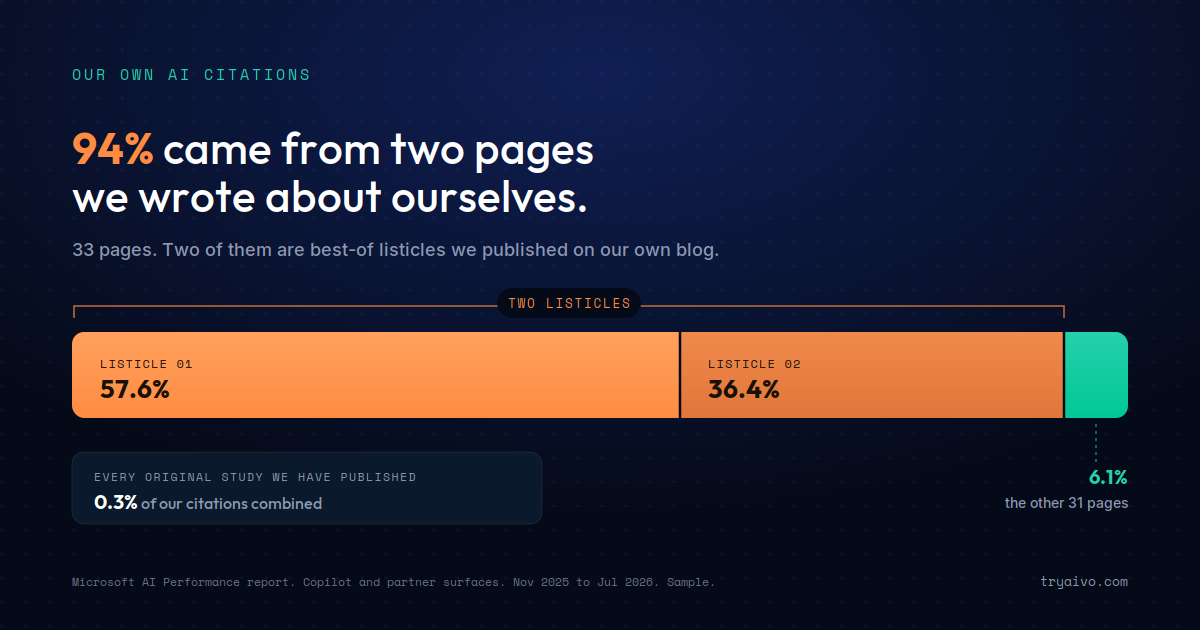
We recently pulled our own AI citation data. Across 33 pages, two of them account for 94% of every citation we have earned. Both are best-of lists we published on our own blog. Our original research accounts for less than half a percent.
One of those pieces was a pre-registered, multi-month study with a falsification threshold set before we ran a single query. It does not appear in the citation report at all.
So before anyone accuses this industry of gaming AI search, we should say plainly that the tactic works, and that we are holding the receipt.
📋 TL;DR
- Our own Copilot citation data: two self-published listicles on our blog account for 94% of citations across 33 pages; original research is under half a percent.
- Listicles match buyer intent: in our ChatGPT listicle study, listicles were cited 100% of the time on commercial investigation prompts and near-zero on navigational queries.
- The honesty test: a roundup that never concludes against the publisher is an advertisement; our most-cited page names competitors and when to hire them instead.
- The tactic decays: retrieval diversifies sources, recency is a hard filter, and every prior shortcut in search history was corrected retroactively.
The format is doing exactly what it is supposed to do
It would be easy to read that 94% as evidence that AI search is broken. Our own research says something less convenient.
We ran 138 ChatGPT queries across 46 conversational prompts, three times each. When someone asks a commercial investigation question, the kind that starts with "best" or "top", ChatGPT cited a listicle 100% of the time. Every category we tested. On informational questions it dropped to 13%. On navigational questions it was zero.
The listicle is not a loophole. For the question a buyer asks when they are choosing between vendors, it is the format the model wants. Publishing one is ordinary marketing.
That is the part the current panic gets wrong, and it is why we are not going to tell you to stop writing them.
So where is the line
Here is a test any reader can run in thirty seconds, on any page, including this one.
Does the roundup ever conclude against the company that published it?
If a comparison never names a competitor as the better choice for anyone, it is an advertisement wearing a listicle's clothes. The domain is a disclosure. The content is a pitch. Everybody can see it except the machine.
On our own most-cited page there is a section headed "Where other tools beat AIVO." It names four competitors and the specific situations in which a reader should hire them instead of us. That page has earned more AI citations than everything else we have ever published, combined. We did not lose anything by writing it.
The second half of the test is what happens when someone asks to be added. We get those emails. We do not reply to them, and we do not change the list. Nothing gets a company into that roundup except being the better answer for somebody.
That is the whole standard, and it costs something to hold. Which is the point.
Three tiers, and only one of them is a real problem
There are three tiers.
Earned placement is a publisher testing you and choosing you, on their domain, on the merits. It is slow and it compounds.
Self-published comparison is you publishing a roundup on your own domain. The domain itself discloses the bias. It becomes an advertisement the moment the list can only ever conclude in your favor.
Paid placement inside a roundup that presents itself as independent, with no disclosure, is the one that is actually a problem. Same for seeded forum threads and manufactured mentions. The material connection between the brand and the endorsement is hidden from the reader, and hidden from the model reading on the reader's behalf. That is the practice our black hat series has been documenting, and it is not a matter of taste. Disclosure of a material connection is the settled standard in advertising, and a chatbot is a reader.
What has changed is who the audience is. These pages are no longer written for people. They are written for the machine that reads them and repeats what it found. The Atlantic documented brands publishing dozens of ranked lists on their own blogs, repeatedly placing themselves at or near the top, and chatbots citing those lists as though they were independent reviews. The runner-up changes. The winner never does.
The machines read more of the web, faster than any human ever will. They are also, right now, unable to tell an independent review from an advertisement the brand posted about itself. Some brands noticed that gap before others. They are not smarter. They noticed the referee is nearsighted.
Why the tactic decays
We have three reasons, and two of them come from our own data.
The retrieval layer diversifies on purpose. In our listicle study, ChatGPT's citations spread across more than 300 distinct domains. The single most-cited domain accounted for roughly 3% of them. A brand that publishes 300 of its own lists is pushing against the one behavior the retrieval layer is built to perform. Concentration is the anomaly these systems correct. It is not the outcome they reward.
Recency is a hard filter. 92% of the listicles ChatGPT cited carried the current year. That makes a self-published list a rented position, paid for again every twelve months. Both of our top pages still carry 2025 in the URL. Our own winners are already aging.
We have watched this movie. Content farms worked. Exact-match domains worked. Link networks worked. Every one of them worked right up until the correction, and the correction was retroactive. Nobody got a warning. The gap between what the machine can read and what the machine can verify is closing, and it has only ever closed in one direction. For how this fits the wider 2026 landscape, see 10 things that changed in AI search.
The uncomfortable part
Here is the argument against everything above, and it deserves a straight answer.
Earning your way into somebody else's roundup takes a quarter, maybe two. Publishing your own takes an afternoon and starts collecting citations this month. When a competitor is buying the result now, who is going to fund the slow thing?
The honest answer is that plenty of people will take the fast one, and for a while it will look like the right call. That is what a window is. It stays open long enough to make the people standing in it feel clever, and it closes without an announcement, on everyone inside at once.
We are not asking anyone to be virtuous about this. We are pointing out that a rented position is being priced as an owned one, and the invoice comes later.
The measurable thing is which sources the models in your category actually trust, and whether you are in any of them. Most brands have never checked. That number is knowable today, and it does not require anyone's opinion about ethics. The 2026 measurement stack is a starting point for what platforms report natively; cross-engine source analysis is where the picture completes. For how citation vs recommendation fits the full system, see the AI search ecosystem.
What to do with this
Keep publishing comparisons. Let them conclude against you when the truth points that way, and watch what happens to your citations. Go earn placement in the roundups the models already read, which means finding out which ones those are before you pitch anybody. Treat any offer to buy your way into an independent list as what it is.
And if someone shows you a visibility score with no methodology behind it, ask them which questions they asked, how many times they ran them, and whether the answers came back the same twice.
We run one read on how AI describes, ranks, and recommends a brand across every engine, which sources those answers are built from, and what to do next. One market, about a week, no subscription. Book a meeting to see where you stand.
Citation figures are from AIVO's Microsoft AI Performance report, November 2025 through July 2026, covering Copilot and partner surfaces, reported as a sample by Microsoft. Listicle findings are from AIVO's pre-registered ChatGPT listicle study, June 2026. Additional reporting on self-published ranked lists: The Atlantic, June 2026.
FAQ
Q: Do listicles actually help AI visibility?
A: Yes, for commercial questions. In our study of 138 ChatGPT queries, listicles were cited 100% of the time on commercial investigation prompts, the ones that begin with "best" or "top". On informational prompts that fell to 13%, and on navigational prompts it was zero. The format matters only where buyers are comparing options.
Q: Should I publish my own best-of listicle?
A: Publishing a comparison on your own domain is ordinary marketing, and the domain discloses your interest. The question is whether the list can ever conclude against you. If a competitor is never the better choice for any reader, it is an advertisement, and readers and models will eventually treat it as one.
Q: Why do AI engines cite listicles so often?
A: Because the format matches the question. A best-of list is structured, comparative, and dated, which is what a model needs to answer a comparison prompt. In our study, 92% of cited listicles carried the current year and the median list ran to ten items.
Q: Is publishing a self-ranking listicle black hat?
A: It sits between the two. Paying for placement in a roundup that presents itself as independent, with no disclosure, is the practice that hides a material connection from the reader. Publishing your own list under your own name discloses the interest by default, and it becomes a problem when the conclusion is fixed before the research starts.
Q: How long will self-published listicles keep working?
A: Unknown, and shorter than the people using them expect. In our study, AI citations spread across more than 300 domains with no single publisher above roughly 3%, which suggests retrieval systems are built to diversify sources rather than concentrate on one. Search engines corrected content farms and link networks the same way, retroactively.
Q: How do I find out which sources AI trusts in my category?
A: Run the questions your buyers actually ask, many times per engine, and record which domains the answers are built from. AIVO does this at scale, and the source list is usually more useful than the visibility score.
Key Takeaways
- Self-published listicles can dominate first-party citation reports — our two roundup pages account for 94% of Copilot citations across 33 URLs, while original research barely registers.
- The format wins on commercial intent, not everywhere — listicles were cited on every commercial investigation prompt in our ChatGPT study and almost never on navigational queries.
- Honest comparisons can still earn citations — naming when competitors are the better fit is the line between roundup and advertisement, and it is testable in thirty seconds.
- Three tiers matter: earned placement, disclosed self-published comparison, and hidden paid placement — only the last is the black-hat problem our series documents.
- The tactic is rented, not owned — recency filters, source diversification, and history's retroactive corrections all point the same direction.
Author: Sebastian Pinzon is Co-Founder of AIVO, the AI Visibility Intelligence Platform. After 15+ years in digital marketing at Publicis, WPP, and Omnicom, he helps mid-market brands measure and improve their presence across ChatGPT, Perplexity, Google AI Overviews, and Claude.
Connect on LinkedIn | tryaivo.com
Related Articles

How to Track AI Overviews Traffic (And Why Google Will Not Let You)

How to Advertise in AI in 2026: Google, ChatGPT, Amazon & Walmart
