AI Brand Visibility: Why the CMO's New Metric Is Easy to Game
AI brand visibility reached the C-suite this year. But a high score usually just means you measured the easy questions. What you measure decides everything.
CMOs Are Taking AI Brand Visibility Seriously. Most Are Measuring It Wrong.
AI brand visibility reached the C-suite this year. But a high score usually just means you measured the easy questions. What you measure decides everything, and that is the hard part.
📋 TL;DR
- AI brand visibility is now a CMO-level conversation, but most teams still lack a rigorous way to measure it.
- Branded-prompt scores look strong because the model already knows the name you typed; category prompts tell you where buyers actually shortlist.
- A single visibility number is a snapshot: the same prompt returns different brand lists most of the time unless you measure at scale.
- The hard work is choosing buyer questions, running them consistently, and reading results as a range—not buying another dashboard.
AI brand visibility reached the C-suite in 2026
AI brand visibility became a CMO topic in 2026. The people who run brands are now asking what ChatGPT, Gemini, and Perplexity say about them, and treating the answer as a real marketing number. That part is healthy. The trouble starts with how the number gets measured.
Start with the shift, because it is real. When Business Insider asked a group of top CMOs this summer which platforms they are focused on, AI search came up on its own, on both sides of the house. Comcast's Jon Gieselman described traffic migrating away from SEO and the need to show up in AI search results the way you want to. Chime's Vineet Mehra is a pilot advertiser buying ads inside ChatGPT. One organic, one paid, both at the CMO level.
The surveys back the trend. Generative engine optimization is now used by 40% of companies in the Duke Fuqua CMO Survey, a capability that did not exist in earlier editions. Gartner has CMOs putting 15.3% of marketing budget into AI, with 70% calling AI leadership a critical 2026 goal and only 30% saying they are ready to scale it. And in McKinsey's 2026 State of Marketing report, brand is the number one CMO priority while AI ranks 17th—summarized in this Entrepreneur contributor piece on the gap. The attention arrived. The method did not.
One note on scale, to keep it grounded. For most brands AI referral traffic is still about 1% of sessions, and visible revenue loss is rare so far. This is an early channel that is growing fast, not a fire. Which is exactly why it is worth measuring properly before anyone spends against it.
The number is only as good as the questions behind it
Here is the part almost nobody says out loud. An AI visibility score is not one fixed thing. It is a rate, and it depends entirely on which questions you ask the model. Change the questions and the score changes.
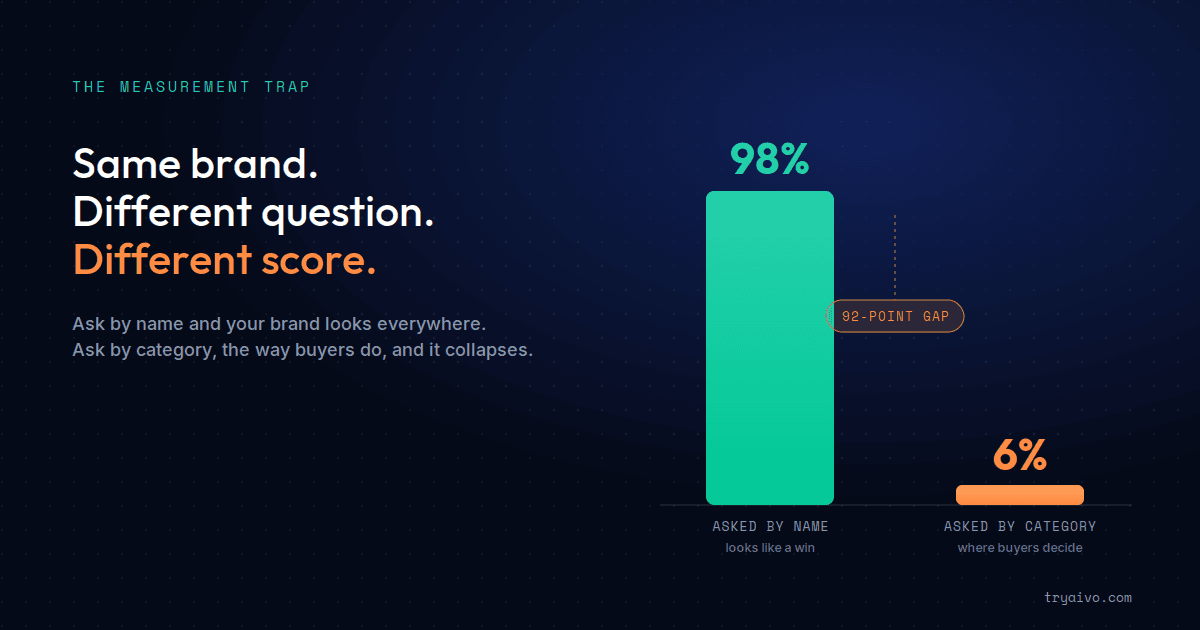
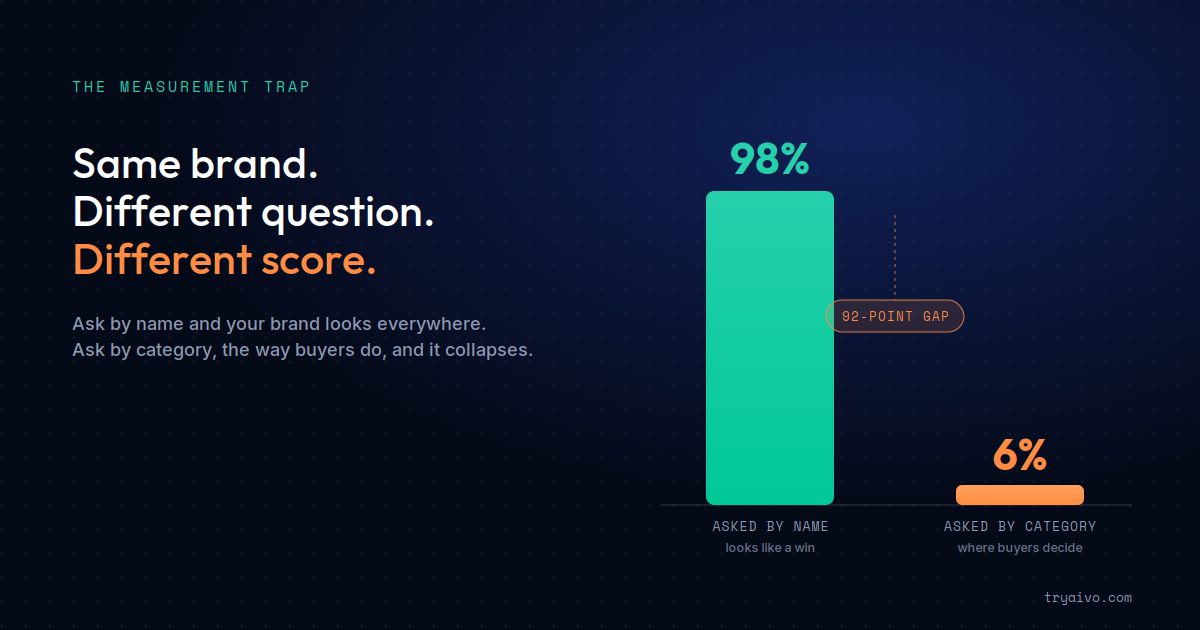
That is the opening for a trap. Measure prompts that include your brand name and you will look great, because the model already knows the brand you just named. A dashboard full of branded prompts can show 90-plus percent visibility and tell you nothing. Your buyer does not type your name. They ask by category. Best laptop for editing. Most reliable machine for travel. That is where the shortlist actually forms, and it is a different question entirely.
We saw the gap cleanly on one brand. Searched by name, it was everywhere, present on 98% of branded prompts. Asked by category, it dropped to about 6%. And 95.6% of the sources feeding those category answers came from pages the brand did not own. The team was proud of a score that measured the one question their buyers never ask.
It gets worse: the number will not hold still
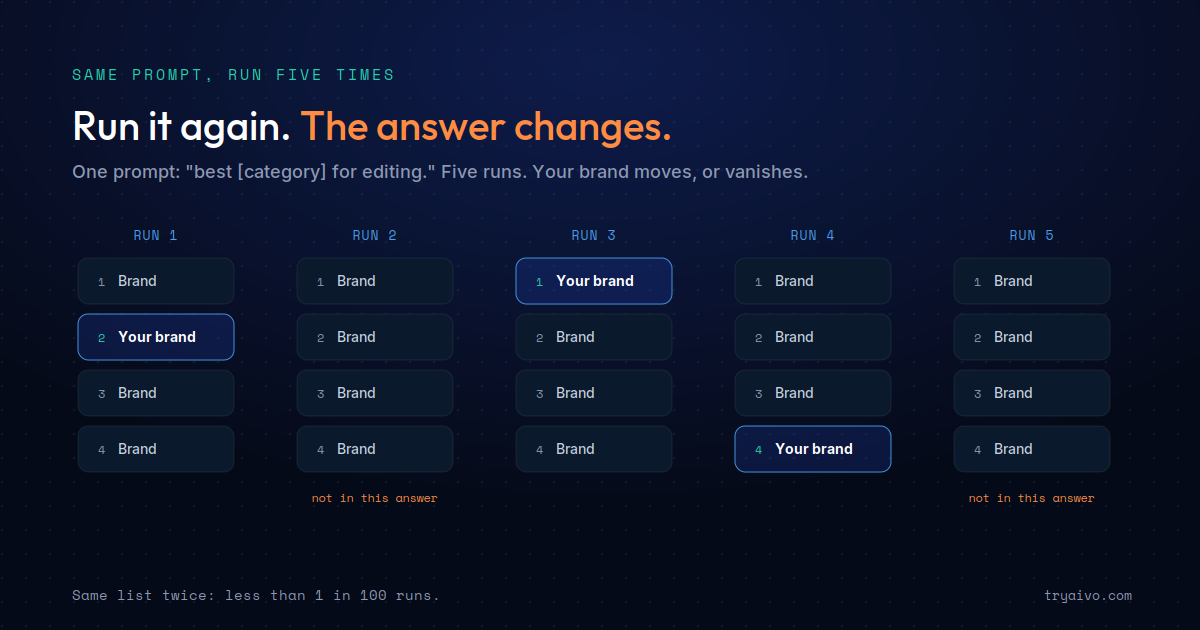
Even with the right questions, a single score is a snapshot. Run the same prompt through a model 100 times and the list of names changes. Across thousands of runs we see less than a coin-flip chance you get the same set twice. So any tidy visibility score off one pass is a photo of a moving target.
This matters because the market standardized on prompt tracking, and prompt tracking is easy to game. Pick friendly questions, run them once, screenshot the win. The score goes up and nothing real changed. A number that moves run to run, and that you chose the questions for, is not a measurement. It is a story you told yourself. For how the broader generative engine optimization landscape is shifting in 2026, see our latest industry read. Recommendation is one layer of a larger AI search ecosystem—engines, access, sources, structure, and measurement all have to work together.
Why this is a measurement problem, not a tool problem
The hard part is not buying a dashboard. There are already too many tools and too much noise. The hard part is deciding what to measure: which buyer questions actually matter in your category, how to ask them the way real buyers do, and how many times to run them before the number means anything. Get that wrong and a high AI visibility score is worse than no number, because it points you the wrong way with confidence. Similarweb's 2026 AI search data sharpens why that discipline belongs on the CMO's desk: AI search behaves like a brand awareness channel, measured by share of voice and branded-search lift, not by referral clicks alone.
That judgment is the reason we run this as a consultancy and not a login. The work is designing the read: the right questions, measured the same way twice, reported as a range instead of a single score. The fix, if there is one, is normal marketing your own teams already do, so we hand that part off. What is hard, and what is worth paying for, is knowing what to measure and what the answer actually means. Our measurement research documents how we run those reads in practice.
Meanwhile, BCG's 2026 agentic marketing research finds 96% of CMOs say AI drives transformation, but only about a third have executed—another sign that attention outran operational rigor.
What a CMO should walk away with
One read should answer three things in plain terms. Whether AI discovery is worth worrying about yet, given your category and your real numbers. If so, where, meaning which buyer questions and which competitors get named instead of you. And what to do about it, in priority order, including whether the right call is to wait.
One market, about a week, no subscription. A small spend to find out whether the much larger spend behind it is worth making at all. Book a meeting to see where you stand.
Key Takeaways
- CMO attention on AI search is real; measurement discipline is not keeping pace.
- Branded-prompt visibility inflates scores; category prompts reflect how buyers actually discover brands.
- Single-run scores are unstable—report ranges across many runs on questions buyers use.
- Tools multiply; the valuable work is prompt architecture and interpretation, not another login.
- A focused read should tell you whether to act, where you lose the shortlist, and what to do first—or whether to wait.
Frequently asked questions
Q: Is AI search actually hurting my brand yet? A: For most brands, not much yet. AI referral traffic tends to sit around 1% of sessions and visible revenue loss is rare so far. The behavior is real and growing, so it is worth a read, but for many brands the right call this quarter is to do very little. A read tells you whether you are the exception.
Q: Why do branded-prompt AI visibility scores look so high? A: Because the model already knows the brand you named in the question. Prompts that include your brand name inflate the score and reveal little. Buyers ask by category, without naming anyone, so category questions are the ones that show where you actually stand.
Q: Can you trust a single AI visibility score? A: Not on its own. The score depends entirely on which questions were asked, and the same prompt returns a different brand list most of the time. Real measurement reports a rate with a range across many runs, on questions your buyers actually use.
Q: Why is AI brand visibility a CMO responsibility? A: Because it is brand measurement. It shapes how buyers perceive and shortlist the brand, it reads across the whole web rather than one owned site, and it sits next to the perception metrics a CMO already owns.
Q: Does traditional SEO cover AI brand visibility? A: Partly. Crawlability and authority still matter, so strong SEO helps. But AI engines cite sources that never rank in Google's top results, and each engine draws on a different set, so ranking well does not guarantee being named in the answer.
Sources: Business Insider (July 2026), Duke Fuqua CMO Survey 2026, Gartner 2026 CMO Spend Survey, Entrepreneur (2026), BCG (2026), and Similarweb AI referral data. Findings and run counts are from AIVO's own reads, brand anonymized.
Author: Sebastian Pinzon Duran is Head of Discovery at AIVO, the strategic AI visibility consultancy. He helps marketing leaders measure how ChatGPT, Gemini, Perplexity, and Google AI name their brands—and what to do when the easy score lies.
Related Articles

How to Advertise in AI in 2026: Google, ChatGPT, Amazon & Walmart
AI Marketing in 2026: The Full Picture (and the Half That Wins Clients)
