Generative Engine Optimization in 2026: 10 AI Search Shifts to Know
The 10 biggest generative engine optimization shifts of 2026—from Google retiring the search box to why AI cites your listicle but names a competitor.
10 Things That Changed in AI Search in 2026 (And Why Your Brand Should Care)
The biggest shifts in AI search this year, and what each one means for whether AI names your brand or skips it.
AI search did not just get bigger in 2026. The rules changed underneath it. Google retired the search box it had used for 25 years. ChatGPT started selling ads inside the answer. And the engines stopped agreeing on which brands to recommend.
At AIVO (AI Visibility Optimization) we track what ChatGPT, Gemini, Google AI Overviews, Perplexity, and Claude say about brands every day. Here are the 10 shifts from 2026 that changed the game, and what each one means for whether your brand shows up. Read them together and one thing is clear. Generative engine optimization (GEO) is no longer about ranking. It is about being the brand the model names.
📋 TL;DR
- Google replaced the 25-year-old search box with an AI interface.
- ChatGPT ad prices are already falling as OpenAI shifts to performance pricing.
- Perplexity and Anthropic both bet against ads. Claude is staying ad-free.
- AI cites your "best" listicle, then recommends a competitor 69% of the time.
- Claude and ChatGPT agree on which sources to cite just 8% of the time.
The landscape changed
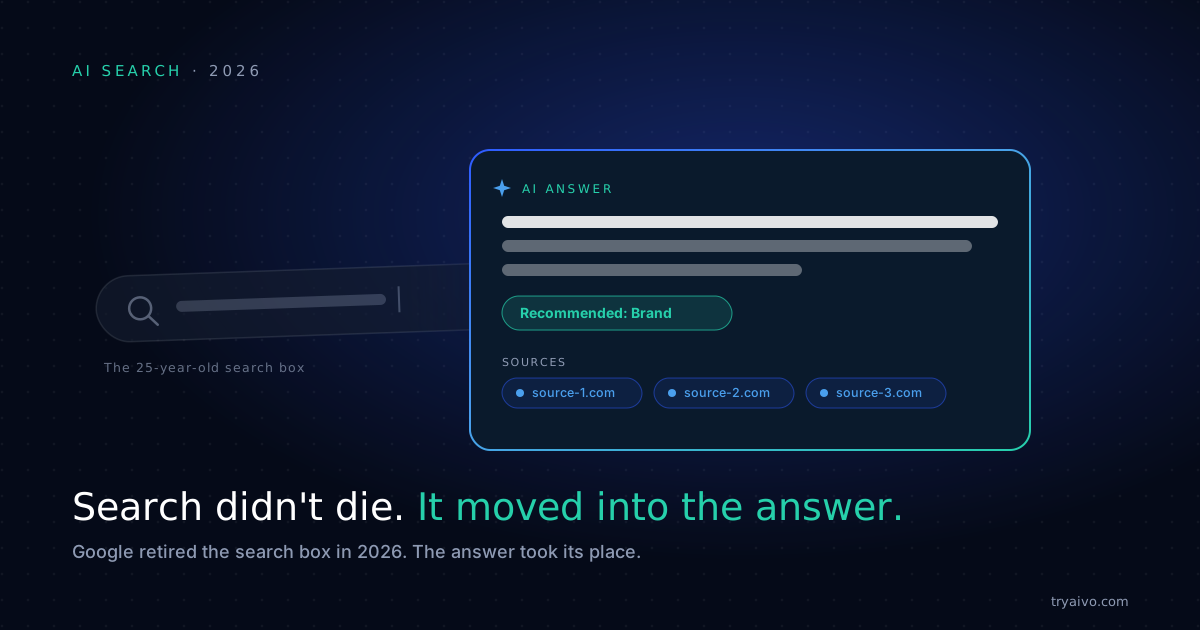
1. Google retired the 25-year-old search box. At I/O 2026, Google replaced the blank search box with an AI interface built on Gemini 3.5 Flash. It added information agents that watch the web around the clock and generative UI that builds custom tools and layouts on the fly. The box that defined the internet for a generation is gone. Read Google's own announcement.
Takeaway: the front door to the web is now an AI answer, not a list of links.
2. ChatGPT ad prices are already falling. OpenAI launched ads in ChatGPT in February 2026 at a $60 CPM, premium territory for a digital ad, and hit $100 million in annualized revenue in about six weeks. Then the model shifted. OpenAI recognized its real business is performance, not brand impressions, so it added cost-per-click bidding in April and cost-per-action after that. CPMs fell from $60 to as low as $25 in ten weeks. A premium land grab is becoming a performance channel. See our ground-level read on AI search advertising.
Takeaway: paid placement in the answer is getting cheaper and more measurable, but organic visibility is still the part you do not bid for.
3. Two engines bet against ads entirely. In the same month, Perplexity pulled advertising completely and staked its business on subscriptions, arguing ads erode the trust that makes an answer engine worth using. Anthropic went further and drew a hard line: Claude will stay ad-free, no sponsored links, no product placements in answers. It even ran Super Bowl ads with the line "Ads are coming to AI. But not to Claude."
Takeaway: the platforms are splitting on how they make money, and an ad-free answer is now a competitive position, not just a default.
The money moved
4. WPP called AI a $1.3 trillion opportunity. When the largest holding company in advertising puts a number that size on AI, it stops being a trend slide and becomes the budget. Every dollar of it assumes brands can influence what the AI says. Most cannot, because they do not measure it.
Takeaway: the spend is arriving before the visibility. The brands already legible to AI will absorb it.
5. The click is dying. New Pew Research data shows that when an AI summary appears, only 8% of people click through to a result, compared with 15% when there is no summary. Most readers take the answer and stop.
Takeaway: for a growing share of searches, you are either inside the summary or you do not exist.
The rules of visibility changed
6. There is no single AI search. Give Claude and ChatGPT the same prompt and their cited sources overlap just 8% of the time, according to analysis reported by Search Engine Land. Claude's citations line up with Google rankings 64% of the time. ChatGPT's do not. Different engines read a different web.
Takeaway: a single AI visibility number is hiding several different answers. Optimize per engine.
7. AI visibility became a native metric in the tools you already use. For two years the only way to see how you showed up in AI answers was to run the prompts by hand. That changed fast in
- Bing Webmaster Tools shipped an AI citation report in February. Microsoft Clarity made its Citations dashboard generally available in May. Then on June 3, Google Search Console added dedicated reports for AI Overviews and AI Mode impressions. The largest search platforms now report AI visibility natively. We broke down what each tool shows and misses in how to measure AI visibility in 2026, the Microsoft Clarity citation data, and the new GA4 AI Assistant channel.
8. Your own "best" list is recommending your competitor. Lily Ray studied 100 B2B "best software" queries in Google AI Overviews between April and June 2026. When a brand's self-promotional listicle was cited, the brand itself was left out of the recommendation 69% of the time. Google used the page and named a competitor. Read the study via Search Engine Land.
Takeaway: getting cited is not getting recommended. Ranking yourself first can hand the win to the rivals you listed.
9. Original research is the content the engines actually reward. NP Digital surveyed 500 marketers in May 2026 and ranked content types by AI citation performance. Original research came out on top at 82%. Generic blog posts scored 25%. Video scored 2%. See the results via PPC Land.
Takeaway: summaries and reworded guides are close to invisible. First-party data is the entry fee.
People are already gaming it
10. The black hat era of AI search has started. A tactic is spreading fast. Brands pay publishers and seed forum threads, including coordinated Reddit posts, so the models pick up the mention. It works until the engines learn the pattern and discount it. One community, r/biohackers, already banned peptide posts after vendors gamed it to steer what LLMs repeat. See Search Engine Land's reporting on paid brand mentions in GEO, our read on black hat AI search with proof, and which brands AI actually recommends.
Takeaway: every channel AI trusts becomes a channel someone games. Earned authority is the only version that compounds.
Key Takeaways
The AI answer is not a mirror of your ad spend or your Google rankings. It is built from the content each engine can retrieve, filtered through that engine's own sources, and it is increasingly the place your buyer decides before they ever reach your site.
Three things follow. Being cited is not being recommended. There is no single AI search to win, there are five. And the content that earns a citation is the content only you could publish.
One note, since this is a listicle. This is a news digest that cites its sources and points to original AIVO data, not a page that ranks our own product first. After reading number 8 above, that distinction is the whole game.
If you do not know which engines name your brand and which name your competitor, that is not caution. It is a blind spot your competitor may have already closed.
FAQ
Q: What changed in AI search in 2026?
A: The biggest shifts were structural. Google replaced its 25-year-old search box with an AI interface at I/O 2026, ChatGPT launched ads inside its answers, and Perplexity dropped ads entirely. Studies also showed the engines cite very different sources from each other and from Google rankings.
Q: What is generative engine optimization (GEO)?
A: Generative engine optimization is the practice of getting a brand cited and recommended inside AI-generated answers from tools like ChatGPT, Gemini, Perplexity, and Google AI Overviews. Unlike traditional SEO, it optimizes for being named in the answer, not for ranking in a list of links.
Q: Does ranking on Google get my brand cited by AI?
A: Not reliably. More than 80% of the pages AI engines cite in 2026 do not rank in Google's top 10, and Claude and ChatGPT overlap on cited sources only 8% of the time. Google rankings and AI citations are separate outcomes.
Q: Why does ChatGPT recommend my competitor and not me?
A: Because citation and recommendation are different. AI often uses your page as a source, then names a more established or more widely referenced brand. In one 2026 study, brands that published self-ranking "best" lists were left out of the recommendation 69% of the time.
Q: Do all AI engines recommend the same brands?
A: No. Claude and ChatGPT agree on cited sources only 8% of the time, and each engine reads a different slice of the web. A brand visible in one engine can be absent from another.
Q: What kind of content gets cited by AI in 2026?
A: Original research and first-party data. In an NP Digital survey, original research was the top-performing content type for AI citations at 82%, while generic blog posts scored 25% and video scored 2%.
Q: How do I measure my brand's AI search visibility?
A: By running the same buyer prompts across every engine (ChatGPT, Gemini, Google AI Overviews, Perplexity, and Claude) and tracking which brands get cited and recommended, how often, and in what position. AIVO does this at scale. Book a meeting and we will benchmark your category.
---
Want to know which brands AI names in your category, and which one it names instead of you? Book a meeting and we will run the benchmark.
Sources: Google I/O 2026, Pew Research, NP Digital (May 2026), Lily Ray via Search Engine Land, and additional 2026 AI search studies. AIVO (AI Visibility Optimization) is a strategic AI visibility consultancy that tracks and optimizes how brands appear across AI search.


