Microsoft Clarity Just Made AI Citation Tracking Mainstream
Microsoft Clarity shipped an AI Citations dashboard on May 15, 2026. For the first time, citation data lives inside the same free tool your team already uses for session replay. This is first-party data for the AI era.

Microsoft Clarity Just Made AI Citation Tracking Mainstream
Microsoft Clarity shipped an AI Citations dashboard on May 15, 2026. For the first time, citation data lives inside the same free tool your team already uses for session replay. This is first-party data for the AI era. Google hasn't shipped anything like it. And they're telling you not to worry about it.
Citation data has existed for a while. AIVO tracks it. Profound tracks it. Scrunch tracks it. BrightEdge has a module for it. But until May 15, 2026, it only lived inside specialist tools that required a separate login, a separate budget conversation, and a separate explanation to your CFO about why this metric mattered.
Microsoft just changed that. They put citation tracking inside Clarity — the same free tool used by hundreds of thousands of websites for heatmaps and session replay. No new install. No new contract. Six new metrics, available by default, in the dashboard your analytics team already opens every morning.
That's not a feature launch. That's a category shift.
We set this up on tryaivo.com within days of launch. If you want help doing the same for your brand, that's what AIVO does.
📋 TL;DR
- Clarity's AI Citations dashboard is free, available to all projects, and live as of May 15, 2026.
- It tracks six metrics: citations, share of authority, AI referral traffic, grounding queries, cited pages, and trendlines.
- Grounding queries are not what users typed. They are internal retrieval instructions the AI generates before fetching web content. This vocabulary is almost completely different from SEO keywords.
- High query volume with low citation rate means your content is entering the retrieval pool but losing the selection decision. That is a content authority problem, not a discoverability problem.
- The data comes from Microsoft's actual retrieval infrastructure. No third-party tool can access or replicate it.
- Scope: Microsoft ecosystem only (Copilot, Bing AI, ChatGPT via Bing). Your verified domain only — not brand mentions on YouTube, press coverage, or third-party sites.
- To activate it: install Clarity, verify your domain via Bing Webmaster Tools or Google Search Console, connect your CDN provider.
Citation tracking just became first-party data
First-party data means you own it. It lives in your stack. You don't depend on a third party to tell you what's happening on your own property.
Web traffic was always first-party. Conversion data was always first-party. Citation data wasn't. You had to buy it from someone running their own query infrastructure against AI engines and reporting back to you.
Microsoft changed the model. Their crawler network, Bing's AI surfaces, and Copilot are all part of the same ecosystem. When Clarity reports citation data, it's pulling from Microsoft's own AI infrastructure. That's not third-party research. That's the platform telling you directly what it cited you for.
That's what makes this different from everything that came before it.
What Microsoft built
The dashboard ships six metrics:
- Page citations — total times your domain pages appeared in AI-generated answers.
- Share of authority — your percentage of citations versus competing domains across the same queries.
- AI referral traffic — sessions that originated from AI assistants.
- Queries — the specific prompts AI systems used to surface your content.
- Cited pages — URL-level breakdown of which pages earned citations and how many.
- Trendlines — how all of the above moves over time.
One thing to be clear about: this dashboard covers Microsoft's ecosystem. That means ChatGPT (via OpenAI's integration with Bing), Microsoft Copilot, and Bing AI surfaces. It does not cover Google AI Overviews, Gemini, or Google's answer surfaces. That gap matters, and we'll come back to it.
What a grounding query actually is
This is the part of the dashboard most people misread, and it's worth getting right.
When a user types a question into Copilot or ChatGPT, the model does not search the web with those exact words. Before it generates any answer, it translates the user's question into one or more structured retrieval queries. Internal, precise, often long-tail. Then it sends those queries to its retrieval layer — Bing's index, in Microsoft's case — to pull back the most relevant web content. Only then does it synthesize an answer using those retrieved sources.
That translation step is called grounding. The AI is essentially issuing a "go find this" instruction to its own search infrastructure before it writes a single word.
The queries you see in Clarity are those internal instructions. Not the user's original phrasing. The machine-generated retrieval query the model created before going to fetch sources.
A user might type: "what's the best tool to track how my brand appears in AI answers?"
The grounding query the AI issues internally might look like: "AI visibility monitoring tools citation tracking enterprise brand comparison 2026"
Those are not the same thing. And the gap between them is enormous for content strategy. A research study by SALT.agency that compared grounding queries from Clarity against Ahrefs keyword data found that only 2% were exact keyword matches. 80.5% had no corresponding Ahrefs ranking data at all.
That's not a gap in Ahrefs. It's proof that AI retrieval operates on a completely different vocabulary than search. Your SEO keyword data doesn't track grounding queries. It never has. This dashboard is the first time that vocabulary has been visible to anyone outside Microsoft's own infrastructure.
Considered but not cited: your most actionable signal
The dashboard separates two events that most tools treat as one.
The first is query volume. Every instance where your domain was eligible to appear in AI grounding activity, whether cited or not. The AI found your content. It entered the retrieval pool.
The second is citation count. The instances where your page was actually selected as a source in the final answer.
The gap between those two numbers is the most actionable signal in the entire dashboard.
If your query volume is high and your citation rate is low, your content is being considered but not chosen. The AI found you and decided against you. That is not a discoverability problem. That is a content authority problem. The fix is different.
You're not missing from the index. You're losing the selection decision after you're already in the pool. That means the issue is on the page — depth, structure, freshness, authority signals — not in the crawl.
Most tools only tell you whether you appeared. Clarity tells you whether you almost appeared and lost. That is a fundamentally more useful signal, and it didn't exist anywhere before this dashboard shipped.
Meanwhile, Google is telling you not to worry about it
Google's public position on AEO has been consistent throughout 2025 and 2026: it's the same as SEO. Write good content. Optimize for users. The signals that work for search work for AI. Trust the algorithm.
What Google has not done is ship a dashboard.
GA4 added AI assistant referral traffic reporting earlier in 2026. That tells you when AI sent someone to your site. It does not tell you how many times AI cited your page and nobody clicked. It does not tell you your share of authority. It does not tell you which queries AI used to surface you, or which competitors are getting the citation slots you're missing.
Google is asking you to trust a process without showing you the results. Microsoft built a tool that shows you the results.
One of these companies showed up with receipts.
We installed it. Here's what it looks like.
We connected Clarity's AI Visibility dashboard to tryaivo.com the week it launched. The setup was straightforward. If you already have the Clarity tag on your site, you need to verify ownership of your site via Bing webmaster tools or Google Search Console for the citations dashboard. It populates automatically as Microsoft's systems detect citation activity.
We also connected Cloudflare as the CDN provider in Clarity settings. This is the step most guides skip. Connecting Cloudflare unlocks the Bot Activity view — a separate dashboard that shows which AI crawlers are hitting your site, at what frequency, which pages they're crawling, and whether any violations are occurring against your robots.txt configuration. That data comes through Cloudflare's network layer, so the fidelity is high.
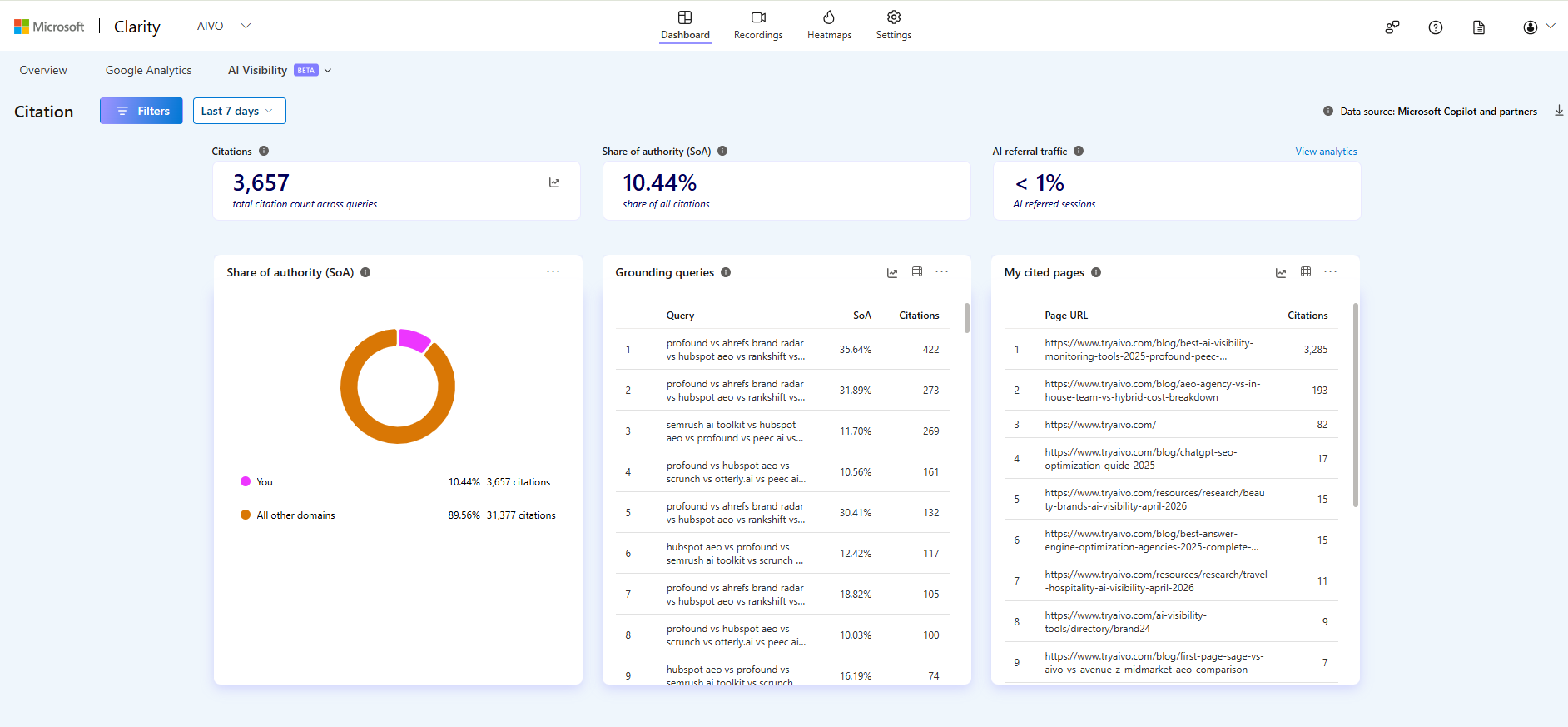
Microsoft Clarity — AI Visibility — Citations dashboard — tryaivo.com — Last 7 days. Showing: 3,657 total citations, 10.44% share of authority, top cited pages breakdown.
We're still in the early data-gathering phase. One week in is a baseline, not a trend. But a baseline is exactly what we didn't have before.
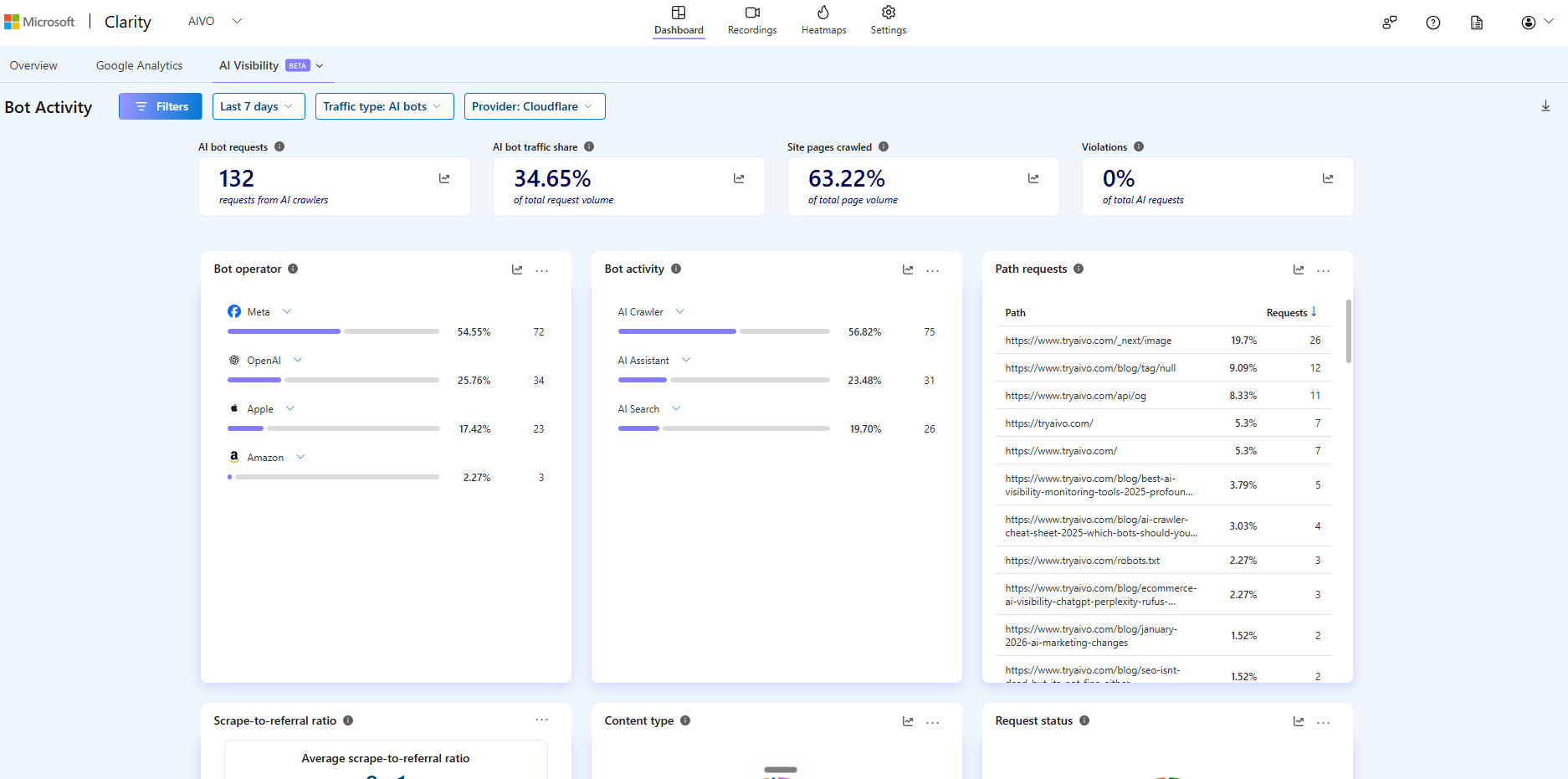
Microsoft Clarity — AI Visibility — Bot Activity dashboard — Provider: Cloudflare — Bot activity: AI Assistant. Showing: OpenAI crawling at 100% bot traffic share, path-level breakdown.
The bot view tells you immediately which AI crawlers are active on your site, how often, and which pages they prioritize. Most brands have no idea. Clarity makes it a one-click answer — and Cloudflare is what makes the path-level breakdown possible.
Why no other tool has this data
Every paid AI visibility tool on the market today — SEMrush, Ahrefs Brand Radar, Profound, Scrunch, Otterly, Peec AI — uses the same fundamental methodology. They send test prompts to AI engines, parse the responses, check whether your brand or URL appeared, and report back.
That's prompt simulation. It's a valid approach. It gives you directional signal across multiple engines. But it has a structural ceiling: you only know about the queries you thought to test. And the answers you get are sampled outputs, not infrastructure-level signals.
Clarity's data doesn't come from test prompts. It comes from Microsoft's actual grounding infrastructure — the retrieval layer that runs underneath Copilot, Bing AI, and ChatGPT's web access. When a real user asks a real question and the AI retrieves real content to answer it, that event is logged. Not a simulation. Not a sample. The actual retrieval record from the system that ran the query.
No third-party tool can buy this data. It doesn't exist in a public API. It lives inside Microsoft's infrastructure. If you want to understand how the paid tools compare — SEMrush, Profound, Scrunch, Otterly — we've broken them down in our AI visibility tools comparison. The only way to access it is to install Clarity and have Microsoft surface the signal for your own verified domain.
That's why this is a no-brainer. The data is structurally inaccessible to every other analytics vendor in the market. It's free. And it's yours the moment you install a script tag, verify your domain, and connect your CDN.
The setup is straightforward if you know what you're doing. If you don't — Webmaster Tools configuration, CDN setup, reading grounding query data correctly and turning it into content action — that's exactly what AIVO is here for. We help brands set up, read, and act on this data across every engine. Start at tryaivo.com.
The coverage gap you need to understand
This dashboard is a Microsoft product tracking a Microsoft ecosystem. That's not a criticism. It's context you need before you act on the data.
If your priority is understanding how ChatGPT and Copilot are citing your brand, Clarity now gives you a free, first-party answer. That's real signal. ChatGPT is the highest-traffic AI assistant in most categories. This data matters.
But there are two distinct gaps to understand before you act on what you see.
The first is engine coverage. Google AI Overviews, Gemini, Perplexity, Claude, Meta AI — none of those appear in this dashboard. For brands that need to audit their full AI footprint across every engine, specialist tools remain the only option.
The second gap is scope, and this one catches most people off guard. Clarity only tracks citations to pages on your own verified domain. If an AI engine cites a YouTube video featuring your brand, a press article about your product launch, a Reddit thread mentioning your company, or a partner blog that references your work — none of that appears here. The dashboard measures your owned content's presence in AI answers. It does not measure your brand's full presence in AI answers.
That distinction matters for how you read the numbers. A strong share of authority in Clarity tells you your own pages are being selected as trusted sources. It does not tell you the full picture of how often AI mentions your brand across the web. For that broader view — owned and earned media, all engines — specialist tools remain the way to get it.
| Capability | GA4 | Microsoft Clarity | Specialist Tools (AIVO etc.) |
| --- | --- | --- | --- |
| AI assistant referral traffic | Yes | Yes | Yes |
| Page-level citation counts | No | Yes (Microsoft ecosystem) | Yes (all engines) |
| Share of authority | No | Yes | Yes |
| Queries AI used to surface you | No | Yes | Yes |
| Win/loss vs named competitors | No | No | Yes |
| Bot-level crawler activity | No | Yes (via CDN integration) | No |
What to do this week
- Install Clarity if you haven't. It's free. The citations dashboard is now reason enough even if you never use session replay. Setup is a single script tag.
- Verify domain ownership via Webmaster Tools. This is the step that actually unlocks citation data. Connect either Bing Webmaster Tools or Google Search Console to your Clarity project. Without it, the dashboard stays empty.
- Connect your CDN provider in Clarity settings. Clarity supports Cloudflare and other CDN providers. This unlocks the Bot Activity view — without it, you get citation data but not crawler-level path detail.
- Pull your first baseline. Look at your share of authority. Look at which pages are getting cited. Look at which queries AI used to find you. Write those numbers down. That's your starting point.
- Need help with setup or interpreting the data? Connecting the tools is one thing. Reading grounding queries correctly and turning them into content decisions is another. That's what AIVO does. Start at tryaivo.com.
Frequently asked questions
What is a grounding query in Microsoft Clarity?
A grounding query is the internal retrieval instruction an AI model generates before fetching web content to answer a user's question. It is not the phrase the user typed. The AI translates user input into a structured query, sends it to its retrieval layer (Bing's index in Microsoft's case), and then synthesizes an answer from the results. The queries you see in Clarity are those internal instructions — a window into how AI systems classify and discover content that has never been visible to brands before.
Which AI engines does Clarity track citations for?
Clarity covers Microsoft's ecosystem: Microsoft Copilot, Bing AI surfaces, and ChatGPT via Bing web grounding. It does not cover Google AI Overviews, Gemini, Perplexity, Claude, or Meta AI. For cross-engine visibility, specialist tools are required.
Do I need to verify my domain to activate AI citation tracking?
Yes. Domain ownership verification is required before citation data populates. You can verify using either Bing Webmaster Tools or Google Search Console inside your Clarity project settings. Without this step, the dashboard is active but citation metrics stay empty.
How do I unlock the Bot Activity view?
Connect a CDN provider — Cloudflare or another supported option — in your Clarity project settings. The Bot Activity dashboard shows which AI crawlers are hitting your site, which pages they prioritize, and whether any robots.txt violations are occurring. Without a connected CDN, you get citation data but not the crawler-level path detail.
What does it mean when my query volume is high but my citation rate is low?
It means your content is entering the AI's retrieval pool but losing the selection decision. The AI found your page and chose someone else. That is a content authority problem — depth, structure, freshness, credibility signals — not a discoverability problem. The fix is on the page, not in the crawl. This is the most actionable signal the dashboard surfaces, and it didn't exist anywhere before Clarity shipped it.
Does Clarity track brand mentions on third-party sites?
No. Clarity only tracks citations to pages on your own verified domain. If an AI engine cites a YouTube video about your brand, a press article, a Reddit thread, or a partner blog, none of that appears in the dashboard. It measures your owned content's presence in AI answers — not your brand's full presence across the web.
How does Clarity compare to GA4 for AI tracking?
GA4 tracks AI referral traffic — sessions that started from an AI assistant. Clarity tracks citation activity — when your pages are referenced in AI-generated answers, including zero-click instances where the AI cited you but no user navigated to your site. GA4 tells you when AI sent someone. Clarity tells you when AI mentioned you, whether or not anyone clicked.
Is Microsoft Clarity's AI citations feature free?
Yes. Clarity is a free analytics product from Microsoft. The AI Citations dashboard is included at no additional cost for all Clarity projects.
How is Clarity different from SEMrush, Profound, or other AI visibility tools?
Every paid AI visibility tool uses prompt simulation — they send test queries to AI engines, parse the responses, and check whether your brand appeared. Clarity's data comes from Microsoft's actual grounding infrastructure, the retrieval layer that runs underneath the AI systems themselves. It is observed data from real user queries, not sampled outputs from test prompts. No third-party vendor can buy or replicate this signal.
What should I do first after installing Clarity?
Verify domain ownership via Bing Webmaster Tools or Google Search Console — this is the unlock step most people miss. Then connect your CDN to enable bot activity tracking. Then pull your first numbers: share of authority, cited pages, top grounding queries. Write them down. That baseline is everything. You cannot measure improvement without it.
The closer
Microsoft built the data layer the industry needed and made it free. That's a significant product decision. It pressures GA4, Adobe, and every other analytics platform to match it. It gives marketing teams a reason to care about citation share in their existing workflow. It makes the metric real for finance teams who need to see it in a familiar dashboard before they'll assign it a budget line.
Google's position creates a specific risk for brands that follow it. If you're optimizing for AI visibility without measuring it, you're flying blind on a channel that's already affecting your traffic. The argument that AEO is just SEO is harder to defend when a competitor just shipped six metrics that prove the gap is measurable.
The brands that set a baseline now will have 18 months of trend data when everyone else is still figuring out what to track.
Microsoft showed up with the dashboard. The next move is yours.
---
Author: Sebastian Pinzon is Co-Founder of AIVO, the AI Visibility Intelligence Platform. After 15+ years in digital marketing at Publicis, WPP, and Omnicom, he helps mid-market brands measure and improve their presence across ChatGPT, Perplexity, Google AI Overviews, and Claude.
Connect on LinkedIn | tryaivo.com


