AEO Isn't "Just SEO": Why Google Is Half-Right in 2026
Google's Search team says llms.txt is irrelevant. Their Chrome team added it to Lighthouse the same week. That contradiction tells you everything about where AEO is actually heading.
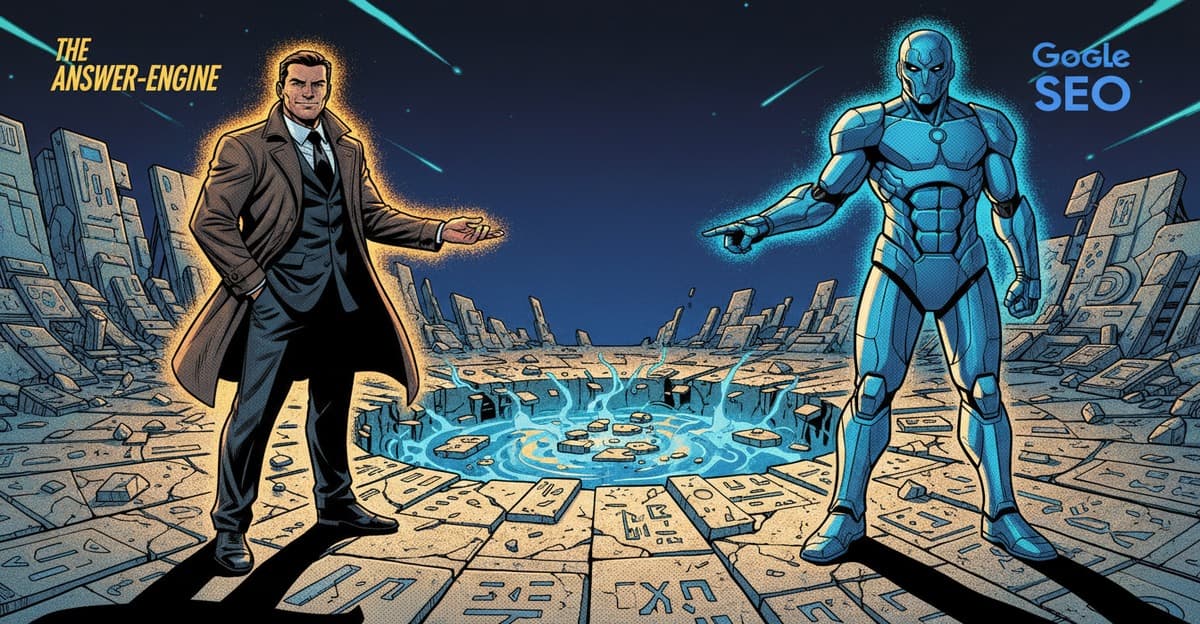
AEO Isn't "Just SEO" — Why Google Is Half-Right About AI Search in 2026
Google's Search team published a guide this month saying you don't need llms.txt for AI Search visibility. Days later, the Chrome team added llms.txt to Lighthouse as an agentic readiness check. Same company. Same week. Opposite guidance. That contradiction is the most important signal in the AEO vs SEO debate — and it tells you exactly where this is heading.
We track AI citation share for brands across ChatGPT, Perplexity, Gemini, Claude, and Google AI Overviews. If you want to understand where your brand stands, AIVO can show you.
📋 TL;DR
- Google's Search Central guide says llms.txt is irrelevant for AI features. Google's Chrome team added it to Lighthouse the same week for agentic readiness. Two teams. Two products. Two different answers.
- There are now two optimization games: AI Search (AEO + SEO editorial layer) and the Agentic Web (where llms.txt matters for agents completing tasks on your site).
- Google I/O 2026 messaging: "Google Search is AI Search." AI Mode hit 1B users. AI Overviews hit 2.5B. They're now one seamless experience.
- AEO and SEO share the same foundation. The editorial layer is genuinely different. Google is right about the first part. Wrong about the second.
- The brands assuming both games are the same game will lose on both channels.
The contradiction Google didn't explain
Google's Search Central team published its May 2026 guide on optimizing for generative AI features. It listed five things you don't need: llms.txt files, content chunking, AI-specific rewrites, inauthentic mentions, excessive schema. The message was clear. Stop worrying about special AI files.
Days earlier, Google's Chrome team shipped Lighthouse 13.3 with a new experimental Agentic Browsing category. One of its audit checks: whether llms.txt exists at your domain root. The documentation explains why: without it, agents may spend more time crawling the site to understand its high-level structure and primary content.
Search Engine Journal confirmed the split: Google Search says llms.txt isn't needed for AI features, while Lighthouse now checks it for agentic browsing readiness. Google hasn't commented on the documentation gap between the two product teams.
This isn't contradictory. It's a reveal.
Game 1 is AI Search. AI Overviews, AI Mode, ChatGPT, Perplexity, Claude. Citation visibility. For this game, llms.txt does nothing. What matters is editorial structure: direct-answer leads, standalone paragraphs, FAQ sections, question-phrased headings. The AEO layer.
Game 2 is the Agentic Web. AI agents completing tasks, navigating sites, making purchases, retrieving information autonomously on behalf of users. For this game, llms.txt is the efficient handshake. HTML is noisy for AI agents — navigation, ads, and tracking scripts burn through the model's context window before it reaches useful content. The file gives agents a clean, low-token map of your site.
Google is building both products simultaneously. Their Search team is answering questions about Game 1. Their Chrome team is building infrastructure for Game
- The brands that conflate them will be unprepared for both.
What Google I/O 2026 confirmed
Google's official I/O 2026 messaging was three words: "Google Search is AI Search." Not a feature. The product.
AI Overviews crossed 2.5 billion monthly active users. AI Mode surpassed 1 billion monthly active users in just a year, with query volumes more than doubling every quarter. AI Overviews and AI Mode are now one seamless experience — users can flow from a question to an AI Overview to a follow-up in AI Mode, with context carrying throughout. Information Agents are now live — AI agents that operate in the background 24/7, monitoring topics and tasks on behalf of users.
If Search IS AI Search, then the editorial requirements for appearing in Search are the editorial requirements for AI citation. That's not the same as ranking for ten blue links. Google validated the AEO premise on stage while the optimization guide tried to dismiss it in print.
Why Google is half-right
Google's May 2026 AI Optimization Guide argues that the same crawling, indexing, and ranking signals that power traditional search also power AI Overviews and AI Mode. On the technical foundation — crawlability, authority, schema — Google is correct. You can't do AEO without doing SEO well first.
The editorial layer is where it breaks down.
SEO content is optimized to be ranked — picked from a list of ten blue links. The reader clicks, scrolls, and engages with the page. AEO content is optimized to be quoted — lifted verbatim by an AI engine into an answer the user never clicks back from. The model reads it. The user doesn't see the page.
Three editorial moves diverge from SEO: direct-answer leads in the first 80 words, standalone paragraphs readable without surrounding context, and FAQ-structured sections the model can lift directly. None of these hurt SEO. All three are required for AI citation. That's the part Google is glossing over.
There's also a data problem with "just do SEO." Across AIVO's research on AI engine citations, in 2025 roughly 76% of AI Overview citations came from the top-10 Google organic results for the same query. By Q1 2026, that had dropped to 38%. More than half of AI citations now come from sources outside the top-10. The model is making its own trust judgments. A site optimized purely for ranking is already losing the citation surface.
Calling AEO "just SEO" is like calling mobile "just web." Technically true. Strategically the gap that kills you if you ignore it.
Frequently asked questions
Is AEO the same as SEO?
They share the same technical foundation — crawlability, authority, schema. The editorial requirements diverge. SEO optimizes to be ranked. AEO optimizes to be quoted verbatim by an AI engine in an answer the user never clicks back from.
Should I add an llms.txt file to my site?
For AI Search visibility (AI Overviews, AI Mode, ChatGPT citations), the file makes no difference. For AI agent readiness — agents that browse and complete tasks on your site — the file is a useful navigation handshake that reduces the token cost of agent exploration. Google's own Lighthouse now audits for it under Agentic Browsing. It's low effort and future-proof. Add it.
What did Google I/O 2026 mean for SEO and AEO?
Google confirmed that AI Search is now the primary surface, not a feature. AI Overviews and AI Mode merged into one experience. Information Agents launched — background agents monitoring topics 24/7. If the product is AI Search, optimizing for it requires the AEO editorial layer. Google's I/O keynote made the AEO argument stronger, not weaker.
Why is my SEO performing well but my AI citation share is declining?
Citation gravity has decoupled from PageRank. More than half of AI citations now come from sources outside the top-10 Google organic results for the same query. AI engines make their own trust judgments. A page ranked #1 can lose the citation slot to a lower-ranked but better-structured competitor.
How do I measure AI citation share?
GA4 tracks AI referral sessions — clicks from AI assistants. It does not track citations, including zero-click instances where AI quoted your page but no user visited. For citation share across ChatGPT, Perplexity, Gemini, Claude, and Google AI Overviews, you need a specialist tool. AIVO tracks this across all major engines using a proprietary methodology.
The closer
Google is right that AEO needs SEO as its foundation. It's wrong that SEO is sufficient. AEO sits inside a larger AI search ecosystem—six layers from crawl access to recommendation and measurement.
The llms.txt contradiction tells you why. The Search team is managing one product. The Chrome team is building another. Two optimization games are running simultaneously, and the guidance brands are receiving only covers one of them.
The brands that win in 2026 run both layers — the editorial discipline for AI citation, and the technical readiness for the agentic web. Neither is optional. And both are different from what Google's optimization guide is telling you to do.
If you want to know where your brand stands on the citation surface right now — across ChatGPT, Perplexity, Gemini, Claude, and Google AI Overviews — that's exactly what AIVO measures.
---
Author: Sebastian Pinzon is Co-Founder of AIVO, the AI Visibility Intelligence Platform. After 15+ years in digital marketing at Publicis, WPP, and Omnicom, he helps mid-market brands measure and improve their presence across ChatGPT, Perplexity, Google AI Overviews, and Claude.
Connect on LinkedIn | tryaivo.com


