Google AI Mode: What the Data Means for Brands (10 Takeaways)
Google published a year of AI Mode usage. Read for brands: the query is now a conversation, and the model—not the search box—decides who gets named.
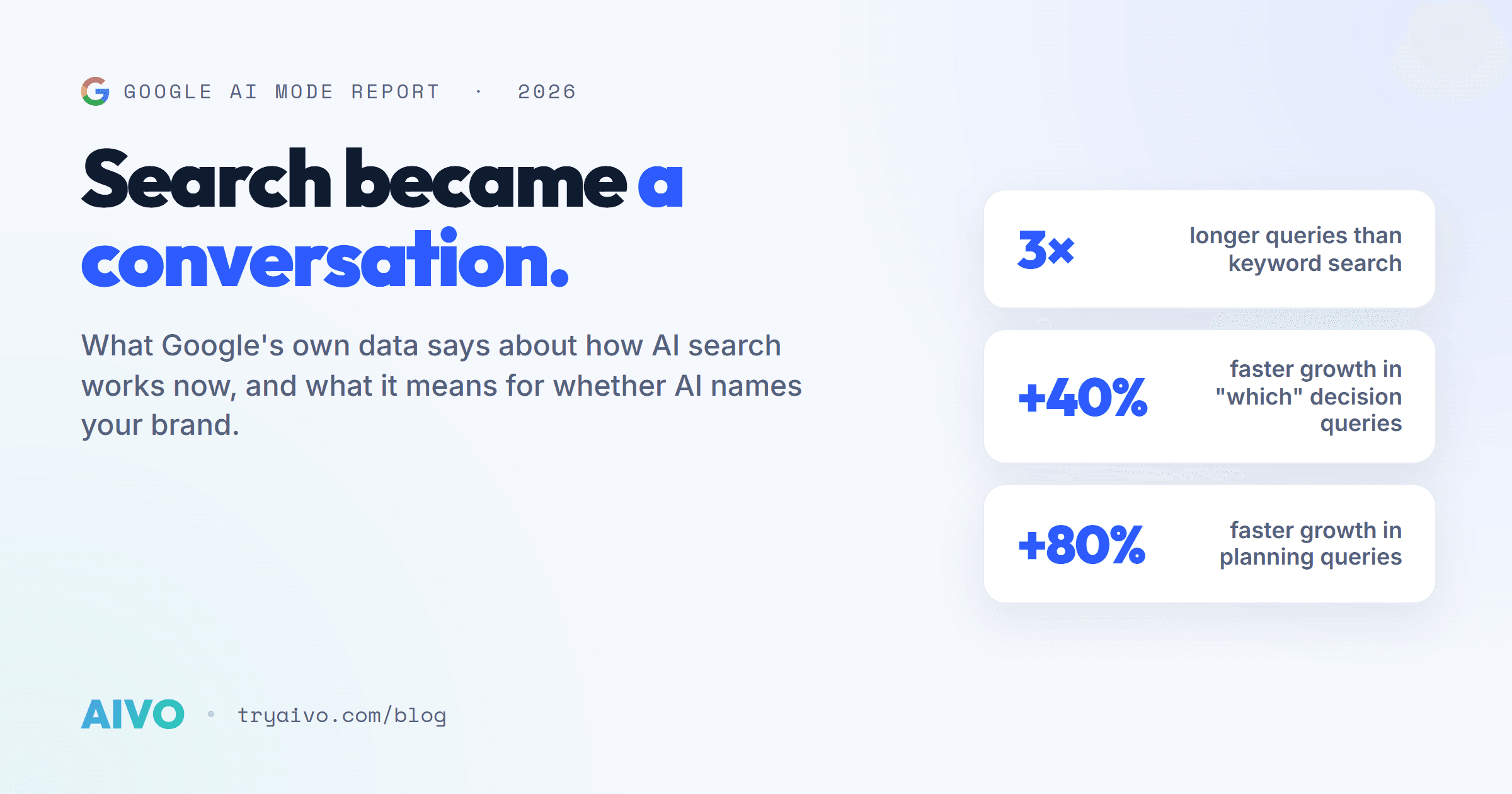
Search Became a Conversation: 10 Takeaways from Google AI Mode
Google published a year of AI Mode usage. Read for brands, it says one thing ten ways: the query is now a conversation, and the model, not the search box, decides who gets named.
In May 2026, Google shared how people used AI Mode in its first year in the U.S. It is Google's own data, drawn from a Trends sample, so read the growth rates as direction rather than precise volume. But the direction is unambiguous, and most of the report is not really about Google. It is about how people now ask, decide, and buy, and that is a brand problem long before it is an SEO one.
At AIVO (AI Visibility Optimization) we track what ChatGPT, Gemini, Google AI Overviews, Perplexity, and Claude say about brands every day. Here is what Google AI Mode's numbers mean for whether the answer names you.
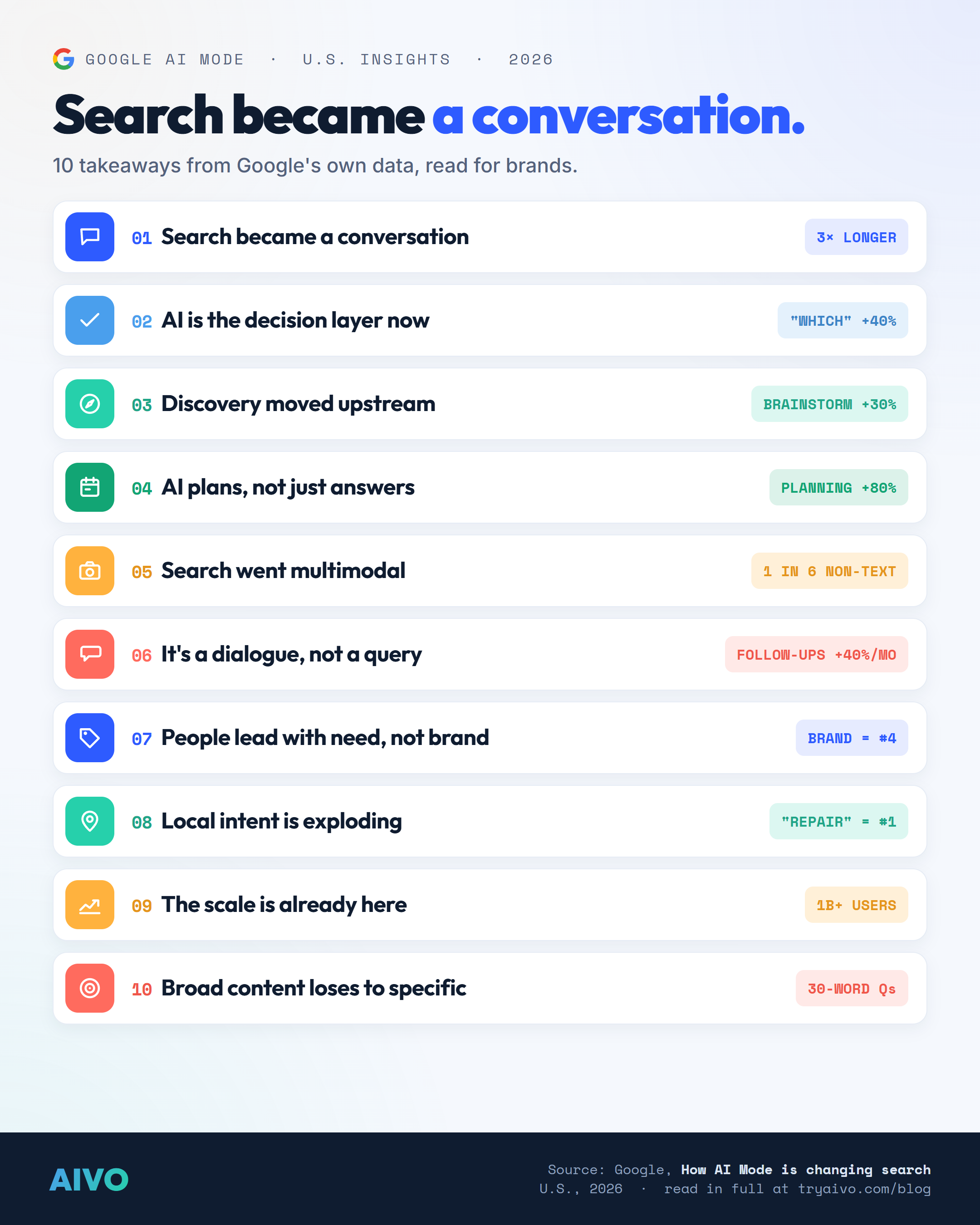
📋 TL;DR
- Average AI Mode queries are 3x longer than traditional search; people ask full questions, not keywords.
- "Which" decision queries grew 40% faster than AI Mode overall—the model chooses, it does not just list.
- Brainstorming (+30%) and planning (+80%) moved discovery and itineraries upstream into the answer.
- More than one in six queries are non-text; image-input search is growing 40%+ month over month.
- Follow-ups grew 40%+ per month—you must survive the whole conversation, not one answer.
- Shoppers lead with need (price, location, color) before brand; the model supplies the brand.
- Local and commercial intent is exploding; Google Business Profile grounds what the model says.
- AI Mode passed a billion monthly users and has more than doubled every quarter since launch.
- Broad content loses; specific, citable answers win citations.
- Measure per engine against the questions your buyers actually ask.
1. Search became a conversation
The average AI Mode query is three times the length of a traditional search, and the top opening words are what, how, and I. People stopped compressing thoughts into keywords and started asking the full question. For a decade, brands optimized for the three-word phrase. The model is now reading the paragraph.
Takeaway: write for the question a person actually asks, not the keyword they used to type.
2. AI is the decision layer, not the lookup layer
Queries starting with which grew 40 percent faster than AI Mode overall in six months, led by which of and which one. People are not asking where to find options. They are asking the model to choose between them. That is the exact moment being recommended beats being cited, because the model names a pick, and it does not recommend who you think. Anthropic's Economic Index shows the same pattern on Claude: search is the top work task people give AI, and product recommendations rank third.
Takeaway: the comparison query is the new shelf. Win the which, or watch a competitor get named.
3. Discovery moved upstream, into the answer
Brainstorming queries grew 30 percent faster than AI Mode overall, and openers like where to and ideas for are climbing. People come to explore before they know what they want. The top of the funnel now happens inside the answer, where a brand is either part of the consideration set or absent from it.
Takeaway: if you only show up for high-intent queries, you missed the part where the shortlist got built.
4. AI plans, it does not just answer
Planning queries grew 80 percent faster than AI Mode overall, whole itineraries, schedules, and budgets, not single facts. The model is doing the work a brand's website and a human researcher used to do. Your brand is either a component of that plan or it is not in the room.
Takeaway: be structured enough that the model can slot you into a plan it assembles.
5. Search went multimodal
More than one in six AI Mode queries are non-text, and image-input search is growing more than 40 percent month over month. People point a camera and ask. Your brand now has to be legible to an image and a voice query, not only a string of text.
Takeaway: recognition is no longer only textual. Products, packaging, and storefronts are queries now.
6. It is a dialogue, not a query
Follow-up questions grew more than 40 percent per month. The first answer is not the end, it is the opening of a back-and-forth where the model narrows the field turn by turn. Every turn is another chance to be added or dropped.
Takeaway: you are not optimizing for one answer. You are trying to survive the whole conversation.
7. People lead with need, not brand
When shopping in AI Mode, the attributes people give the model rank price, location, color, and only then brand at number four. They describe the problem, and the model supplies the brand. If you are not the pick, the buyer never typed your name, which is why AI representation is now a CMO problem, not only an SEO one. Our Beauty Representation Report found the same: presence and recommendation are different races.
Takeaway: buyers describe the need. Make sure the model fills the blank with you.
8. Local and commercial intent is exploding
The single most common thing people ask when a query starts with where should I is repair a car, and near me tops the list of store follow-ups. AI is now discovering and dispatching local demand in real time. For local businesses, the Google Business Profile grounds what the model says, and getting it right decides whether you make that shortlist.
Takeaway: local discovery moved into the assistant. Your reviews and profile are the entry ticket.
9. The scale is already here
AI Mode passed a billion monthly users and has more than doubled every quarter since launch. This is not a pilot to watch. It is a channel already carrying the behavior above at scale, which is why teams are moving it from experiment to line item.
Takeaway: the behavior shift is not coming. It is this quarter's traffic.
10. Broad content loses to the specific answer
Queries got longer and more specific, and the model answers by quoting whoever said the specific thing. A leading solution gives it nothing. Cut audit time from six hours to nine minutes gives it something to cite. A decade of SEO trained brands to write broad enough to catch every keyword; AI search rewards the opposite, and it is a large part of why AEO is not just SEO.
Takeaway: the safest, most committee-approved sentence on your page is the one no model will ever repeat. Say the specific thing.
What this means for your brand
Read together, Google's numbers describe a single shift: discovery, comparison, and decision now happen inside one conversation, and the model does the choosing. The old funnel gave you three touchpoints to be remembered. The answer gives you one chance to be named. None of the old work is wasted, reviews, authority, and structured content still decide the outcome, but the surface they feed has changed, and it has to be measured per engine against the truth. That is the demand half of AI marketing in 2026—the part most teams still do not staff. Sponsored units in AI Mode are real, but they are opt-in inventory from existing campaigns, not a placement you can target or buy to become the recommendation—the same pattern holds on ChatGPT, Amazon, and Walmart. If you do not know how AI answers the questions your buyers actually ask, that is the place to start.
Book a meeting and we will map your category across all five engines.
FAQ
Q: What is Google AI Mode? A: AI Mode is Google's AI-native search experience, powered by its Gemini models, that answers questions conversationally instead of returning a list of links. Google reported it passed one billion monthly active users within a year of its U.S. launch.
Q: How is AI search changing the way people search? A: Google's own data shows queries are now three times longer than traditional search, phrased as full questions, with fast growth in decision (which), planning, brainstorming, and multimodal (image and voice) queries. People ask the model to compare and choose, not just to find links.
Q: Why does this matter for brands and not just SEO? A: Because when people describe a need instead of naming a brand, the model supplies the brand. Being recommended inside the answer is a brand and reputation outcome, not a keyword ranking, and it has to be measured per engine, since each AI engine reads a different slice of the web.
Q: Is Google's AI Mode data reliable? A: It is directional. The figures come from Google's own internal and Trends data and are reported as relative growth, not absolute volume, and Google is describing its own product. The trends are consistent with what independent AI-visibility measurement shows, but the specific numbers should be read as direction. You can read Google's original report directly.
Q: What should brands do about it? A: Optimize for the specific questions buyers actually ask, earn the sources AI trusts in your category, keep your entities and reviews accurate, and measure how often each engine names you. Answer engine optimization is how brands get cited and recommended inside AI answers.
Key Takeaways
- Write for the full question people ask, not the three-word keyword they used to type.
- Win comparison and "which" queries—being recommended beats being cited.
- Show up upstream in brainstorming and planning, not only at high intent.
- Survive the multi-turn conversation; the first answer is only the opening.
- Buyers lead with need; make sure the model fills the blank with your brand.
- Treat local profile and reviews as entry tickets; measure visibility per engine.
Author: Sebastian Pinzon Duran is Head of Discovery at AIVO, the strategic AI visibility consultancy. He helps marketing leaders measure how ChatGPT, Gemini, Perplexity, Claude, and Google AI name their brands—and what Google's own AI Mode data means for whether the answer names you.
Related Articles
Reddit's ChatGPT Citations Fell 86%. It Happened Before and It Came Back.
Is AI Advertising Illegal? What You Actually Have to Disclose in 2026