AI Marketing in 2026: The Full Picture (and the Half That Wins Clients)
Most AI marketing is about producing more and running leaner. The bigger shift, the one almost nobody measures, is that AI is now where your customers discover, perceive, and choose you.
AI Marketing in 2026: What It Is, and the Half Most Teams Are Missing
Most AI marketing is about producing more and running leaner. The bigger shift, the one almost nobody measures, is that AI is now where your customers discover, perceive, and choose you. Here is the full picture, and the part that actually brings in clients.
Ask a marketing team how they use AI and you hear the same list. How do we make more content. How do we produce video. How do we make it not look AI. Then the operational half: how do we sharpen targeting, and how do we automate the busywork so the team can spend time on higher-value work.
All of that is real, and all of it matters. But notice what it has in common. Every item is about doing the job you already have faster and cheaper. It is the supply side of marketing: produce more, spend less.
Almost nobody is working on the other half. AI is now the layer where customers find brands, form an opinion, and decide. Google's own data shows the average AI search is three times longer than a keyword search, more than one in six queries are already voice or image, and comparison questions that start with "which" are growing 40 percent faster than everything else. People are asking AI to choose for them, and the model answers by naming a few brands.
That is not a productivity tool. That is your new storefront. And it can bring you clients or hand them to a competitor, usually without you ever seeing it happen.
At AIVO (AI Visibility Optimization) we measure what ChatGPT, Gemini, Google AI Overviews, Perplexity, and Claude say about brands every day. Here is the full landscape of AI marketing in 2026, and why the half that wins customers is the half being ignored.
📋 TL;DR
- AI marketing in 2026 splits into supply (produce more, run leaner) and demand (get discovered and recommended inside AI answers).
- Most teams have staffed the supply side; the same models and tools make that race table stakes, not an edge.
- The demand side is where customers find, perceive, and choose brands—and almost nobody measures it.
- Engines disagree, citation is not recommendation, and fluent wrong answers shape perception before a human reaches you.
- Start by measuring per engine, fixing absence and wrong descriptions, and earning the sources AI trusts in your category.
What AI marketing actually means in 2026
AI marketing is any use of artificial intelligence to grow a brand. In practice it splits into two jobs, and most teams have only staffed the first.
The supply side is AI that helps you make and operate: generate content, produce creative, model audiences, automate workflows. It makes the team faster.
The demand side is AI that decides whether customers find and choose you: how you are discovered, described, compared, and recommended inside AI answers. It decides whether the team has customers to serve.
The first is a cost story. The second is a growth story. This guide covers both, but spends its weight where the opportunity is.
The supply side: where everyone already is
This is the AI marketing most people mean, and it is worth doing well.
Content and creative. Models draft copy, blogs, and scripts, and generate or edit video and images. The frontier has moved from "can AI write this" to "can anyone tell it did," which is why so much effort now goes into making AI output not read as AI.
Efficiency and operations. AI sharpens targeting through lead scoring and audience modeling, and automates the repetitive work of campaign ops so the team can focus on strategy and craft. It also runs the customer-facing layer now, on-site chatbots and voice agents that field routine questions.
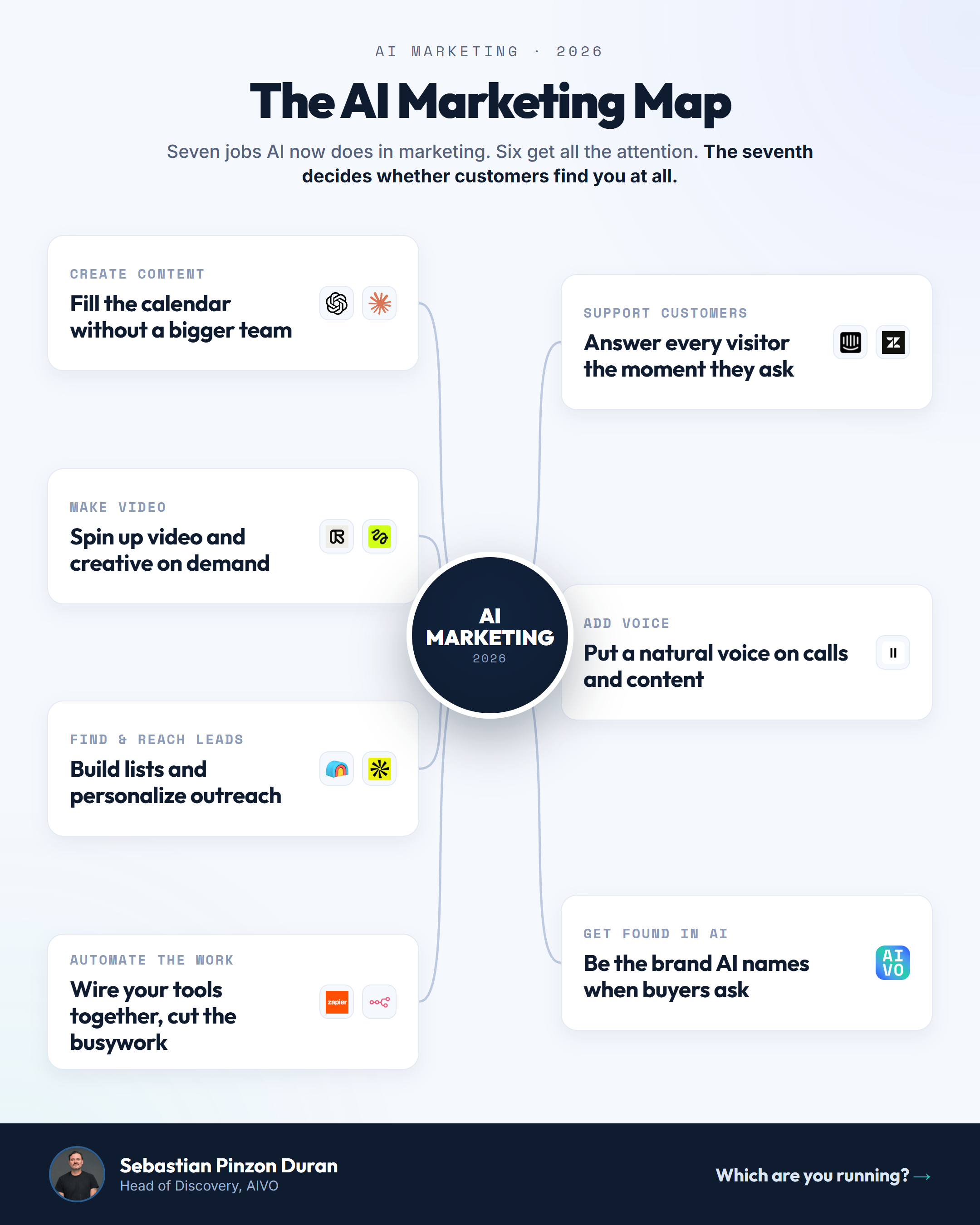
Here is the stack most teams are assembling:
| Category | What it does | Example tools |
| Content generation | Drafts copy and creative | ChatGPT, Claude |
| Video and creative | Generates and edits video | Runway, Higgsfield |
| Find & reach leads | Builds lists, personalizes outreach | Clay, Apollo |
| Automation and workflow | Wires your tools together | Zapier, n8n |
| Customer service | On-site chat and support | Intercom, Zendesk |
| AI voice | Voice on calls and content | ElevenLabs |
| AI visibility | Measures how AI represents your brand | AIVO |
The demand side: the half that wins clients
This is the half almost nobody is working on, and it is where AI is redistributing demand.
Discovery moved into the answer. Your customers increasingly start with an assistant, not a search bar, and they act on the paragraph that comes back. The brands named in that paragraph get the consideration. The ones that are not may as well not exist for that buyer. This is the AI search ecosystem, and getting named in it is answer engine optimization, which is not the same as SEO.
The engines disagree with each other. There is no single "AI answer." Ask five engines the same question and you can get five different brand lists. In our beauty representation study, one brand appeared in 22 percent of ChatGPT's answers and 9 percent of Claude's, with confidence bands that do not overlap. A blended "we're doing fine in AI" number hides the engine where you are invisible.
Being named is not being recommended. An engine can cite your page and still recommend a competitor. Presence and recommendation are two different races, and recommendation is the one that moves revenue.
AI shapes perception before a human reaches you. The model does not just point to your brand, it describes it, and it can be fluent, confident, and wrong. We have watched engines state outdated certifications and stale facts as current. That answer is forming your customer's opinion of you, which makes AI representation a brand and reputation problem, not only an SEO task. For the practical take on hearing that answer the way you already do social listening—across engines, over time, with enough samples—see Social Listening Isn't Enough Anymore.
Put together, this is how AI actually brings you clients: by making you the brand it discovers, trusts, and names. That is demand, not cost, and it is the half sitting unmanaged.
Measuring the half nobody measures
You cannot manage what you cannot see, and this is where most teams are blind. AI-sourced customers arrive without a clean label, so they get filed under direct or organic and the channel looks smaller than it is. The first move is to see the AI channel in GA4 and separate it from the noise. From there, measure visibility per engine rather than as one blended score, and track it against the traffic the open web is quietly losing to zero-click answers.
What to do now
Keep the supply-side wins. Faster content and leaner ops fund the team's time, and you should take that time.
But put someone on the demand side, because right now almost no one has. Three moves to start:
- Measure how AI represents you today, per engine, across the questions your buyers actually ask. You cannot fix what you have not seen.
- Find where you are absent, out-ranked, or described wrong, and treat the wrong descriptions as urgent. A confident error spreads.
- Earn the sources the engines trust in your category. AI answers are built from earned media, reviews, and third-party authority, not your homepage.
What this means for your brand
The AI marketing conversation is stuck on the factory: how to make more, faster, cheaper. That work is real, but it is a race everyone runs with the same tools. The advantage is on the other side, in the channel AI just created, where discovery and decisions now happen and almost no one is measuring the outcome. The teams that pull ahead treat AI not only as a way to produce marketing, but as the place their customers now find and choose them.
If you do not know how AI describes and recommends your brand today, that is where to start. Book a meeting and we will map your category across all five engines.
FAQ
Q: What is AI marketing? A: AI marketing is the use of artificial intelligence to grow a brand. It covers two areas: the supply side, using AI to produce content and run marketing operations more efficiently, and the demand side, being discovered, described, and recommended inside AI-generated answers where customers now search and decide.
Q: How is AI changing marketing in 2026? A: On the production side, AI drafts content, generates video, sharpens targeting, and automates workflows. The larger change is on the discovery side: people increasingly ask an AI assistant instead of searching, and the assistant names a few brands as the answer. Google's data shows AI queries are three times longer than keyword searches and rising fast in voice, image, and decision queries.
Q: Is AI marketing just using ChatGPT to write content? A: No. Content generation is one part, and the most commoditized one. The higher-value question is whether AI engines discover and recommend your brand when customers ask, which is a different discipline called answer engine optimization.
Q: How do I measure AI marketing results? A: Separate AI-referred traffic in GA4 so it is not hidden under direct or organic, track how often each AI engine names and recommends your brand per engine rather than as one blended score, and tie both to conversions. Attribution is the hardest part because AI often influences a decision without a trackable click.
Q: What is the difference between AI marketing and answer engine optimization? A: AI marketing is the whole field, including content, automation, and analytics. Answer engine optimization is the specific practice of getting your brand cited and recommended inside AI answers. It is the demand-side half that most AI marketing coverage skips.
Key Takeaways
- Staff both halves of AI marketing: supply (content and ops) and demand (discovery and recommendation inside AI answers).
- Supply-side tools are table stakes; they cut cost but do not, alone, win new customers.
- Demand is redistributed when assistants name a few brands; measure that per engine, not as one blended score.
- Citation is not recommendation, and a fluent wrong answer is a brand problem.
- Measure how AI represents you, fix absence and errors, and earn the third-party sources engines trust.
Related Articles
Reddit's ChatGPT Citations Fell 86%. It Happened Before and It Came Back.
Is AI Advertising Illegal? What You Actually Have to Disclose in 2026