Social Listening Isn't Enough: What AI Says About Your Brand
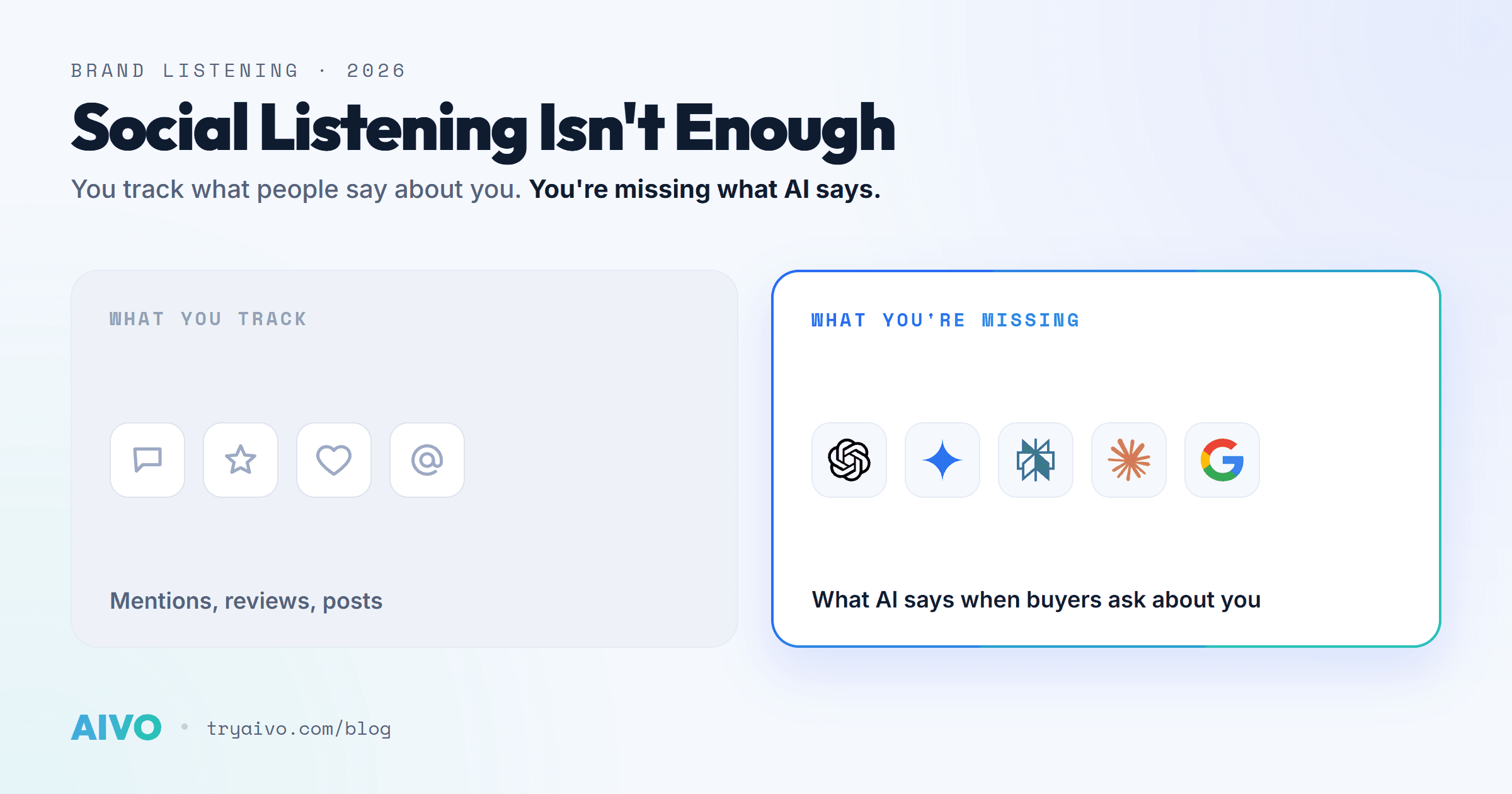
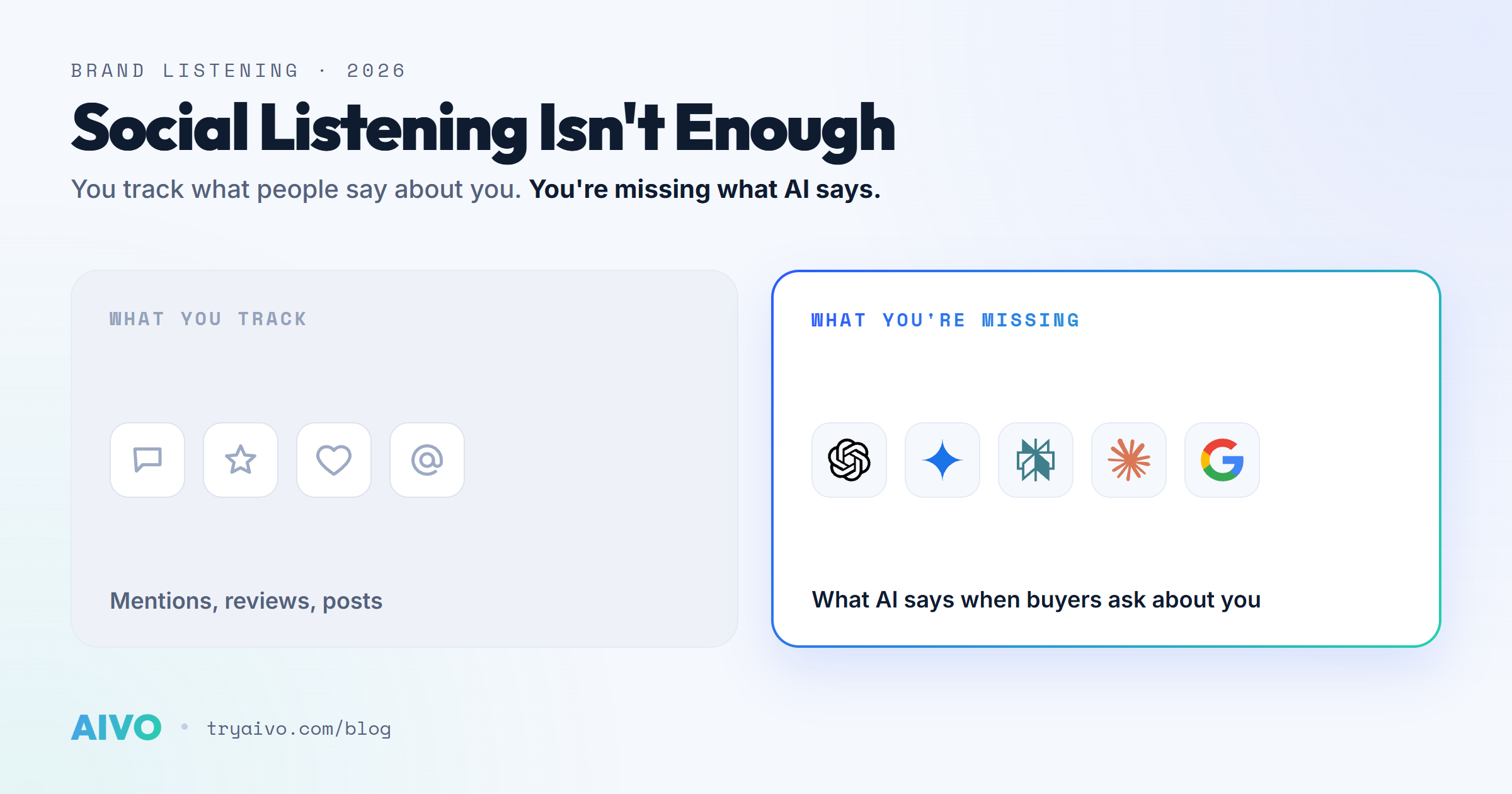
You track what people say about you on social. Customers are asking AI about you too—and trusting the answer. Here is how to hear it.
Social Listening Isn't Enough Anymore: What AI Says About Your Brand
You know what people say about you on social. But your customers are asking AI about you too, and trusting the answer. Almost nobody is listening to that.
📋 TL;DR
- Customers ask AI about your brand before they reach you, and they trust the paragraph that comes back.
- That answer is built mostly from sources you do not own—reviews, Reddit, press, comparisons—not your marketing site.
- Social listening now has a second half: what ChatGPT, Gemini, Perplexity, Claude, and Google AI say about you.
- Engines disagree, answers drift over time, and a single check is noise—you need samples across engines, repeatedly.
- Earn mentions where AI looks, keep facts consistent, and treat "what AI says about us" as a metric you track.
AI is already talking about you
Ask AI a question in your category and it doesn't hesitate. It names a few brands. In our research, AI names specific companies in about 72% of unbranded questions, usually around four per answer.
Here is the uncomfortable part: it builds that answer from sources you don't own. Reviews, Reddit threads, press, comparison posts, even your competitors' pages. Only about half of what AI cites comes from anything the brand controls.
So the story AI tells about you is assembled from the internet's read on you, not from your marketing.
This is a reputation problem, not a search problem
This is where it stops being an SEO task and becomes a brand one, which is exactly why it has landed on the CMO's desk and not the webmaster's. The AI's answer is a first impression. It decides whether a buyer even considers you before they see your site, your ad, or your team.
And it can be confidently wrong. We have watched engines describe brands with stale certifications and discontinued products, stated as current, in a calm and authoritative voice. A buyer has no reason to doubt it.
You would never let a false review sit on your Google profile. This is the same thing, except it is the default answer, and you can't see it unless you go looking.
Why your usual playbook doesn't fix it
The instinct is to publish more or add schema markup. Both mostly miss.
A 2026 test that added structured data to pages found no meaningful change in how often AI cited them. The results ranged from -4.6% to +2.4%. Basically noise. AI is not reading your markup and deciding to recommend you. It is reading what the rest of the web says about you, which is a big part of why answer engine optimization is not the same as SEO.
More content on your own site doesn't move it much either, because your site is only half the picture, and often the half AI trusts least.
The new social listening
So how do you actually listen to this? Three things, and the third is the one people skip.
Listen across engines. ChatGPT, Gemini, Perplexity, Claude, and Google's AI do not agree. Ask the same question and you can get a different brand list on each. In our beauty study, one brand appeared in 22% of ChatGPT's answers and just 9% of Claude's. A single "we're doing fine in AI" number hides the engine where you are invisible.
Listen over time. The answer drifts. Sources change, models update, and what AI said last month may not be what it says today.
Listen enough times. This is the part most people miss. Ask AI about your brand once and you get one answer. Ask again tomorrow and it can be different: different brands, different framing. One check is a snapshot of noise. When we ran the same question over and over, only about a quarter of the brand mentions repeated. To get a real read you have to ask across every engine, and enough times to see the pattern instead of the fluke.
That last point is why you can't eyeball this once a quarter. It is not a vibe check. It is measurement.
What to do about it
You can't fully control what AI says. But you can shape it, and you can watch it.
- Earn mentions where AI looks. The reviews, the reputable press, the community threads, the comparison sites. That is the raw material AI reads.
- Keep your facts straight everywhere. Consistent, current, provable claims across the web lower the odds AI repeats something wrong about you.
- Watch it like a metric. Per engine, over time, sampled enough to trust. Treat "what AI says about us" as a number you track, not a thing you check when someone panics.
We wrote a longer, deeper piece on why this shift is happening and why it is structural, not a passing trend: The Interpretation Economy. This is the practical version.
Book a meeting and we will show you what AI says about your brand across all five engines.
FAQ
Q: What is AI social listening? A: AI social listening is tracking what AI answer engines like ChatGPT, Gemini, Perplexity, Claude, and Google AI say about your brand when customers ask, the same way traditional social listening tracks what people say on social media. Because buyers increasingly ask AI before they decide, the AI's answer shapes your reputation before anyone reaches your site.
Q: How is it different from regular social listening? A: Regular social listening watches human posts and mentions. AI social listening watches machine-generated answers that are assembled from many sources, differ per engine, and drift over time. It also requires sampling: a single AI answer is unreliable, so you have to ask repeatedly to get a true read.
Q: Can I just check what ChatGPT says about my brand myself? A: You can look once, but one answer is noise. Ask again and it can change, and each engine says something different. A reliable read needs many samples across engines over time, which is a measurement problem, not a one-off check.
Q: Does schema markup help my brand show up in AI? A: Barely. A 2026 test found adding structured data changed AI citation rates by -4.6% to +2.4%, which is statistically insignificant. AI reads what the wider web says about you far more than your own markup.
Q: How do I improve what AI says about my brand? A: Earn mentions in the sources AI trusts (reviews, reputable press, community threads, comparison sites), keep your facts consistent and current across the web, and monitor what each engine says, per engine and over time, so you catch errors early.
Key Takeaways
- Social listening now includes what AI says about your brand—not only what people post on social.
- AI answers are first impressions assembled from sources you mostly do not control.
- Schema and more owned content alone do not fix how AI describes you.
- Listen across engines, over time, and with enough samples that one answer is not noise.
- Earn the sources AI trusts, keep facts consistent, and track AI reputation like a metric.
Related Articles
Reddit's ChatGPT Citations Fell 86%. It Happened Before and It Came Back.
Is AI Advertising Illegal? What You Actually Have to Disclose in 2026