Anthropic Economic Index 2026: What People Actually Use AI For
Anthropic's Economic Index maps Claude conversations to job tasks across 121 countries. Biggest findings: search and recommendations—most brands aren't ready.
What People Actually Use AI For, According to Anthropic's Own Data
Anthropic's Economic Index maps anonymized Claude conversations to real job tasks across 121 countries. The two biggest findings are about search and recommendations, and most brands are not ready for either.
Every debate about AI at work runs on anecdotes. The Anthropic Economic Index replaces them with data: anonymized Claude conversations matched to the job tasks they perform, published openly under CC BY 4.0. The May 2026 snapshot covers 121 countries, all 50 US states plus Washington, D.C., and over 700 occupations.
At AIVO we track what ChatGPT, Gemini, Google AI Overviews, Perplexity, and Claude say about brands every day, so we went through the full dataset. These are the findings that matter if you run a brand, plus one that should come as a relief.
📋 TL;DR
- The number one work task people give AI is search—not coding or writing.
- The third biggest task is asking for product and service recommendations.
- Nearly half of AI conversations are full delegation; the person sees only the answer.
- Content creation beats software development as the largest request topic worldwide.
- Adoption is real but shallow: habits are forming now, which is when AI answer positions get decided.
1. The number one work task people give AI is search
Not coding. Not writing. Search.
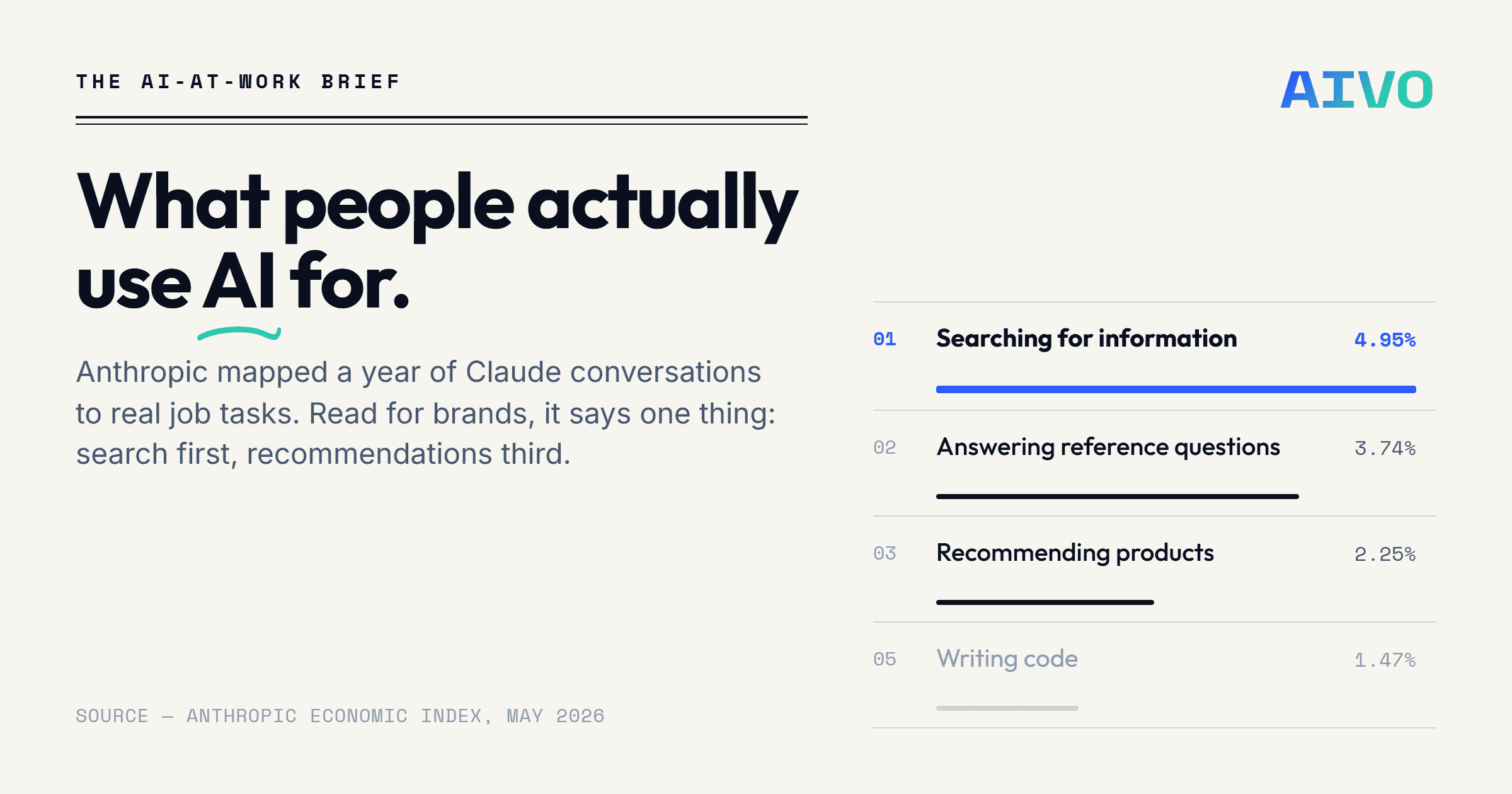
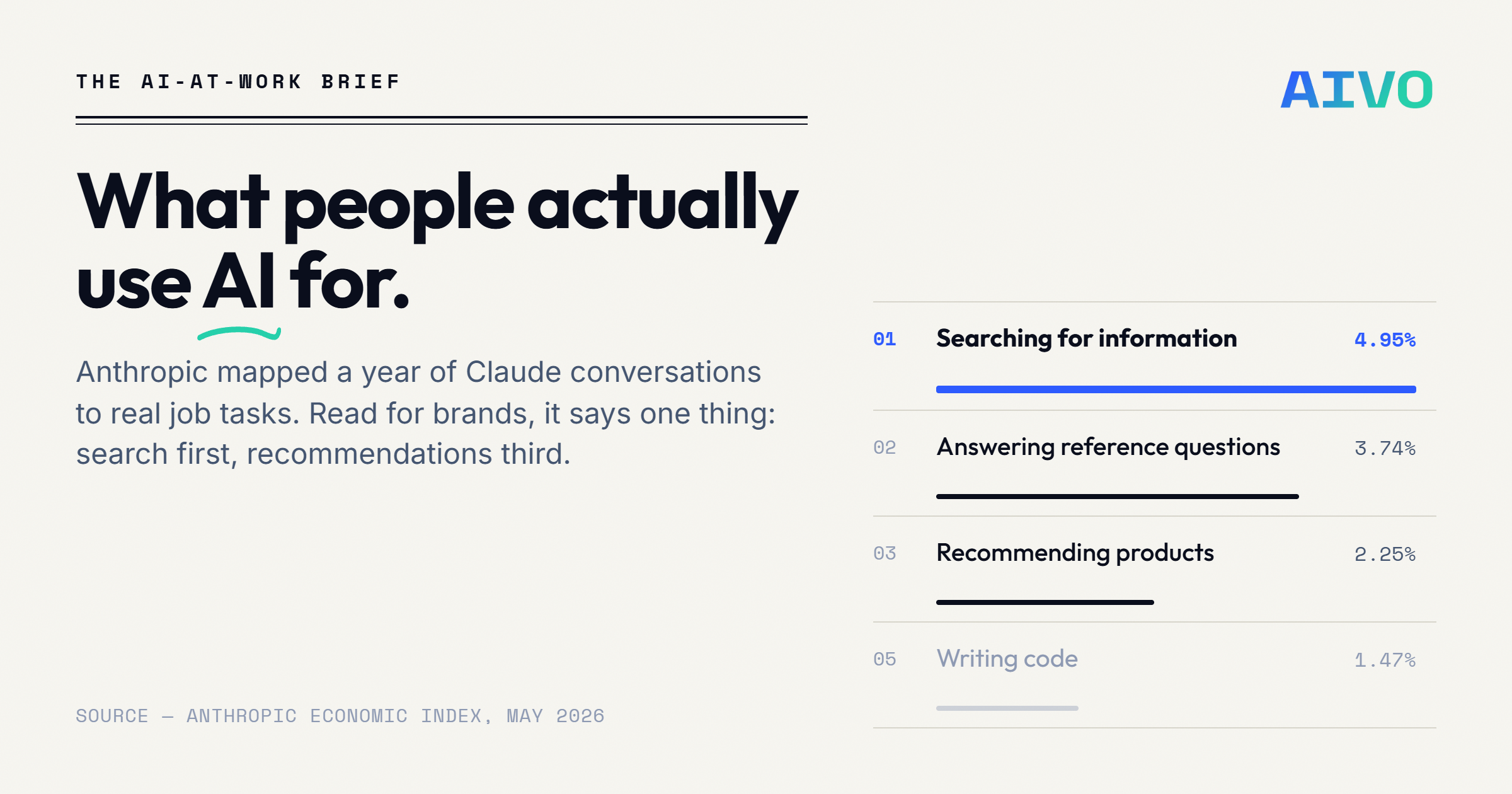
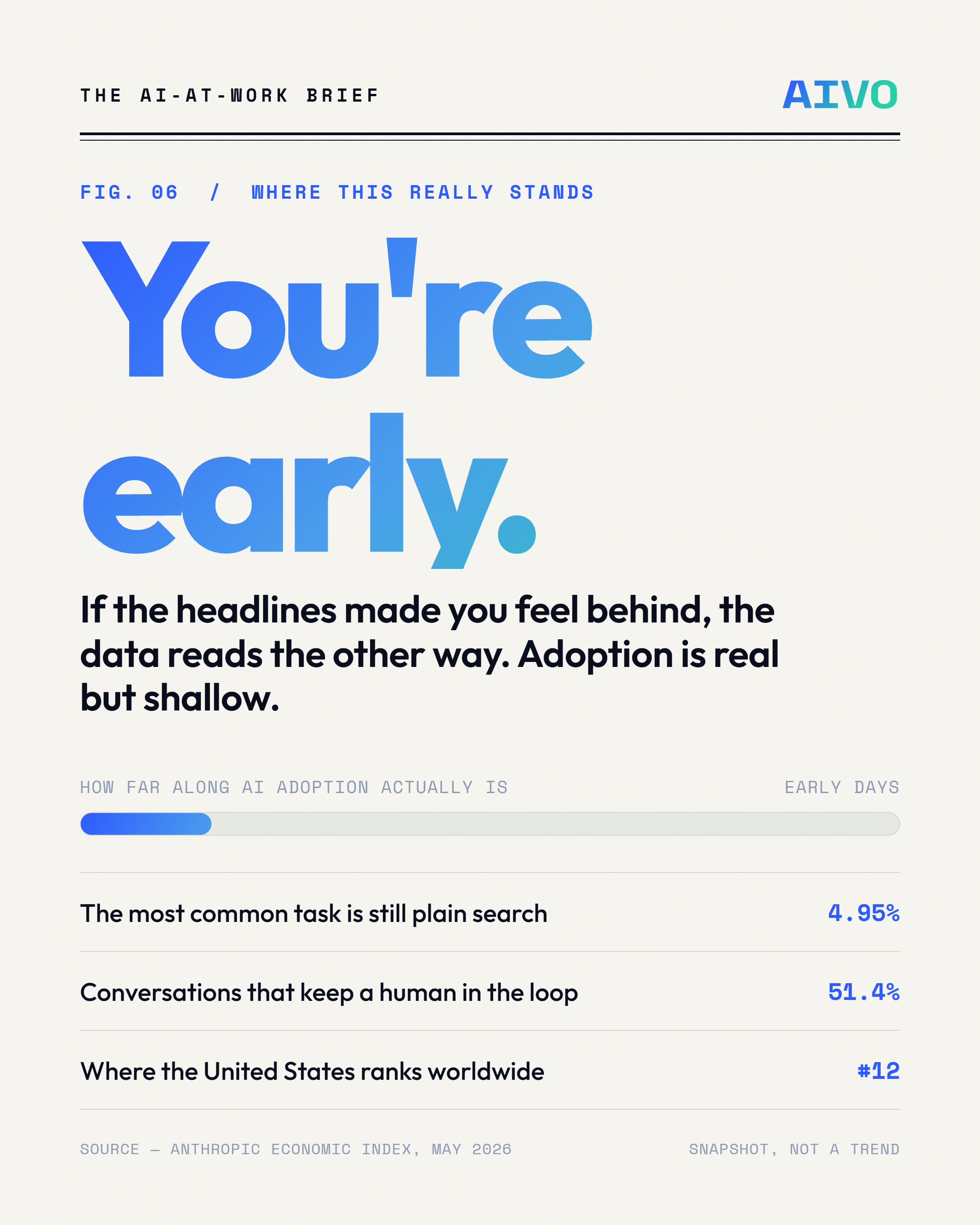
The most common work task in the dataset is "search electronic sources, such as databases or repositories, or manual sources for information" at 4.95 percent of sampled conversations. The second most common is answering reference questions using online sources, at 3.74 percent. Together they run almost six times the share of the top coding task, writing programs, which sits fifth at 1.47 percent.
The single biggest job people give AI is the job they used to give a search engine.
Takeaway: AI assistants already work as the front door to information. The queries did not disappear. They moved.
2. The third biggest task is asking for recommendations
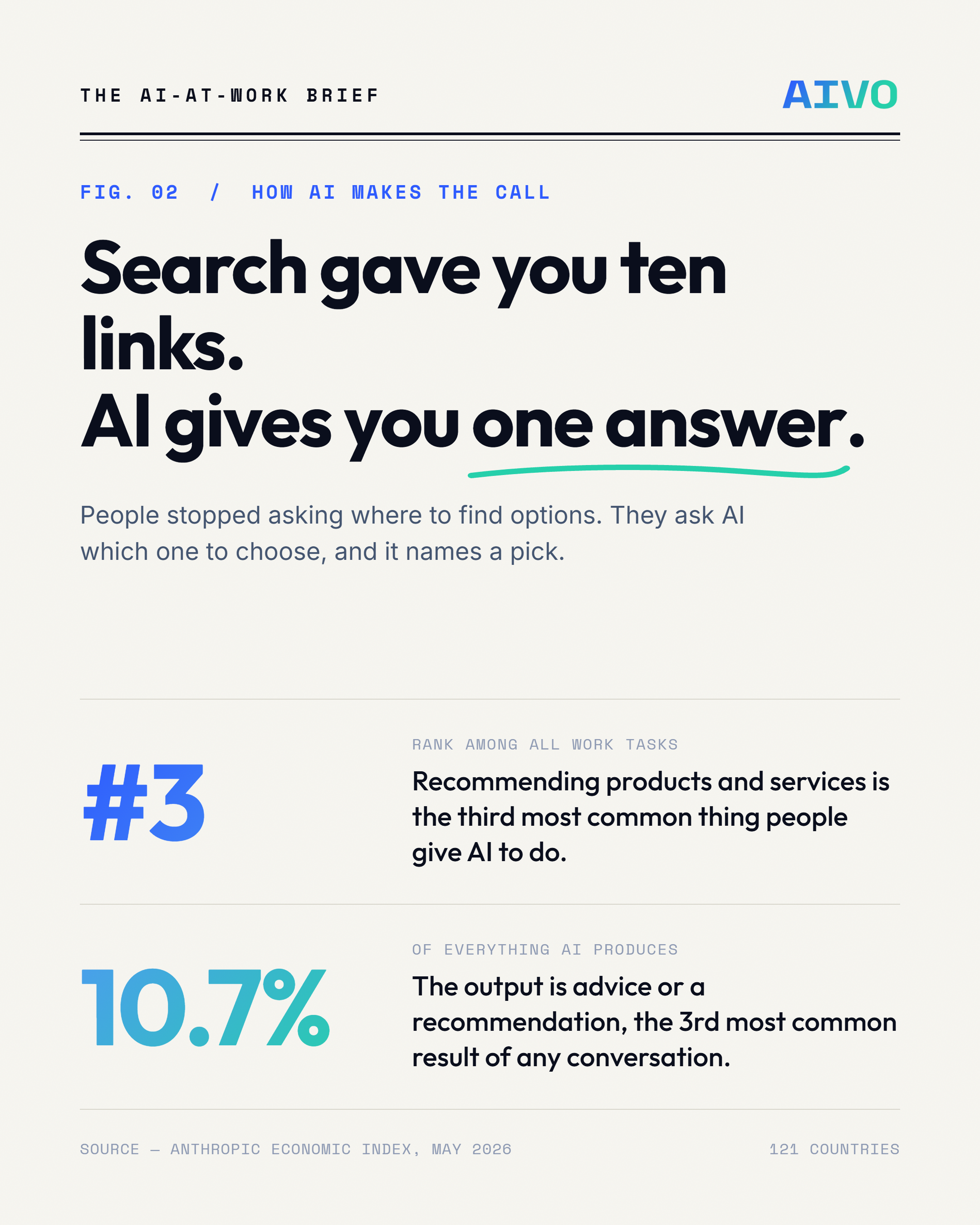
Ranked third: "recommend and provide advice on a wide variety of products and services" at 2.25 percent. Financial advice ranks seventh. Product recommendations based on customer needs rank eighth. And when Anthropic classifies what conversations produce, "advice or recommendation" is the third most common output at 10.7 percent.
A pattern forms. People ask AI to find things, then ask it what to choose. Google's own AI Mode data shows the same behavior: decision queries growing 40 percent faster than search overall. Two engines, two datasets, one conclusion, and the model does not recommend who you think.
A search engine returned ten links and let the user decide. An AI assistant returns one answer.
Takeaway: product and service recommendations are now a native AI behavior, at global scale, measured by the AI company itself.
3. Half of AI use is already delegation
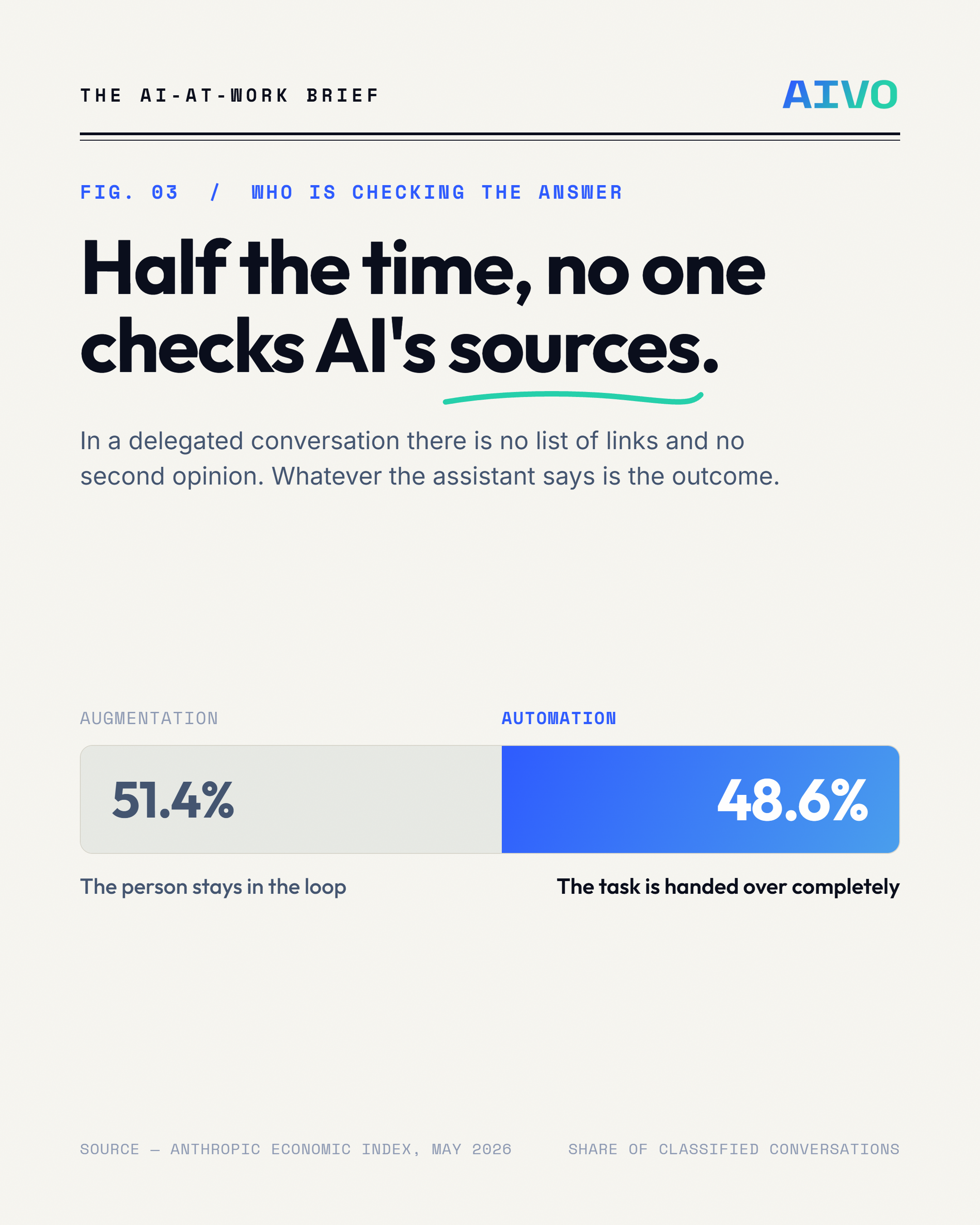
Anthropic classifies each conversation as augmentation (the person stays involved) or automation (the person hands the task over). The global split: 51.4 percent augmentation, 48.6 percent automation.
Nearly half of AI work conversations are not a human asking for help. They are a human delegating the task entirely, including the research and the shortlist. When the task is delegated, nobody double-checks the sources, which is why being recommended beats being cited. The answer is the outcome.
Takeaway: in half of AI conversations, whatever the assistant says about a brand goes unchallenged.
4. Content beats code
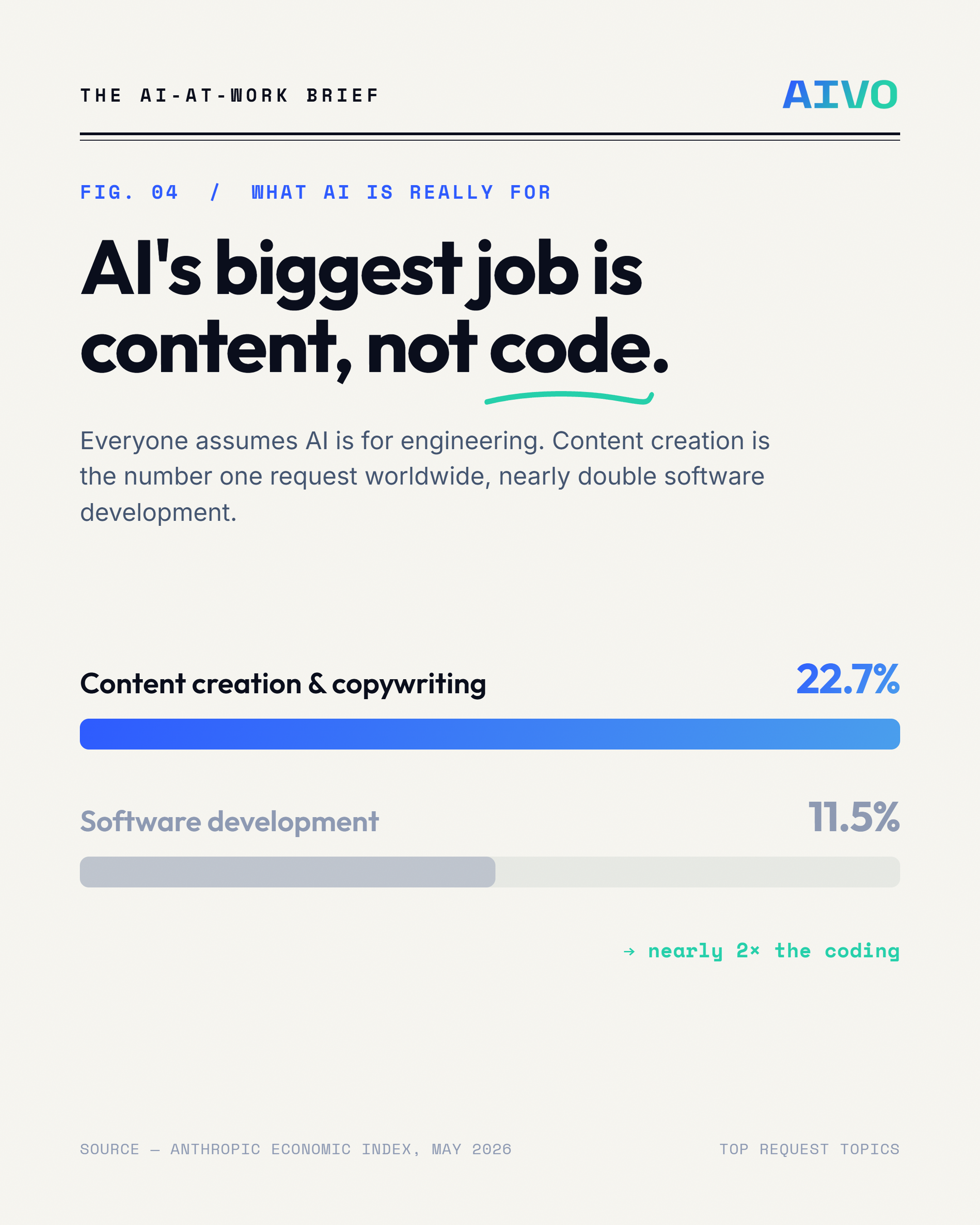
Ask most executives what AI is for and they say engineering. The data disagrees.
Content Creation and Copywriting is the largest request topic worldwide at 22.7 percent of conversations. Software Development is 11.5 percent. Add Education and Learning (13.2 percent) and Research and Intelligence (10.9 percent), and the picture is clear: the biggest AI workload on earth is producing, learning from, and retrieving content.
That same content is the raw material AI engines use to answer questions about your brand, which is why what gets cited is a content decision long before it is a technical one.
Takeaway: AI's main job is content, and content is what AI answers are built from.
5. AI compresses hours into minutes
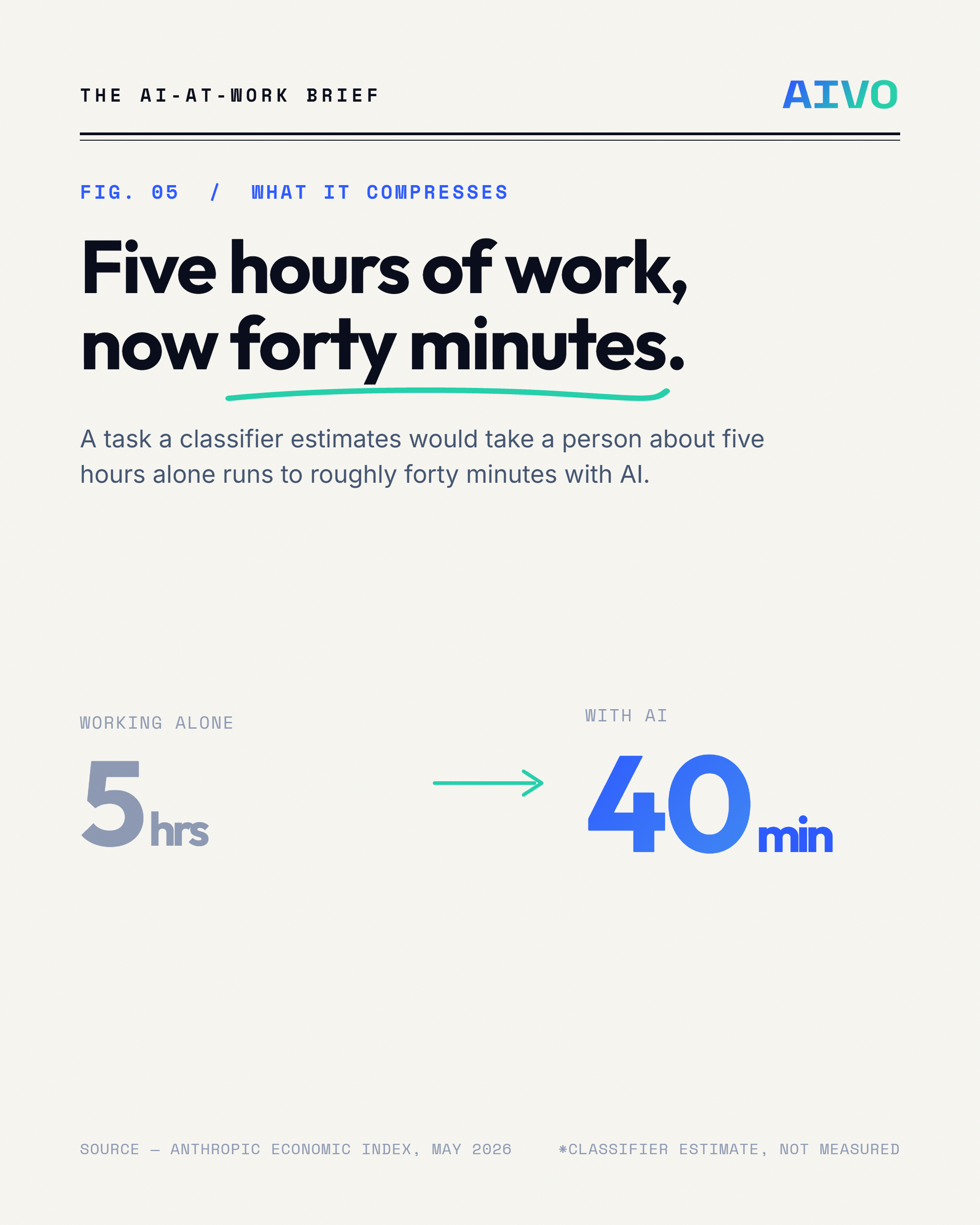
Anthropic's classifier estimates that a task which would take a person about five hours working alone runs to roughly forty minutes of conversation with AI. These are automated estimates, bucketed by order of magnitude and not measured times, but the direction is the point: AI collapses the distance between a question and a finished answer.
That compression is why discovery, comparison, and decision increasingly happen in a single sitting instead of across a week of open tabs. The faster the answer arrives, the more weight rides on whatever the AI names inside it.
Takeaway: the gap between asking and deciding is shrinking to minutes, and whatever the assistant surfaces in those minutes is what gets chosen.
6. The data says you are early
If the last year of AI headlines made you feel behind, the dataset reads the other way.
The most common work task people give AI is plain search, the simplest possible use. Half of conversations still keep the human in the loop. Many of the world's most populous economies sit below the global usage average, and the country ranked first still indexes at only 6.4 times its population share.
Adoption is real but shallow. Almost nobody has AI figured out, including the markets that talk about it the most.
Takeaway: the habits are forming right now, which is exactly when positions inside AI answers get decided. Early is an advantage only if you use it.
What this data cannot tell you
Three limits worth being honest about, because most coverage of this dataset ignores them.
It covers Claude only. No ChatGPT, no Gemini, no Perplexity, no Google AI Overviews. Claude's audience skews professional, and the consumer assistants publish no equivalent data at all.
It measures conversations, not people. Tasks are matched from conversation content, so it says nothing about jobs, employment, or displacement.
It is a snapshot, not a trend. One period, no growth claims.
Here is the uncomfortable part: this is the only AI company publishing usage data at this granularity, and even this best-available dataset shows search and recommendations on top. On the engines bigger than Claude, brands are flying blind, which is why AI representation has to be measured per engine.
Takeaway: treat the Index as the clearest available window into AI behavior, not the whole view. The whole view does not exist publicly.
What this means for your brand
Put the findings together. The top work task people give AI is searching for information. The third is asking for recommendations on products and services. Nearly half the time, the task is fully delegated and the person sees only the answer.
Your buyers are running discovery inside AI assistants, and the assistant compresses the entire funnel into a single response. Being present, accurate, and cited in that response is the discipline of answer engine optimization, and it is a brand problem before it is an SEO one. Similarweb's 2026 AI search data shows what that recommendation is worth commercially: AI-named brands see more visits, but most of the lift arrives as branded search—a demand channel, not a referral click. It starts with knowing what AI engines currently say about you, which most brands have never checked.
Book a meeting and we will show you how the five engines answer the questions your buyers actually ask.
FAQ
Q: What is the Anthropic Economic Index? A: An open dataset published by Anthropic that maps anonymized Claude conversations to job tasks and occupations across 121 countries. It measures observed AI usage, not employment. Data is published under CC BY 4.0 at anthropic.com/economic-index.
Q: What do people use AI for the most? A: By work task, searching for information ranks first. By topic, Content Creation and Copywriting leads at 22.7 percent of conversations, ahead of Software Development at 11.5 percent.
Q: Which countries use Claude the most relative to population? A: Australia (6.4 times its working-age population share), Singapore (5.8), and Switzerland (5.0). The United States ranks twelfth.
Q: How much AI usage is automation versus augmentation? A: 51.4 percent augmentation, where the person stays involved, versus 48.6 percent automation, where the task is delegated to the AI, per the May 2026 snapshot.
Q: Does the Anthropic Economic Index cover ChatGPT or Gemini? A: No. It covers Claude conversations only. No equivalent public dataset exists for ChatGPT, Gemini, or Perplexity, which is why brands measure their AI visibility per engine instead.
Key Takeaways
- Search is the top AI work task; recommendations rank third—discovery and choice now live inside assistants.
- Nearly half of conversations are full delegation, so the answer often goes unchallenged.
- Content creation outweighs coding as the largest request topic; content is also what AI answers are built from.
- The Index is Claude-only, conversations not people, and a snapshot—not the whole multi-engine picture.
- Habits are still forming; measuring what AI says about your brand per engine is the place to start.
Source: Anthropic Economic Index, May 2026 snapshot, CC BY 4.0.
Related Articles
Reddit's ChatGPT Citations Fell 86%. It Happened Before and It Came Back.
Is AI Advertising Illegal? What You Actually Have to Disclose in 2026