What Similarweb's 2026 AI Search Data Means for Brands
AI-recommended brands get 2.5x more visits—but 55.9% arrives as branded search. Why AI search is a brand awareness channel, and how to measure it.
What Similarweb's 2026 AI Search Data Means for Brands
The stat everyone is sharing: AI-recommended brands get 2.5x more visits. The part they skipped: most of it arrives as branded search. AI search is behaving like a brand awareness channel, and brand teams already know how to measure those.
Similarweb published its 2026 Generative AI Landscape and a companion Brand Visibility Index, and one number is doing the rounds: brands recommended by AI get more than twice the visits of the ones that are not. True, and important. But read as a marketer, the report says something more specific, and more useful, than the headline everyone is repeating.
📋 TL;DR
- AI-recommended brands see about 2.5x more visits within seven days—but Similarweb estimates 55.9% of that traffic arrives via branded search, not AI referral clicks.
- AI search behaves like a brand awareness channel: the recommendation plants the name; branded search cashes it in.
- The TV lift playbook half-transfers: AI drives branded search like television, but without a synchronized airing to attribute backward.
- Measure share of voice per engine over time, then connect it to branded search and site engagement—not single-prompt screenshots.
- Winning the recommendation is half the job; owning your branded SERP and homepage is the other half.
1. The number everyone is sharing, and the one they are not
Similarweb found that a brand recommended by ChatGPT was 2.5 times more likely to get a site visit within seven days than a competitor that was not named. The AI Landscape report puts the range at two to four times across finance, travel and beauty.
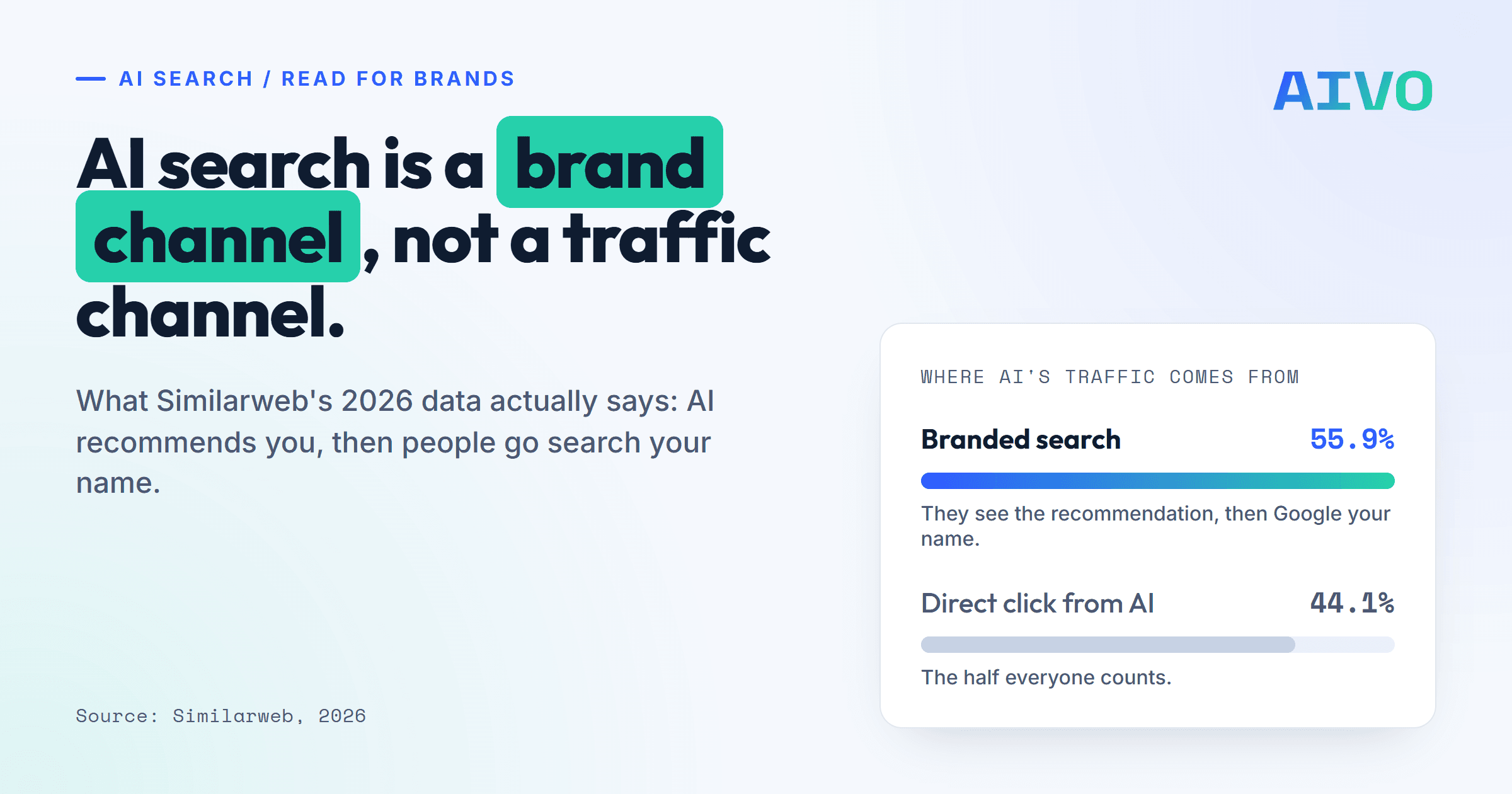
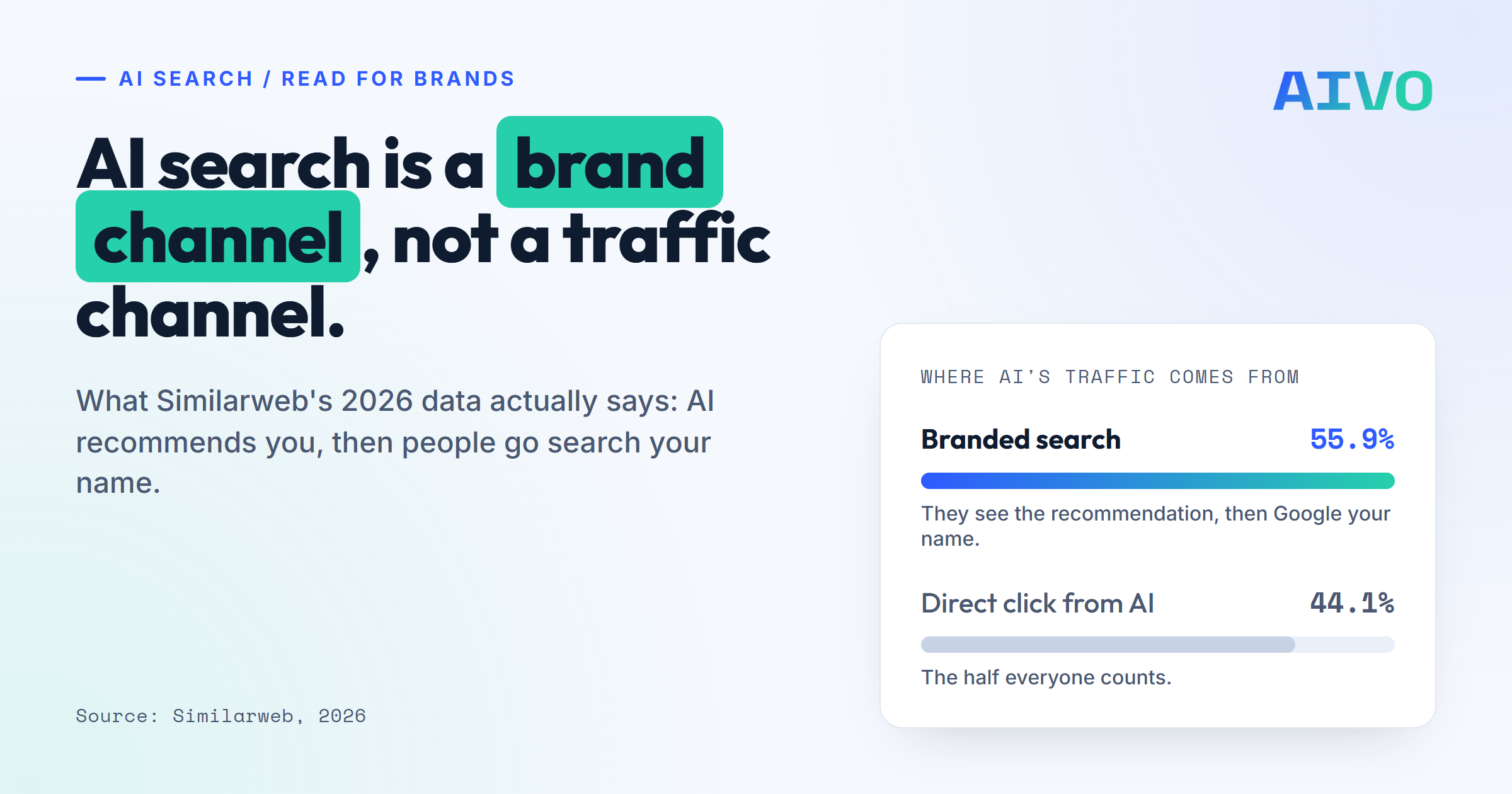
Here is the part that changes the story. According to Similarweb's data, 55.9 percent of that traffic came from branded search. People did not click a link inside the AI answer. They read the recommendation, left, and typed the brand name into Google.
Takeaway: the lift is real, but it does not arrive the way most teams are measuring for. It arrives as demand, not as a click.
2. AI does not send you clicks. It sends you to Google.
This reframes what AI search actually is. If more than half the impact shows up as a branded search that happens somewhere else, then AI is not functioning as a traffic channel at all. It is functioning as a demand channel. The recommendation plants the name. The search cashes it in.
That also explains why AI referral traffic looks so small in analytics while its influence feels much larger. Most brands are counting the clicks that come directly from AI, which is the smaller half, and missing the branded search it created, which is the larger half and usually gets filed under organic or direct.
Takeaway: if you judge AI search by its referral traffic, you are measuring the wrong half and concluding it does not matter.
3. We have seen this before. It was called television.
A channel that builds awareness, does not earn the click itself, and shows up later as a spike in people searching your name: brand marketers have measured exactly this for decades. It is television.
Rand Fishkin made the connection inside the Similarweb report: "This data is a near-replica of how advertisers in the 20th Century measured the impact of billboards, TV, and radio advertising using lift in store visits or sales." He is right, and the measurement industry he is describing already exists. Companies like iSpot and EDO built their businesses on one mechanic: a spot airs, and they measure the lift in branded search and site visits in the window right after, then attribute it back to the ad. Nobody ever expected the TV itself to be clickable.
AI search behaves the same way. The engine names you, and the lift shows up as branded search minutes or days later.
Takeaway: AI search is not a new performance channel. It is a new brand channel, and brand channels have always been measured by lift, not clicks.
4. Where the television comparison breaks
Television had one thing AI search does not: an airing. One ad reaches millions of people at the same moment, on a known network, at a known time. That synchronized spike is what makes TV measurable. Run a spot, and the branded-search bump in the minutes after is clean enough to attribute to it.
AI search has no airing. Every recommendation is a private, one-to-one conversation, personalized, unlogged, and spread across millions of separate moments with no shared timestamp. There is no spike to catch, because there was never a broadcast. And the message is not even fixed: the same question can name different brands to different people, or to the same person twice.
That is the real measurement problem, and it is why the TV playbook only half transfers. You cannot wait for the lift and attribute it backward, because the impression that caused it is invisible. AI search drives branded search like television, but it is delivered like word of mouth, one to one and off the record.
Takeaway: you cannot measure a channel you never see air. So you stop trying to catch the spike and start measuring the source.
5. Which makes this a CMO problem, not an SEO one
Once you see AI search as a brand channel, the right vocabulary is the one brand teams already use.
Share of voice. Kevin Indig, in the same report, argues share of voice is the metric that matters in AI because "users focus on brand mentions instead of clicking on sources. Visibility is success." Share of voice has measured brand presence since the era of print and broadcast. AI just gave it a new surface: the share of answers in your category that name you.
Mental availability. When a buyer asks an assistant for the best option in your category, you are either one of the brands it can readily recall or you are absent from the set. That is mental availability, the same idea brand managers have optimized for since long before AI, now being decided inside a model instead of inside a memory. Google's own AI Mode data shows the same shift from the query side: decision and "which" questions are where the shortlist forms.
Takeaway: the discipline is not new. The surface is. This is a brand problem before it is an SEO one.
6. The trap: you can create the demand and still lose it
A branding channel that works through branded search comes with a specific risk. You can earn the recommendation and still fail to capture it.
If AI sends a buyer to Google to look you up, three things decide whether that demand becomes yours: whether your branded search result is strong, whether your homepage converts the arrival (Similarweb found 58.8 percent of AI-driven traffic lands on homepages), and whether a competitor is bidding on your name to intercept the buyer you just earned. Create the demand and neglect any of the three, and you hand the result to someone else.
Takeaway: winning the recommendation is half the job. Owning your name the moment they search it is the other half.
7. So how do you measure a brand channel
Since you cannot observe the impression, you measure the input. That means sampling the engines continuously to estimate your presence, rather than waiting for a spike that carries no timestamp.
Start with share of voice per engine: how often each assistant names you in your category, tracked over time, not from a single prompt. Fishkin's own research notes that AI returns different brands on repeated identical queries, so any single answer is noise. Sustained presence is the signal. Then connect that visibility to the downstream: branded search volume, direct and organic-brand traffic in GA4, and the quality of that traffic. Similarweb found AI-influenced branded visitors browsed far more pages and stayed far longer than other sources, though that is correlation, not proof.
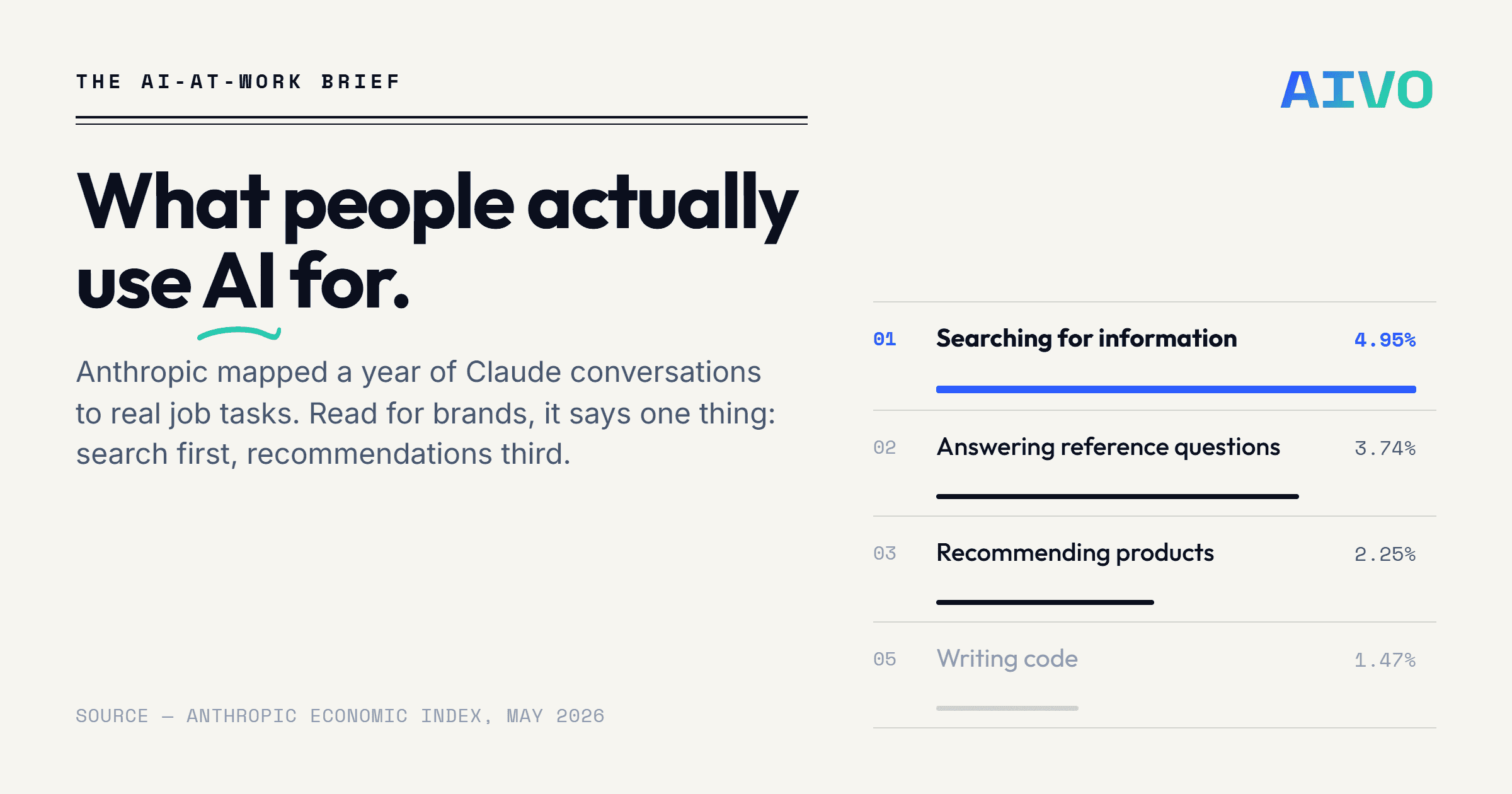
This is the measurement layer of the AI search ecosystem—engines, sources, recommendation, and visibility tracked per surface. Anthropic's Economic Index shows why that layer matters: search and recommendations are already among the top work tasks people give AI. AIVO tracks how ChatGPT, Gemini, Google AI Overviews, Perplexity and Claude represent your brand, per engine and over time, so the awareness AI is building becomes something you can see and act on instead of something you credit to another channel by accident.
What this means for your brand
The brands winning in AI search are not the ones chasing AI clicks. They are the ones treating AI as what the data shows it to be: a brand awareness channel that creates branded demand, measured by share of voice and lift, and captured by owning your name the moment the buyer looks you up.
That is a shift in measurement, not just in tactics. The teams that make it early will define how their category gets discovered. It starts with knowing what the engines currently say about you, which most brands have never checked.
Book a meeting and we will show you your share of voice across the five engines that answer your buyers' questions.
FAQ
Q: Do AI recommendations actually drive traffic? A: Yes, but mostly indirectly. Similarweb found AI-recommended brands were about 2.5 times more likely to get a visit within seven days, and roughly 55.9 percent of that traffic came from branded search, people looking the brand up after seeing it recommended, rather than clicking a link inside the AI answer.
Q: Is AI search a performance channel or a brand channel? A: The data points to a brand channel. Most of its impact shows up as branded search rather than direct clicks, so it works like awareness media. But unlike television, every recommendation is a private one-to-one conversation with no airing to measure against, which makes it closer to word of mouth. It drives branded search, but you read it by your share of voice in the answers, not by a spike.
Q: How should brands measure AI search visibility? A: By share of voice per engine over time, not single-prompt results, then connected to downstream branded search and site engagement. AI returns different brands on repeated queries, so sustained presence matters more than any one answer.
Q: What is AI share of voice? A: The share of AI-generated answers in your category that mention your brand. It is the AI-era version of the share-of-voice metric brand teams have used across print, broadcast and digital for decades.
Key Takeaways
- The 2.5x visit lift is real; most of it arrives as branded search, not AI referral clicks.
- Treat AI search as a brand awareness channel measured by share of voice and lift, not as a performance traffic source.
- The TV analogy helps until the airing problem: private, one-to-one recommendations have no synchronized spike to attribute.
- Measure per engine over time, then connect visibility to branded search and conversion of that demand.
- Own the recommendation and the branded SERP/homepage moment, or you create demand for someone else.
Sources: Similarweb 2026 Generative AI Landscape, Similarweb 2026 GenAI Brand Visibility Index, Search Engine Journal. Figures are Similarweb estimates; engagement comparisons are correlation, not causation.