How to Track AI Overviews Traffic (And Why Google Will Not Let You)
Search Console's new Generative AI report shows AI Overviews impressions and nothing else. The clicks exist and Google counts them. Three Google products make sure you can never connect them.

I Got Access to Search Console's AI Report. You Still Cannot Track AI Overviews Traffic.
Ten minutes with the new report and the excitement wears off. You can prove Google's AI showed your page. You cannot find out what happened next, and that is by design.
📋 TL;DR
- Search Console's Generative AI features report, launched June 3 2026 and still in Beta, reports impressions only, split by page, country, device and date.
- No queries, no clicks, no CTR, no average position, no citation placement, and no view of the passage that supported the answer.
- Clicks are not missing because nobody clicks. Google counts AI Overview and AI Mode clicks and reports them inside the main Performance report, blended with all other search clicks.
- In GA4 those same clicks arrive as google / organic. GA4's AI Assistant channel covers Gemini, ChatGPT and others, but excludes Google's own AI Overviews and AI Mode.
- The report is not available through the Search Console API. We tested it. Manual export is the only way out.
- Data starts May 18 2026 for every property with no backfill, so nobody has a year over year comparison until May 2027.
What the report actually gives you
Google announced the Generative AI performance reports on June 3 2026 and rolled them out to a subset of properties while it gathers feedback. Ours is one of them. It is still labelled Beta.
The first reaction is the good one. You finally see whether Google's AI surfaces are showing your pages at all, which until now was guesswork.
The report covers AI Overviews and AI Mode in Search, plus generative AI features in Discover. You can break your impressions down four ways: by page, by country, by device, and by date.
That is the entire report.
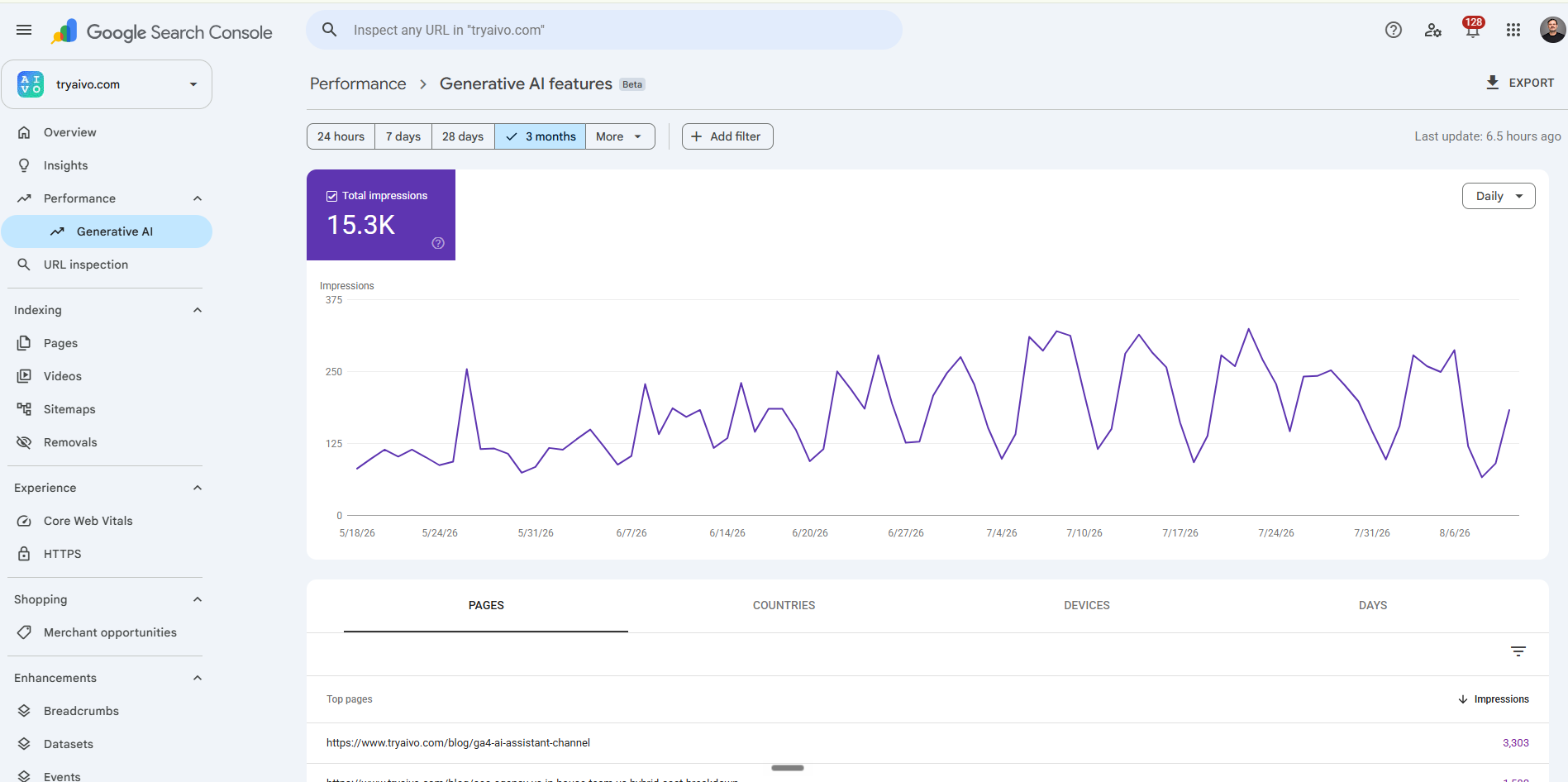
One detail matters if you plan to report the number. An AI Overview link only counts as an impression once it is scrolled or expanded into view, and property level totals will not reconcile with the sum of your page level rows when several of your URLs appear in one answer. It is not an apples to apples number against regular search impressions.
Takeaway: The report answers one question, which is whether Google's AI showed your page. It answers nothing else.
What it does not give you
The list of what is missing is longer than the list of what is there. No queries. No clicks. No click through rate. No average position. No citation placement. No indication of which passage of your page supported the answer.
So you know a link to your page appeared inside an AI answer. You do not know what was asked, what was said, where you sat in the response, or whether anyone clicked.
There is also no history. The data starts on May 18 2026 for every property, with no backfill. Nobody has a year over year comparison for this metric and nobody will until May 2027. Anyone selling you an AI impressions trend right now is working from three months of data at most.
Takeaway: Treat the total as a presence signal. It cannot support a rate, a trend or a forecast yet.
The clicks exist. They are somewhere else.
This is the part that gets misread, and we misread it ourselves at first. The absence of a clicks column does not mean nobody clicks.
Google's own documentation is explicit. Clicking a link to an external page in an AI Overview counts as a click. The same rule applies in AI Mode. Those clicks are counted, and they are reported, in the main Performance report, blended in with every other search click.
Google's stated position is that it is still working with site owners to determine which additional metrics would be useful. The omission is a reporting decision.
The effect is what matters. Google shipped the one metric that makes the surface look large, and withheld the ones that would let you price what it costs you.
Takeaway: You have AI impressions in one report and AI clicks buried inside an aggregate in another. Neither reconciles with the other.
GA4 closes the loop in the wrong direction
When someone does click a link inside an AI Overview or AI Mode, the referrer your site receives is google / organic. Identical to a normal blue link click. No flag, no parameter, nothing to separate them.
GA4 added an AI Assistant channel on May 13 2026, which automatically assigns the ai-assistant medium to sessions from recognised assistants. Gemini is on that list. So are ChatGPT and, as of Google's published definition in mid 2026, Deepseek, Copilot and Grok. Perplexity is not, which catches people out.
Google AI Overviews and AI Mode are excluded from that channel and stay inside Organic Search.
Read that again, because it is the strange part. Gemini traffic gets its own named line in Google's analytics product. AI Overviews, which is Gemini answering inside Google Search, does not. The same model earns a channel in one surface and disappears into organic in the other.
One caution before you paste a platform list into a report: the list moves. Claude was named at launch and had dropped off the published definition by June. Check Google's help page on the day you publish and stamp your list with a date. We cover the channel and its gaps in more detail in GA4 Now Has an AI Assistant Channel. Here's the Catch.
Takeaway: Three Google products hold three pieces of this. Search Console proves you were shown. The Performance report holds the clicks inside an aggregate. GA4 files those same clicks as ordinary organic. There is no join key anywhere.
You cannot automate any of it
We checked whether the data comes through the Search Console API, because a number you cannot pull is a number you cannot report on at scale.
It does not. The API has no AI dimension, and every AI related value we tried was rejected outright. Authentication works and normal search data comes back fine, so this is a gap in the product rather than a permissions problem.
That leaves one route: open the report and export it by hand, every time.
Takeaway: For any agency or in house team running reporting at scale, this data cannot currently sit in an automated pipeline.
The ratio that frames the whole problem
Here is the shape of it on our own property, for the window from May 18 to August 9 2026.
Roughly eleven percent of our total search impressions happened on generative AI surfaces. Over the same three months, our click through rate across all of Google Search sat under a third of one percent.
So AI surfaces accounted for about one impression in nine, and almost nobody clicked anything. How much of that thin click volume came from an AI surface rather than a blue link is unknowable with the tools Google provides. That single unanswerable question is the problem in one line.
One caveat: the two reports do not count impressions identically, so treat the eleven percent as an approximation.
Takeaway: You can measure how often AI shows you. You cannot measure what it returns.
Where the useful signal actually is
The headline total is close to a vanity metric. The Pages tab is not.
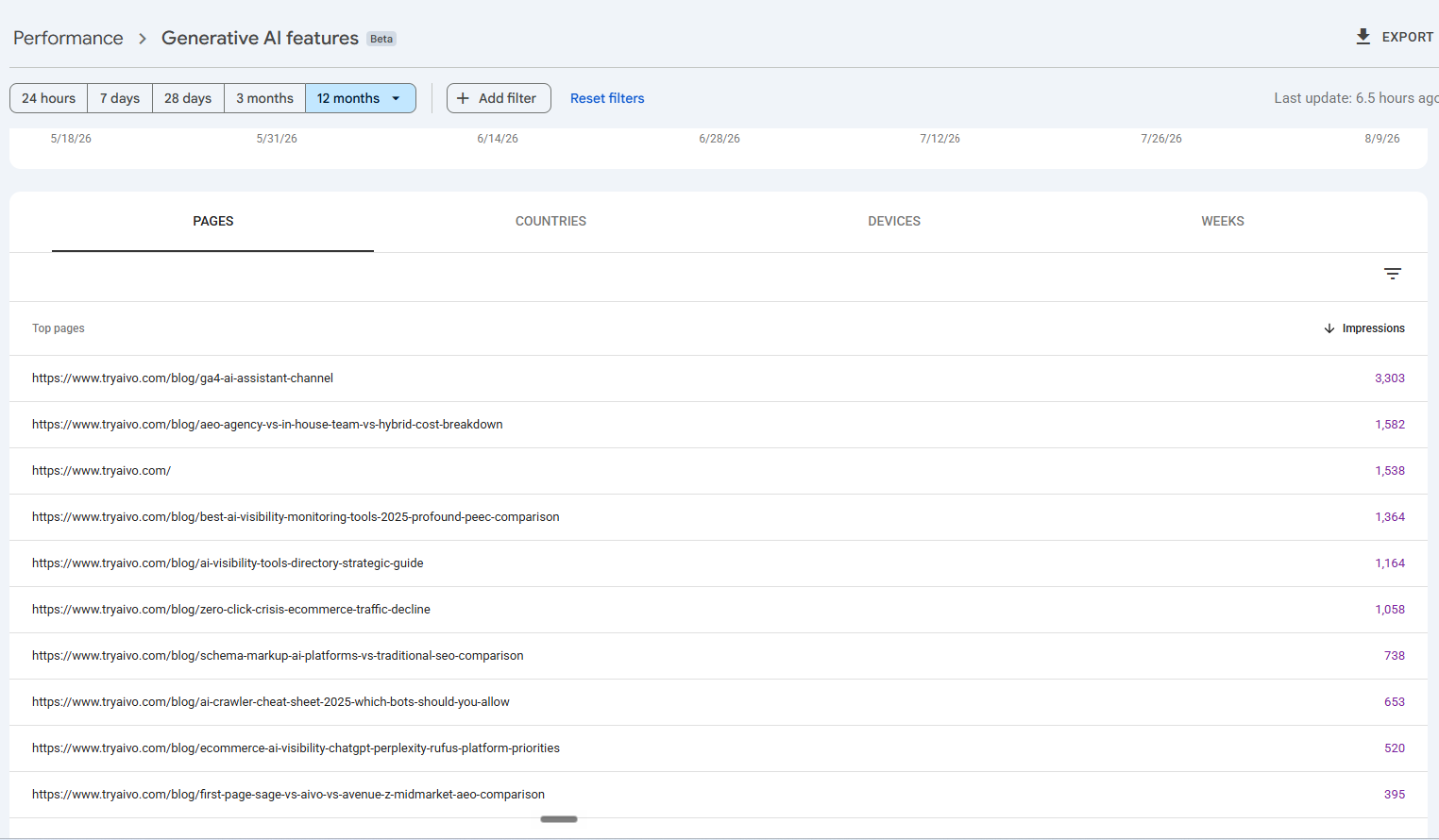
Our top ten URLs carry about eighty percent of all our generative AI impressions. What those pages are is the finding:
- A GA4 AI assistant channel guide
- An AEO agency versus in house versus hybrid cost breakdown
- The homepage
- An AI visibility monitoring tools comparison
- An AI visibility tools directory
- A zero click ecommerce traffic analysis
- A schema markup comparison
- An AI crawler cheat sheet
- An ecommerce AI visibility platform priorities piece
- A head to head vendor comparison
That read is available to anyone with this report, without any of the missing metrics.
Takeaway: Ignore the headline total. Read the page mix. It tells you what the model treats you as a credible reference on.
What this means for your brand
Three things follow, and none of them require the metrics Google withheld.
Stop reporting AI impressions as a performance number. Without clicks, queries or position it cannot carry a rate, and quoting it as growth invites a question you cannot answer. Report it as coverage.
Read the page mix as a content signal. If your comparison and evaluation pages dominate the list, AI is treating you as a reference at decision time. If your awareness content dominates instead, you are being read but not shortlisted. Those two situations call for different work.
Do not wait for Google to close the loop. The clicks are already sitting in your analytics, categorised as ordinary organic, and no Google product currently plans to separate them for you. While that holds, independent measurement of how AI represents your brand is the only place the answer exists.
Book a meeting and we will show you how the engines describe you, with every finding traced back to the prompt and the response behind it.
FAQ
Q: What is the Generative AI features report in Google Search Console? A: It is a Performance report, launched June 3 2026 and still in Beta, that shows how often URLs from your site appeared inside Google's generative AI surfaces. It covers AI Overviews and AI Mode in Search along with generative AI features in Discover, and it reports impressions broken down by page, country, device and date.
Q: Why does the Generative AI report not show clicks? A: Google counts them elsewhere. Clicks on external links in both AI Overviews and AI Mode are counted and reported inside the main Performance report, blended with all other search clicks. Google has said it is still working with site owners on which additional metrics to add.
Q: Can you see which queries triggered an AI Overview for your site? A: No. The Generative AI features report excludes queries, along with click through rate, average position, citation placement and the passage used to generate the answer.
Q: How far back does Search Console generative AI data go? A: Data begins on May 18 2026, with no historical backfill. Year over year comparison is not possible for any property before May 2027.
Q: Is the Search Console generative AI report available through the API? A: No. As of August 2026 the Search Console API exposes no AI dimension and rejects AI related values, so the report can only be read or exported through the Search Console interface.
Q: Does GA4 separate AI Overviews traffic from normal Google organic? A: No. Clicks from AI Overviews and AI Mode arrive with a google / organic referrer and are indistinguishable from standard organic sessions. GA4's AI Assistant channel, added May 13 2026, covers Gemini, ChatGPT and several other assistants but excludes Google's own AI Overviews and AI Mode.
Q: Why do I not have the Generative AI report in my Search Console? A: Google rolled it out to a subset of site owners during testing. It may also be absent if the property has not received enough generative AI impressions to populate it.
Key Takeaways
- The Generative AI features report gives impressions only, with no queries, clicks, position or citation placement.
- AI Overview and AI Mode clicks are counted by Google but reported inside the main Performance report, blended with all other search clicks.
- GA4 gives Gemini its own channel line and leaves AI Overviews and AI Mode inside Organic Search, which is the same model treated two different ways.
- The report is not exposed in the Search Console API, so it cannot be automated or trended without manual export.
- Data starts May 18 2026 with no backfill, so no property has year over year comparison until May 2027.
- The page mix is the usable signal. It tells you what the model treats you as a credible reference on.
Know what AI says about you. And how sure you can be.
Independent measurement of how AI represents your brand. One market, one language, delivered in 7 to 14 business days.
30-minute scoping call · no commitment
Sebastian Pinzon Duran is Co-Founder and Head of Discovery at AIVO. He helps marketing leaders measure AI share of voice across ChatGPT, Gemini, Perplexity, Claude, and Google AI, and capture the branded demand those engines create.
ABOUT AIVO
AIVO is an independent AI brand representation firm. We measure how AI platforms describe a brand across presence, comparison, recommendation, accuracy, sentiment, sources, access, and audiences. Every rate is reported as a range at 95% confidence, per platform and per market, and every finding traces back to the prompts, responses, and citations behind it. We do not sell content, PR, technical remediation, or any other implementation, and we take no referral fee from the partners we recommend.


