How AI Recommends Beauty Brands: We Measured 750 Answers Across 5 Engines
Fifty prompts, five AI engines, three runs each, 750 sampled answers, and a 95% confidence band on every number. This is how AI represents beauty brands in 2026.

What AI Says About Beauty Brands Changes Depending on Which One You Ask
Fifty prompts, five AI engines, three runs each, 750 sampled answers, and a 95% confidence band on every number. This is how AI represents beauty brands in 2026.
Ask ChatGPT which beauty brands it recommends for clean skincare. Then ask Claude the same question. The two lists will barely match. That is not a glitch. We ran that experiment 750 times across five engines, and the disagreement was the pattern, not the exception.
This is what the assistants actually say about beauty brands, and why no single visibility score can capture it.
The Beauty Representation Report is an independent analysis across ChatGPT, Perplexity, Claude, Gemini, and Google AI Overviews. Fifty category prompts, three runs each, 750 sampled answers, 18 public beauty brands, US English, 2026. Every figure is a rate carried with a 95% confidence band and anchored to a named engine. This is original research, not sponsored content: the brands in the set do not pay to be included, and we did not build the study to flatter our own clients.
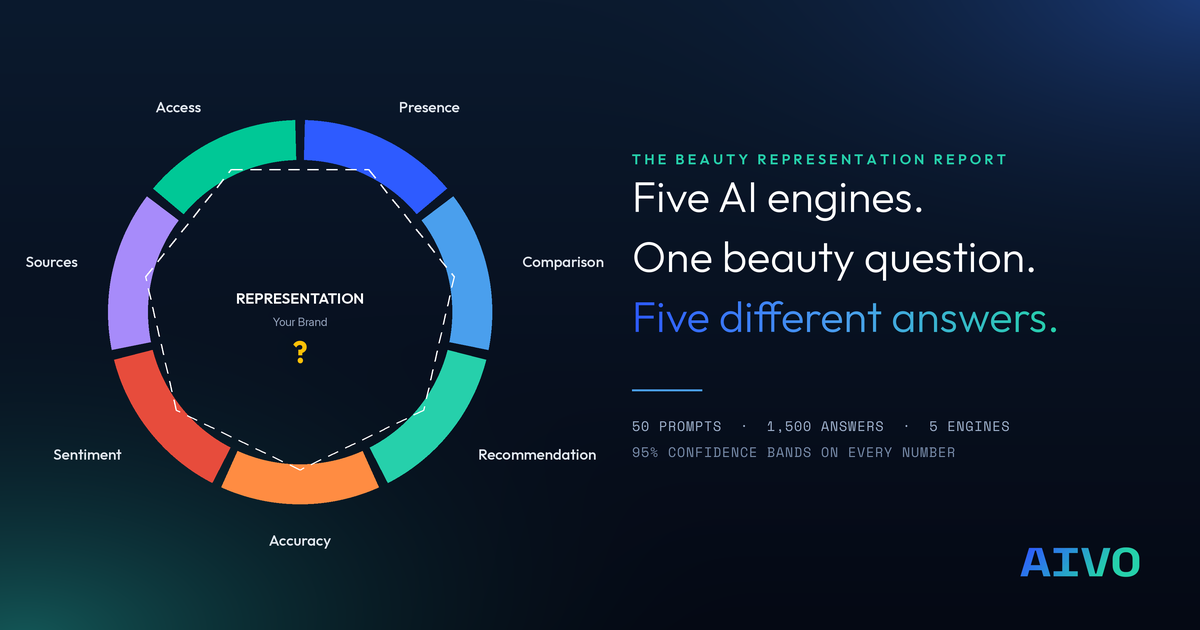
Here is what the data shows.
📋 TL;DR
- The category leader, e.l.f. Beauty, clears only about half of answers on its strongest engine (50.7% on Perplexity); most of the 18 brands sit in single digits.
- The same brand gets a different answer on every engine—La Roche-Posay ranges from 9.3% on Claude to 22.0% on ChatGPT, with bands that do not overlap.
- Being named and being recommended are two different races; value and dupe brands often win the lead slot on unbranded discovery.
- Answers can be fluent, confident, and wrong—one engine named Dr. Bronner's as B Corp certified in every run after the brand dropped that certification in February 2025.
- Brand-owned sites are 2.4% of 3,814 citations across 610 domains; category authority sits off your own property.
- No single blended visibility score captures how AI represents beauty; measure per engine with confidence bands.
The category leader clears about half. Most brands sit in single digits.
The most present brand in the set, e.l.f. Beauty, shows up in only about half of answers on its strongest engine (50.7% on Perplexity). Everyone else drops fast. Most of the 18 brands sit in single digits to low double digits. And because we run every prompt multiple times, each number is a range, not a point. Where the ranges overlap, the data does not support ranking one brand above another. A single leaderboard number would hide that.
The same brand gets a different answer on every engine.
This is the finding that should worry any brand tracking one blended visibility score. La Roche-Posay ranges from 9.3% on Claude to 22.0% on ChatGPT, and the confidence bands do not overlap. That is not noise. That is two engines telling two different stories about the same brand. Revlon pools to about 4% across engines while sitting at 0.7% on Google AI Overviews, effectively absent there. One average number hides the exact engine where a brand has disappeared.
Being named and being recommended are two different races.
Presence puts a brand on the shelf. Recommendation decides who leaves with the shopper. e.l.f. converts broad presence into the lead slot. Most brands do not. NYX and Maybelline get named into the consideration set and then rarely close it. The gap widens on unbranded discovery, where the top slot concentrates on the value and dupe brands the engines reach for first. If you only track whether you are mentioned, you are measuring the wrong race. We wrote about why AI does not recommend who you think here. Google's AI Mode data shows the same pattern at scale: shoppers lead with need, and brand ranks fourth among shopping attributes—the model supplies the brand.
The answer can be fluent, confident, and wrong.
Asked for B Corp certified beauty brands, Perplexity named Dr. Bronner's as currently certified in all three runs. The brand publicly dropped that certification, announced in February 2025. The model was not unsure. It was confident and stale, every single run. A wrong fact repeated with confidence is a brand risk that no amount of paid media fixes, because the shopper never sees your correction.
Your own website is a rounding error.
Across 3,814 citations from 610 domains, brand-owned sites accounted for 2.4% of what the engines actually read. The rest is earned media, retail, social, and a long editorial tail. AI reads YouTube, Reddit, Ulta, TikTok, Allure, and Sephora far more than it reads you. Category authority sits off your own property, which means the usual playbook of polishing your own pages barely moves the answer. This is why the sources an engine trusts matter more than the pages you control.
What this means for your brand
Everything above describes the category. It cannot tell you whether your brand is absent on the engine your buyers actually use, present but never recommended, or being described with a fact that stopped being true a year ago. A category sample is not a brand measurement.
If you run marketing for a beauty brand, the risk is concrete. You could be tracking one blended visibility score while quietly losing the recommendation slot on the exact engine your buyers use, and a single dashboard number would never show it.
The report gives you the category benchmark, with every figure held to a 95% confidence standard so you can trust the gap between you and the field. It reads presence, recommendation, accuracy, sources, and sentiment across all five engines. It is free.
Download the Beauty Representation Report
Fourteen pages, original AIVO research, no cost.
Want the same analysis applied to your own brand, category, and market, so you know exactly where you are present, preferred, or missing? Book a meeting and we will map it across all five engines.
FAQ
Q: How does AI represent beauty brands? A: Unevenly, and differently on each engine. In a 2026 AIVO category read across five AI engines, the most present brand appeared in only about half of answers on its strongest engine, and most of the 18 brands measured sat in single digits. Every figure was carried with a 95% confidence band, so each number is a range, not a fixed rank.
Q: Do ChatGPT, Claude, and Gemini recommend the same beauty brands? A: No. The same brand can get very different visibility on each engine. La Roche-Posay ranged from 9.3% on Claude to 22.0% on ChatGPT, with confidence bands that do not overlap. A single blended visibility score hides the engine where a brand is effectively invisible.
Q: Why does AI recommend dupe or value beauty brands over premium ones? A: Because being named and being recommended are different outcomes. On unbranded discovery prompts, the lead slot concentrates on the value and dupe brands the engines reach for first, even when premium brands are present in the consideration set.
Q: Can AI give wrong information about a beauty brand? A: Yes. In the study, one engine named a brand as currently B Corp certified in all three runs, after the brand had publicly dropped that certification. The answer was fluent and confident and still wrong, which is why accuracy has to be measured, not assumed.
Q: Where does AI get its information about beauty brands? A: Mostly not from the brand. Across 3,814 citations, brand-owned domains were just 2.4% of what the engines read. The rest came from earned media, retailers like Ulta and Sephora, social platforms like YouTube, Reddit, and TikTok, and editorial sites like Allure.
Q: How do I measure AI visibility for my own beauty brand? A: By running the prompts your buyers actually use across every engine, multiple times, and tracking presence, recommendation, accuracy, sources, and sentiment, each with a confidence band. AIVO does this per brand and per engine. The free category report shows the method. A brand report applies it to you.
Key Takeaways
- Beauty AI visibility is uneven: even the category leader appears in only about half of answers on its best engine.
- Track per engine, not one blended score—the same brand can be strong on ChatGPT and nearly invisible on Google AI Overviews.
- Measure recommendation, not just presence; being named into the set is not the same as winning the lead slot.
- Treat accuracy as a visibility risk; confident stale facts about certifications or claims can persist across runs.
- Invest in the sources AI actually reads—brand-owned pages are a tiny fraction of beauty citations.
- Use the free Beauty Representation Report as the category benchmark, then map your own brand across all five engines.


