The GEO Data Nobody's Talking About (March 2026)
Only 38% of AI Overview citations come from top-10 organic results—down from 76% in 2025. Here's what the latest GEO data means for your content strategy.
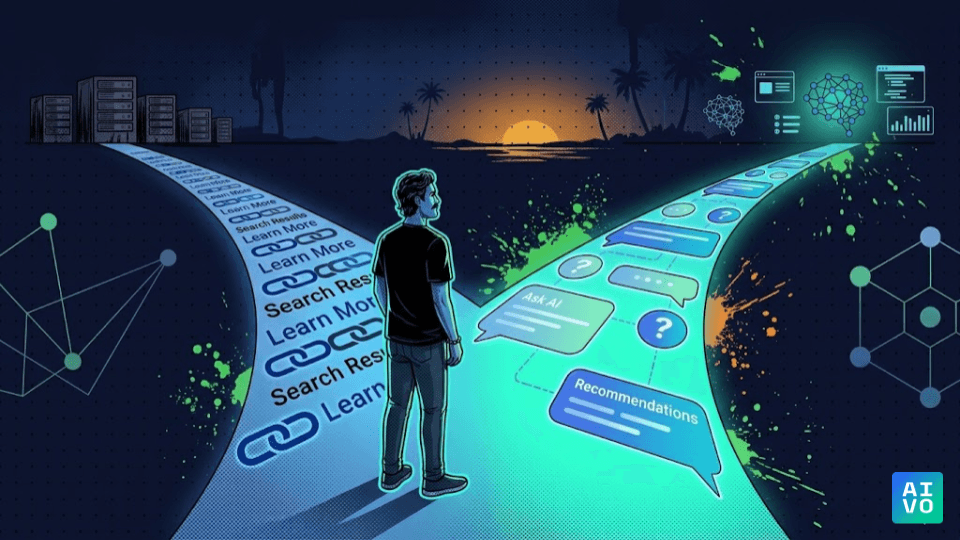
The GEO Data Nobody's Talking About (March 2026)
Yesterday, Ahrefs published updated data on AI Overview citations. The finding: only 38% of URLs cited by Google's AI Overviews now come from pages ranking in the top 10 organic results. In mid-2025, that number was 76%.
That's not a gradual shift. That's the floor falling out in six months.
If you've been operating under the assumption that traditional SEO rankings protect your AI visibility, this is the data that should change your mind. And it's just one of several findings from the past 90 days that are rewriting the GEO playbook faster than most marketers can keep up.
We track AI visibility across ChatGPT, Perplexity, Google AI Overviews, and Claude for our clients at AIVO. Here's what the latest research tells us about where things actually stand in March 2026, and what it means for how you build content from here.
📋 TL;DR (Key Findings)
- The floor has dropped: Only 38% of AI Overview citations now come from top-10 organic results—down from 76% in mid-2025
- AI and SEO rankings diverge: 80% of LLM citations don't even rank in Google's top 100 for the original query
- Front-loading wins: 44.2% of all LLM citations pull from the first 30% of content
- Third-party credibility multiplies reach: Domains on Trustpilot and G2 get 3x more ChatGPT citations; Reddit/Quora presence yields 4x higher citation rates
- AI citations beat rankings: Brands cited in AI Overviews earn 35% more organic clicks and 91% more paid clicks than non-cited competitors
- Each engine plays differently: ChatGPT cites Wikipedia 47.9% of the time; Perplexity pulls from Reddit at 46.7%; Google AI Overviews weight YouTube heavily
- Consistency is a myth: There's less than a 1-in-100 chance ChatGPT gives the same brand recommendations twice for the same query
The Scale of the Shift
The numbers are no longer theoretical.
ChatGPT hit 900 million weekly active users in late February 2026, up from 400 million just 18 months earlier. OpenAI processes over 2.5 billion prompts per day. Perplexity is handling an estimated 1.2 to 1.5 billion search queries per month, up from 230 million in mid-2024.
Meanwhile, organic search traffic to the top 40,000 US websites declined 2.5% year-over-year according to a Graphite/Similarweb study published in January. That sounds modest until you factor in that search volume grew over the same period. People are searching more and clicking less.
The click-through rate collapse is where it gets real. Seer Interactive analyzed 3,119 informational queries across 42 organizations between June 2024 and September 2025. On queries where AI Overviews appeared, organic CTR dropped 61%, falling from 1.76% to 0.61%. Paid CTR dropped 68%.
Those are not rounding errors. That's a structural change in how information reaches people.
AI Citations Don't Follow the Old Rules
Here's the part that should make every SEO practitioner rethink their strategy.
The conventional wisdom was that AI engines mostly cite domains that already rank well in traditional search. The "92% of AI Overview citations come from top-10 domains" stat was everywhere. We used it ourselves.
But Ahrefs just analyzed 863,000 keyword SERPs and 4 million AI Overview URLs. Their updated finding: only 38% of AI Overview citations now come from pages ranking in the top 10. Google's shift to Gemini 3 and its "query fan-out" system—which splits a user's query into multiple related sub-queries and pulls from pages ranking across all of them—fundamentally changed the math.
And it gets more dramatic when you look beyond Google. An Ahrefs study from late 2025 found that only 12% of URLs cited by ChatGPT, Perplexity, and Copilot rank in Google's top 10 results. 80% of LLM citations don't even rank in Google's top 100 for the original query.
Read that again. The pages AI engines trust are largely invisible in traditional search.
This doesn't mean SEO is irrelevant. It means the overlap between "what ranks on Google" and "what gets cited by AI" is far smaller than most people assume. Optimizing for one does not guarantee the other.
What Actually Earns AI Citations
The Princeton/Georgia Tech GEO study from 2024 remains the most rigorous academic research on generative engine optimization. Its core findings still hold: content structured for extractability can see up to 40% higher visibility in AI responses, and adding authoritative outbound citations produced a 115% visibility increase for mid-ranked sites.
But newer data adds important texture.
Your intro matters disproportionately. A Growth Memo analysis from February 2026 found that 44.2% of all LLM citations pull from the first 30% of a piece of content. The middle gets 31.1%. The conclusion gets 24.7%. If your strongest, most citable claims are buried at the bottom of an article, AI engines are less likely to find them.
Third-party credibility signals compound. SE Ranking's November 2025 study found that domains with profiles on review platforms like Trustpilot, G2, and Capterra have 3x higher chances of being cited by ChatGPT than sites without them. Domains with significant presence on Reddit and Quora have roughly 4x higher citation rates. AI engines don't just evaluate your content in isolation. They evaluate whether the broader internet corroborates your authority.
Being cited pays more than ranking. Seer Interactive's data shows that brands cited inside AI Overviews earn 35% more organic clicks and 91% more paid clicks than non-cited competitors on the same queries. In other words, an AI citation is now more valuable than a higher organic position.
Consistency is unreliable. SparkToro's January 2026 analysis found there's less than a 1-in-100 chance that ChatGPT will give you the same list of brand recommendations if you ask the same question 100 times. AI visibility isn't a static ranking you achieve. It's a probability you influence.
Each AI Engine Plays by Different Rules
One of the most persistent mistakes we see is brands treating "AI search" as a single channel. It's not.
Google AI Overviews now use Gemini 3 and query fan-out to pull from a much wider pool of sources than traditional search results. YouTube accounts for 18.2% of cited pages outside the top 100 results. Reddit and YouTube together dominate citation volume at roughly 21% and 18.8% respectively.
ChatGPT relies heavily on Wikipedia, which accounts for 47.9% of its citations according to citation pattern analyses. It processes over 1 billion queries daily, with 31% of prompts triggering an active web search. Commercial intent queries trigger web search at 53.5%, compared to just 18.7% for informational queries.
Perplexity leans hardest on community platforms. Reddit represents 46.7% of its top citations, far more than any other platform in its mix. It also has the most diverse sourcing, with only 25.11% domain duplication compared to ChatGPT's 71%.
Claude shows the least publicly analyzed citation behavior, but in our tracking, it tends to favor primary sources, peer-reviewed research, and .gov/.edu domains more heavily than the other engines.
A brand can be highly visible on Perplexity and completely absent from Google AI Overviews. We see this regularly. If you're only measuring one platform, you're only seeing a fraction of your AI visibility.
| Engine | Top Citation Source | Monthly Scale | Web Search Trigger |
|---|---|---|---|
| Google AI Overviews | Reddit (21%), YouTube (18.8%) | Billions of queries | Always on |
| ChatGPT | Wikipedia (47.9%) | 30B+ prompts/month | 31% of prompts |
| Perplexity | Reddit (46.7%) | 1.2–1.5B queries/month | Always on |
| Claude | .gov/.edu/primary sources | Growing rapidly | Variable by plan |
What This Means for Your Content Strategy
The data points to a few practical shifts.
Front-load your strongest claims. If 44% of citations come from the first third of your content, your introduction needs to contain your most specific, data-backed, citable statements. Save the narrative setup for later. Lead with the answer.
Build your citation ecosystem, not just your content. Review profiles, Reddit presence, third-party mentions, and community engagement all feed the credibility signals AI engines use to decide whether to cite you. Content alone isn't enough.
Optimize for extractability, not just readability. Every H2 section should function as a self-contained answer. AI engines pull chunks, not full articles. If a section requires the reader to have read everything above it to make sense, it's not extractable.
Add outbound citations to your top pages. The 115% visibility increase from the Princeton study came from adding 5–8 authoritative outbound links. This remains one of the highest-leverage tactics in GEO. AI engines want to know you've done your homework before they'll cite you as a source.
Measure across engines, not just Google. Your AI visibility profile looks different on every platform. A strategy that only tracks Google AI Overviews is missing where ChatGPT's 900 million weekly users and Perplexity's growing query volume are sending people.
The Honest Take
There are no GEO experts yet. The field is roughly two years old, the data changes quarterly, and anyone claiming to have cracked the code is selling something.
What we do know is that AI-mediated discovery is no longer an experiment. 900 million people use ChatGPT every week. AI Overviews appear on a significant percentage of Google queries. The gap between "what ranks" and "what gets cited" is widening, not narrowing.
The brands that are getting ahead aren't the ones with secret formulas. They're the ones measuring what's actually happening, treating each AI engine as its own channel, and building content specifically designed to be cited, not just found.
That's what we're building at AIVO: the intelligence layer that makes this measurable. If you want to see where your brand stands across AI engines, get your free AI Visibility Snapshot.
FAQ
What is generative engine optimization (GEO)?
A: GEO is the practice of optimizing content to earn citations in AI-generated responses across platforms like ChatGPT, Perplexity, Google AI Overviews, and Claude. Unlike traditional SEO—which targets keyword rankings in blue-link search results—GEO targets the probability that an AI engine will cite your content when answering a user query. The field is roughly two years old, and the research and tactics are evolving rapidly.
Why does it matter that only 38% of AI Overview citations come from top-10 results?
A: It breaks the core assumption that SEO rankings protect AI visibility. If 62% of AI Overview citations now come from pages that don't rank in the top 10, brands can no longer rely on their existing search performance to ensure they appear in AI-generated answers. You need a separate, complementary strategy to optimize for AI citation—one focused on extractability, authority signals, and citation ecosystem depth.
How is ChatGPT's citation behavior different from Perplexity's?
A: They pull from very different sources. ChatGPT cites Wikipedia for 47.9% of its sources and has 71% domain duplication—it tends to rely on a concentrated set of high-authority domains. Perplexity cites Reddit for 46.7% of queries and has only 25.11% domain duplication, meaning it draws from a much more diverse source pool. A brand that appears frequently in authoritative Wikipedia categories or well-ranked industry pages will likely perform better on ChatGPT. A brand with strong Reddit community presence may have higher Perplexity visibility.
What does "query fan-out" mean for my content?
A: Google's Gemini 3 uses a query fan-out system that splits a user's query into multiple related sub-queries, then pulls from pages ranking for each of those sub-queries—not just the original. This means content can earn AI Overview citations even without ranking for the user's exact search term. It also means highly specialized content that ranks for narrow sub-topics is now more valuable than it was under the old model.
How do I build a citation ecosystem beyond my own content?
A: Start with your existing authority signals: claim and optimize profiles on review platforms (Trustpilot, G2, Capterra), establish a legitimate presence in relevant Reddit communities, build a Quora presence around your category questions, and get mentioned in third-party editorial content. These signals compound. SE Ranking's study found 3x ChatGPT citation rates for brands with review platform profiles, and 4x rates for brands with Reddit/Quora presence. The AI engines aren't just evaluating your website—they're evaluating whether the internet agrees you're an authority.
How should I measure AI visibility across multiple engines?
A: Manual testing is a starting point: run branded and category queries in ChatGPT, Perplexity, Google AI Overviews, and Claude, document whether you appear and in what position. But manual testing doesn't scale—it's time-intensive and inconsistent. Platforms like AIVO automate this at scale, tracking your Share of Model (how often you're recommended vs. competitors) across engines, query types, and time periods. The key insight is that your visibility looks different on every platform, and you need engine-specific data to act on it.
Is AI visibility consistency a realistic goal?
A: Not in the traditional sense. SparkToro found less than a 1-in-100 chance of getting the same brand recommendation list from ChatGPT on identical queries. AI visibility is probabilistic, not deterministic. The goal isn't to guarantee citation—it's to raise the probability that you're cited across a large set of relevant queries. More authoritative content, more credibility signals, and more extractable structure all increase that probability. Track your citation rate across 50–100 relevant queries, not whether you appear in a single query.
Key Takeaways
- SEO rankings no longer protect AI visibility: Only 38% of AI Overview citations come from top-10 organic results (down from 76% in mid-2025). Having a strong SEO position is not sufficient to earn AI citations.
- LLM citations live outside traditional search: 80% of citations by ChatGPT, Perplexity, and Copilot don't rank in Google's top 100. AI and search engines are operating on different authority models.
- Front-load everything that matters: 44.2% of LLM citations come from the first 30% of content. Lead with your most specific, data-backed, citable claims—don't bury them.
- AI citations outperform organic rankings commercially: Brands cited in AI Overviews earn 35% more organic clicks and 91% more paid clicks than non-cited competitors. A citation is now worth more than a rank.
- Build a citation ecosystem: Review platforms, Reddit, Quora, and third-party editorial content are multipliers. 3–4x higher citation rates for brands with strong presence on these platforms.
- Each engine requires a separate strategy: ChatGPT, Perplexity, Google AI Overviews, and Claude each weight different source types. Optimize and measure across all of them—not just the one you know best.
- Treat AI visibility as a probability, not a position: Visibility isn't binary. Focus on increasing your citation rate across a large set of relevant queries through authoritative content, outbound citations, and ecosystem signals.
See Where You Stand
Get your free AI Visibility Snapshot and see exactly how your brand performs across ChatGPT, Perplexity, Google AI Overviews, and Claude. Takes 2 minutes. No credit card required.
Questions about your AI visibility? Email team@tryaivo.com
Sources
- Ahrefs, "Update: 38% of AI Overview Citations Pull From Top 10 Pages" (March 2026)
- Graphite/Similarweb, US Organic Traffic Study (January 2026)
- Seer Interactive, AI Overview CTR Analysis (September 2025)
- Aggarwal et al., "GEO: Generative Engine Optimization," KDD 2024 (Princeton/Georgia Tech)
- Growth Memo, LLM Citation Position Analysis (February 2026)
- SE Ranking, ChatGPT Citation Factors Study (November 2025)
- SparkToro, AI Recommendation Consistency Study (January 2026)
- Profound, AI Platform Citation Patterns (August 2025)
- OpenAI, ChatGPT 900M WAU Announcement (February 2026)
- DemandSage, Perplexity AI Statistics (February 2026)
I also wrote a more personal version of this story on Medium, about leaving agency life and building AIVO from scratch: GEO vs. SEO in 2026: What Actually Changed and What's Just Hype. For a condensed educational framework, see the LinkedIn Article.
Related Articles:
- Regional AI Visibility in 2026 — How North America, Latin America, and Europe require different AI visibility strategies
- How AI Engines Decide What to Cite — Claude, ChatGPT, and Perplexity backend infrastructure explained
- SEO Isn't Dead. But It's Not Fine Either — Understanding the structural shift in organic traffic
Author: Sebastian Pinzon is Co-Founder of AIVO, the AI Visibility Intelligence Platform. After 15+ years in digital marketing at Publicis, WPP, and Omnicom, he helps mid-market brands measure and improve their presence across ChatGPT, Perplexity, Google AI Overviews, and Claude.
Connect on LinkedIn | tryaivo.com


